| Element | |
|---|---|
21ScScandium44.95591262
8 9 2 |
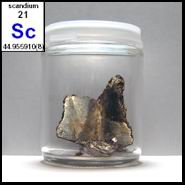
|
| Basic properties | |
|---|---|
| Atomic number | 21 |
| Atomic weight | 44.9559126 amu |
| Element family | Transition metals |
| Period | 4 |
| Group | 2 |
| Block | s-block |
| Discovery year | 1879 |
| Isotope distribution |
|---|
45Sc 100% |
| Physical properties | |
|---|---|
| Density | 2.989 g/cm3 (STP) |
Atomic hydrogen (H) 8.988E-5 Meitnerium (Mt) 28 | |
| Melting | 1539 °C |
Helium (He) -272.2 Carbon (C) 3675 | |
| Boiling | 2832 °C |
Helium (He) -268.9 Tungsten (W) 5927 | |
| Chemical properties | |
|---|---|
| Oxidation states (less common) | +3 (0, +1, +2) |
| First ionization potential | 6.561 eV |
Cesium (Cs) 3.894 Helium (He) 24.587 | |
| Electron affinity | 0.188 eV |
Nobelium (No) -2.33 Atomic chlorine (Cl) 3.612725 | |
| Electronegativity | 1.36 |
Cesium (Cs) 0.79 Atomic fluorine (F) 3.98 | |
| Atomic radius | |
|---|---|
| Covalent radius | 1.48 Å |
Atomic hydrogen (H) 0.32 Francium (Fr) 2.6 | |
| Van der Waals radius | 2.11 Å |
Atomic hydrogen (H) 1.2 Francium (Fr) 3.48 | |
| Metallic radius | 1.62 Å |
Beryllium (Be) 1.12 Cesium (Cs) 2.65 | |
| Compounds | ||
|---|---|---|
| Formula | Name | Oxidation state |
| ScS | Scandium monosulfide | +2 |
| ScCl3 | Scandium(III) chloride | +3 |
| Sc2O3 | Scandium(III) oxide | +3 |
| ScF3 | Scandium(III) fluoride | +3 |
| Sc(NO3)3 | Scandium(III) nitrate | +3 |
| PrScO3 | Praseodymium orthoscandate | +3 |
| Sc(CH3COO)3 | Scandium(III) acetate | +3 |
| Sc(ClO4)3 | Scandium perchlorate | +3 |
| Sc(OH)3 | Scandium(III) hydroxide | +3 |
| Sc(ReO4)3 | Scandium perrhenate | +3 |
| Sc2(CO3)3 | Scandium(III) carbonate | +3 |
| Sc2(SO4)3 | Scandium sulfate | +3 |
| Electronic properties | |
|---|---|
| Electrons per shell | 2, 8, 9, 2 |
| Electronic configuration | [Ar] 3d1 |
|
Bohr atom model

| |
|
Orbital box diagram

| |
| Valence electrons | 3 |
| Lewis dot structure |
|
| Orbital Visualization | |
|---|---|
|
| |
| Electrons | - |
Scandium (Sc): Periodic Table Element
Abstract
Scandium exhibits distinctive chemical properties that position it uniquely within the periodic table as element 21. This silvery-white transition metal demonstrates an exclusive +3 oxidation state in its compounds, with electronic configuration [Ar]3d14s2. Scandium displays ionic radii intermediate between aluminum and yttrium, conferring unique coordination chemistry characteristics. The element occurs sparsely in Earth's crust at approximately 22 ppm, primarily concentrated in rare earth minerals. Industrial applications center on aluminum alloy strengthening, high-intensity lighting, and emerging solid oxide fuel cell technologies. Scandium's single stable isotope, 45Sc, with nuclear spin 7/2, exhibits limited availability that constrains commercial applications despite favorable material properties.
Introduction
Scandium occupies position 21 in the periodic table as the first d-block element, characterized by partial filling of the 3d subshell. The electronic structure [Ar]3d14s2 establishes scandium as a transition metal, though its single d-electron imparts distinct properties relative to neighboring elements. Historical classification as a rare-earth element reflected its occurrence alongside lanthanides in specific mineral deposits, particularly thortveitite and euxenite. Lars Fredrik Nilson's spectroscopic identification in 1879 validated Dmitri Mendeleev's prediction of "ekaboron," demonstrating the predictive power of periodic relationships. The element's name derives from Scandinavia, reflecting its initial discovery in Scandinavian minerals.
Physical Properties and Atomic Structure
Fundamental Atomic Parameters
Scandium possesses atomic number 21 with standard atomic weight 44.955907 ± 0.000004 u. The ground state electron configuration [Ar]3d14s2 results in a single unpaired d-electron, conferring paramagnetic properties. Atomic radius measures 162 pm, while the Sc3+ ionic radius of 74.5 pm positions it between Al3+ (53.5 pm) and Y3+ (90.0 pm). Effective nuclear charge experienced by valence electrons approximates 4.32, with considerable shielding from inner electron shells. First ionization energy reaches 633.1 kJ mol-1, second ionization energy 1235 kJ mol-1, and third ionization energy 2388.7 kJ mol-1. The relatively low third ionization energy facilitates formation of Sc3+ compounds under standard conditions.
Macroscopic Physical Characteristics
Scandium metal exhibits a silvery-white lustrous appearance that develops slight yellowish or pinkish coloration upon atmospheric oxidation. The element crystallizes in hexagonal close-packed structure with lattice parameters a = 330.9 pm and c = 526.8 pm at 298 K. Melting point occurs at 1814 K (1541°C), while boiling point reaches 3103 K (2830°C). Heat of fusion measures 14.1 kJ mol-1, heat of vaporization 332.7 kJ mol-1, and specific heat capacity 25.52 J mol-1 K-1 at 298 K. Density exhibits temperature dependence, measuring 2.985 g cm-3 at 298 K. The metal displays moderate electrical conductivity at 1.81 × 10⁶ S m-1 and thermal conductivity of 15.8 W m-1 K-1.
Chemical Properties and Reactivity
Electronic Structure and Bonding Behavior
The 3d1 configuration establishes scandium's predominant +3 oxidation state, achieved through removal of the single d-electron and both 4s electrons. This electron configuration results in d0 Sc3+ ions that are colorless and diamagnetic. Coordination number 6 predominates in scandium compounds, reflecting the intermediate ionic radius. Common coordination geometries include octahedral arrangements in aqueous solution and solid-state compounds. Covalent bonding occurs in organometallic derivatives, particularly with cyclopentadienyl ligands. Bond enthalpies for Sc-O bonds typically measure 671.4 kJ mol-1, while Sc-F bonds reach 605.8 kJ mol-1. Hybridization patterns in covalent compounds primarily involve sp3d2 orbitals for octahedral geometries.
Electrochemical and Thermodynamic Properties
Electronegativity measures 1.36 on the Pauling scale, positioning scandium between calcium (1.00) and titanium (1.54). Successive ionization energies demonstrate the stability of the Sc3+ ion: first ionization 6.56 eV, second ionization 12.80 eV, and third ionization 24.76 eV. The significant increase in fourth ionization energy (73.5 eV) confirms the stable electronic configuration of Sc3+. Standard reduction potential for Sc3+/Sc couple measures -2.077 V versus standard hydrogen electrode, indicating strong reducing character of metallic scandium. Electron affinity exhibits a positive value of 18.1 kJ mol-1, though this measurement reflects the difficulty of adding electrons to the [Ar]3d14s2 configuration. Thermodynamic stability of scandium compounds generally increases with increasing oxidation state of the anion.
Chemical Compounds and Complex Formation
Binary and Ternary Compounds
Scandium oxide, Sc2O3, represents the most significant binary compound, crystallizing in the cubic bixbyite structure. The oxide exhibits amphoteric character, dissolving in both acids and strong bases. Scandium fluoride, ScF3, displays limited solubility in water but dissolves readily in excess fluoride to form hexafluoroscandiate(III) complexes. The remaining halides ScCl3, ScBr3, and ScI3 exhibit high water solubility and Lewis acid behavior. Scandium sulfide, Sc2S3, forms through direct combination of elements at elevated temperatures. Ternary compounds include scandium phosphate, ScPO4, and various mixed metal oxides such as scandium-stabilized zirconia used in fuel cell applications.
Coordination Chemistry and Organometallic Compounds
Aqueous scandium chemistry predominantly features the hexaaquascandium(III) ion, [Sc(H2O)6]3+, which undergoes hydrolysis at pH values above 4. Ligand substitution reactions proceed through associative mechanisms due to the small ionic radius of Sc3+. Common ligands include acetylacetonate, EDTA, and various phosphonate derivatives. Organometallic scandium compounds feature cyclopentadienyl ligands, with [ScCp2Cl]2 serving as a representative dimeric structure. These compounds exhibit remarkable thermal stability and serve as precursors for catalytic applications. Scandium triflate, Sc(OTf)3, functions as a water-tolerant Lewis acid catalyst in organic synthesis, demonstrating exceptional activity in Diels-Alder reactions and aldol condensations.
Natural Occurrence and Isotopic Analysis
Geochemical Distribution and Abundance
Scandium exhibits crustal abundance of 22 ± 3 ppm, comparable to cobalt and nickel concentrations. Despite this relatively high abundance, scandium displays extreme dispersion throughout crustal materials, rarely concentrating in economically viable deposits. The element demonstrates lithophilic behavior, associating preferentially with oxygen-bearing phases during geochemical differentiation. Primary scandium minerals include thortveitite, (Sc,Y)2Si2O7, containing up to 45 wt% scandium oxide, and kolbeckite, ScPO4·2H2O. Secondary concentrations occur in residual deposits formed through intensive weathering of scandium-bearing igneous rocks. Hydrothermal processes occasionally produce scandium enrichment in specific geological environments, particularly in association with uranium mineralization.
Nuclear Properties and Isotopic Composition
Natural scandium consists exclusively of 45Sc with nuclear spin I = 7/2 and magnetic moment μ = +4.756 nuclear magnetons. This isotope possesses a binding energy of 387.80 MeV and exhibits complete nuclear stability under terrestrial conditions. Artificial isotopes range from 37Sc to 62Sc, with 46Sc displaying the longest half-life at 83.8 days. The radioisotope 46Sc undergoes beta decay to 46Ti with decay energy 2.37 MeV. Nuclear cross-sections for thermal neutron absorption measure 27.5 barns for 45Sc(n,γ)46Sc reaction. The 12.4 keV nuclear transition in 45Sc demonstrates potential for precision timekeeping applications, with theoretical frequency stability exceeding current cesium atomic clocks by three orders of magnitude.
Industrial Production and Technological Applications
Extraction and Purification Methodologies
Global scandium production approximates 15-20 tonnes annually as scandium oxide, with demand slightly exceeding supply. Primary extraction occurs as a byproduct of uranium, nickel, and rare earth mining operations. The Bayan Obo mine in China, Zhovti Vody facilities in Ukraine, and Kola Peninsula operations in Russia constitute major production centers. Extraction processes typically involve ion exchange chromatography or solvent extraction techniques utilizing tributyl phosphate or di(2-ethylhexyl)phosphoric acid. Purification requires multiple separation stages due to scandium's similar chemical behavior to other rare earth elements. Metallic scandium production involves conversion of oxide to fluoride followed by calcium reduction at 1400-1500 K. Alternative reduction methods employ alkali metals or electrolysis of molten salt systems. Production costs range from $4-5 per gram for oxide and $100-130 per gram for metallic scandium.
Technological Applications and Future Prospects
Aluminum-scandium alloys represent the predominant commercial application, consuming approximately 60% of global scandium production. Addition of 0.1-0.5 wt% scandium to aluminum forms coherent Al3Sc precipitates with L12 crystal structure, significantly enhancing mechanical properties and weld quality. High-intensity discharge lamps utilize scandium iodide to produce white light with high color rendering index, consuming approximately 20 kg Sc2O3 annually in the United States. Solid oxide fuel cells employ scandium-stabilized zirconia electrolytes, offering superior ionic conductivity compared to yttrium-stabilized alternatives. Emerging applications include radioactive tracers for oil refinery operations using 46Sc and catalytic systems based on scandium triflate for organic synthesis. Research into scandium-containing high-entropy alloys demonstrates potential for aerospace applications requiring exceptional strength-to-weight ratios.
Historical Development and Discovery
Scandium's discovery resulted from systematic application of periodic law principles established by Dmitri Mendeleev. In 1869, Mendeleev predicted the existence of "ekaboron," an unknown element with atomic mass between 40 and 48, based on gaps in his periodic arrangement. Lars Fredrik Nilson achieved the first isolation of scandium oxide in 1879 through spectroscopic analysis of euxenite and gadolinite minerals from Scandinavia. Nilson's preparation of 2 grams of high-purity scandium oxide represented a remarkable analytical achievement for the period. Per Teodor Cleve subsequently recognized the correspondence between Nilson's element and Mendeleev's prediction, establishing scandium as a crucial validation of periodic theory. Metallic scandium remained elusive until Werner Fischer achieved electrolytic production in 1937 using a eutectic mixture of potassium, lithium, and scandium chlorides at 973-1073 K. Commercial development accelerated following the discovery of aluminum alloy strengthening effects in 1971, leading to aerospace applications in Soviet military aircraft including MiG-21 and MiG-29 fighters.
Conclusion
Scandium occupies a distinctive position among transition metals, characterized by its single d-electron configuration and exclusive +3 oxidation state. The element's intermediate ionic radius between aluminum and yttrium imparts unique coordination chemistry and materials properties that enable specialized technological applications. Limited natural concentration and complex extraction requirements constrain commercial utilization despite favorable mechanical and electronic properties. Current applications in aluminum alloys and high-intensity lighting represent mature technologies, while emerging uses in fuel cells and catalysis offer potential for expanded demand. Future research directions include development of more efficient extraction methods, exploration of high-entropy alloys, and investigation of scandium's role in quantum timekeeping systems.

Please let us know how we can improve this web app.
