| Element | |
|---|---|
75ReRhenium186.20712
8 18 32 13 2 |
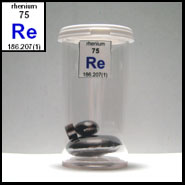
|
| Basic properties | |
|---|---|
| Atomic number | 75 |
| Atomic weight | 186.2071 amu |
| Element family | Transition metals |
| Period | 6 |
| Group | 2 |
| Block | s-block |
| Discovery year | 1925 |
| Isotope distribution |
|---|
185Re 37.40% |
| Physical properties | |
|---|---|
| Density | 21.02 g/cm3 (STP) |
Atomic hydrogen (H) 8.988E-5 Meitnerium (Mt) 28 | |
| Melting | 3180 °C |
Helium (He) -272.2 Carbon (C) 3675 | |
| Boiling | 5627 °C |
Helium (He) -268.9 Tungsten (W) 5927 | |
| Chemical properties | |
|---|---|
| Oxidation states (less common) | +4, +7 (-3, -1, 0, +1, +2, +3, +5, +6) |
| First ionization potential | 7.877 eV |
Cesium (Cs) 3.894 Helium (He) 24.587 | |
| Electron affinity | 0.060 eV |
Nobelium (No) -2.33 Atomic chlorine (Cl) 3.612725 | |
| Electronegativity | 1.9 |
Cesium (Cs) 0.79 Atomic fluorine (F) 3.98 | |
| Atomic radius | |
|---|---|
| Covalent radius | 1.31 Å |
Atomic hydrogen (H) 0.32 Francium (Fr) 2.6 | |
| Metallic radius | 1.37 Å |
Beryllium (Be) 1.12 Cesium (Cs) 2.65 | |
| Compounds | ||
|---|---|---|
| Formula | Name | Oxidation state |
| Re(CO)5Br | Bromopentacarbonylrhenium(I) | +1 |
| ReH(CO)5 | Pentacarbonylhydridorhenium | +1 |
| ReB2 | Rhenium diboride | +2 |
| K2Re2Cl8 | Potassium octachlorodirhenate | +3 |
| ReI3 | Rhenium(III) iodide | +3 |
| ReF4 | Rhenium tetrafluoride | +4 |
| ReI4 | Rhenium tetraiodide | +4 |
| ReCl5 | Rhenium pentachloride | +5 |
| ReF5 | Rhenium pentafluoride | +5 |
| ReF6 | Rhenium hexafluoride | +6 |
| ReO3 | Rhenium trioxide | +6 |
| AgReO4 | Silver perrhenate | +7 |
| Electronic properties | |
|---|---|
| Electrons per shell | 2, 8, 18, 32, 13, 2 |
| Electronic configuration | [Xe] 4f14 |
|
Bohr atom model

| |
|
Orbital box diagram

| |
| Valence electrons | 7 |
| Lewis dot structure |
|
| Orbital Visualization | |
|---|---|
|
| |
| Electrons | - |
Rhenium (Re): Periodic Table Element
Abstract
Rhenium (Re, Z = 75) represents one of the rarest naturally occurring elements in Earth's crust with an abundance of approximately 1 part per billion. This heavy, silvery-gray transition metal exhibits exceptional physical properties including the third-highest melting point among all elements at 3459 K and extraordinary chemical versatility spanning oxidation states from −1 to +7. The element demonstrates unique electronic configurations that enable extensive metal-metal bonding in lower oxidation states while forming stable high-oxidation compounds such as Re₂O₇. Industrial applications concentrate primarily in nickel-based superalloys for aerospace applications and platinum-rhenium catalysts for petroleum refining processes.
Introduction
Rhenium occupies position 75 in the periodic table as a member of Group 7 (manganese family) and the third transition series. The element exhibits remarkable thermal stability with a melting point of 3459 K, exceeded only by tungsten and carbon in sublimation temperature. Its discovery represents a complex historical narrative involving initial misidentification by Masataka Ogawa in 1908 and subsequent confirmation by Walter Noddack, Ida Tacke, and Otto Berg in 1925. The element's electronic configuration [Xe]4f¹⁴5d⁵6s² positions it uniquely among transition metals, enabling formation of quadruple metal-metal bonds and exhibiting the broadest range of stable oxidation states within Group 7. Industrial significance derives from scarcity-driven high economic value and specialized applications requiring extreme temperature stability and catalytic efficiency.
Physical Properties and Atomic Structure
Fundamental Atomic Parameters
Rhenium possesses an atomic mass of 186.207 ± 0.001 u with nuclear configuration containing 75 protons and predominantly 112 neutrons in the most abundant isotope 187Re. The electronic structure [Xe]4f¹⁴5d⁵6s² demonstrates characteristic transition metal d-orbital occupancy patterns with five unpaired electrons in the 5d subshell. Atomic radius measurements indicate 137 pm for the metallic radius, while ionic radii vary significantly with oxidation state: Re³⁺ exhibits 63 pm radius, whereas Re⁷⁺ contracts to 38 pm reflecting increased nuclear charge effects. Effective nuclear charge calculations yield approximately 6.76 for the outermost 6s electrons, contributing to the element's high first ionization energy of 760 kJ·mol⁻¹.
Macroscopic Physical Characteristics
Metallic rhenium crystallizes in a hexagonal close-packed structure with lattice parameters a = 276.1 pm and c = 445.6 pm, yielding exceptional density of 21.02 g·cm⁻³ at 293 K. The element demonstrates extraordinary thermal properties including a melting point of 3459 K, boiling point of 5869 K, and heat of fusion of 60.43 kJ·mol⁻¹. Vaporization enthalpy reaches 704 kJ·mol⁻¹, reflecting strong metallic bonding characteristics. Specific heat capacity measures 25.48 J·mol⁻¹·K⁻¹ at standard conditions. The metal exhibits silvery-gray metallic luster with high reflectivity across the visible spectrum. Mechanical properties include exceptional ductility after annealing, allowing fabrication into fine wire and foil forms despite the inherently refractory nature.
Chemical Properties and Reactivity
Electronic Structure and Bonding Behavior
The d⁵ electronic configuration enables rhenium to exhibit oxidation states ranging from −1 to +7, with +7, +4, and +3 representing the most thermodynamically stable configurations. In lower oxidation states, extensive metal-metal bonding occurs, exemplified by the quadruple Re-Re bond in [Re₂Cl₈]²⁻ with bond length 224 pm and exceptional bond energy exceeding 500 kJ·mol⁻¹. Coordination chemistry typically involves octahedral geometries for Re(IV) and Re(III) complexes, while tetrahedral arrangements characterize high-oxidation rhenium compounds. The element forms stable covalent bonds with electronegative elements, particularly oxygen and fluorine, enabling isolation of compounds such as ReF₇ and Re₂O₇.
Electrochemical and Thermodynamic Properties
Electronegativity values place rhenium at 1.9 on the Pauling scale, intermediate between manganese (1.55) and osmium (2.2), reflecting moderate electron-attracting capability. Successive ionization energies demonstrate typical transition metal trends: first ionization energy 760 kJ·mol⁻¹, second 1260 kJ·mol⁻¹, and third 2510 kJ·mol⁻¹. Standard reduction potentials vary dramatically with oxidation state and solution conditions: ReO₄⁻/Re exhibits E° = +0.368 V in acidic media, while Re³⁺/Re shows E° = +0.300 V. The unusual stability of the +7 oxidation state manifests in the thermodynamic favorability of perrhenate formation under oxidizing conditions.
Chemical Compounds and Complex Formation
Binary and Ternary Compounds
Rhenium oxide chemistry encompasses multiple stoichiometries reflecting variable oxidation states. Re₂O₇ represents the most stable oxide, crystallizing in a complex structure with Re-O bond lengths of 171 pm and demonstrating high volatility with sublimation occurring at 633 K. ReO₃ adopts the cubic perovskite structure characterized by metallic conductivity due to extensive Re-O-Re bridge formation. Lower oxidation state oxides include ReO₂ (rutile structure) and Re₂O₃. Halide chemistry features complete series for chlorides, bromides, and iodides, with ReCl₆ representing the highest oxidation state chloride. The unique ReF₇ demonstrates pentagonal bipyramidal molecular geometry, constituting the only known neutral heptafluoride.
Coordination Chemistry and Organometallic Compounds
Rhenium coordination complexes demonstrate extraordinary diversity spanning formal oxidation states from −1 to +7. The archetypal [Re(CO)₅]⁻ anion exhibits trigonal bipyramidal geometry with Re-C bond lengths of 200 pm and represents formal oxidation state −1. Carbonyl chemistry centers on Re₂(CO)₁₀, featuring Re-Re bond length of 304 pm and serving as precursor for organometallic synthesis. Higher oxidation state complexes include [ReO₄]⁻ perrhenate with tetrahedral geometry and Re-O distances of 172 pm. The unusual [ReH₉]²⁻ hydride demonstrates tricapped trigonal prismatic coordination representing the highest coordination number achieved by rhenium.
Natural Occurrence and Isotopic Analysis
Geochemical Distribution and Abundance
Crustal abundance of rhenium measures approximately 1.0 ppb by mass, ranking as the 77th most abundant element and among the three rarest stable elements alongside indium and tellurium. Geochemical behavior demonstrates chalcophile characteristics with preferential concentration in sulfide mineral phases. Primary occurrence involves substitution for molybdenum in molybdenite (MoS₂) with concentrations typically ranging from 10 to 2000 ppm. The Kudriavy volcano on Iturup Island represents the only known natural rhenium mineral deposit, where ReS₂ (rheniite) precipitates directly from volcanic fumaroles at temperatures exceeding 773 K. Chilean porphyry copper deposits contain the world's largest rhenium reserves as molybdenite-associated concentrations.
Nuclear Properties and Isotopic Composition
Natural rhenium consists of two isotopes with unusual abundance distribution: 185Re (37.4% abundance, stable) and 187Re (62.6% abundance, radioactive with t₁/₂ = 4.12 × 10¹⁰ years). The 187Re beta decay to 187Os proceeds with decay energy of 2.6 keV, representing the second-lowest known decay energy among all radionuclides. This decay process enables rhenium-osmium dating of ore deposits with precision extending to Precambrian ages. Nuclear spin states indicate 185Re with I = 5/2 and magnetic moment μ = 3.1871 nuclear magnetons, while 187Re exhibits I = 5/2 and μ = 3.2197 nuclear magnetons. Artificial isotopes range from 160Re to 194Re, with 186Re (t₁/₂ = 90.6 hours) and 188Re (t₁/₂ = 17.0 hours) finding medical applications.
Industrial Production and Technological Applications
Extraction and Purification Methodologies
Industrial rhenium recovery predominantly utilizes molybdenite roasting processes wherein temperature elevation to 973-1073 K volatilizes rhenium as Re₂O₇ with vapor pressure reaching 133 Pa at 633 K. Flue gas scrubbing with aqueous solutions produces perrhenic acid (HReO₄), which undergoes subsequent precipitation with potassium or ammonium chloride yielding crystalline perrhenate salts. Purification involves recrystallization techniques achieving purity levels exceeding 99.99%. Alternative extraction from uranium in-situ leaching solutions represents emerging technology with selectivity coefficients for rhenium extraction reaching 10⁴. Global annual production approximates 45-50 tonnes concentrated in Chile (60%), United States (15%), and Peru (10%), with recycling contributing additional 15 tonnes annually.
Technological Applications and Future Prospects
Aerospace applications consume approximately 70% of global rhenium production through nickel-based superalloy formulations containing 3-6 wt% rhenium for turbine blade manufacture. These applications exploit rhenium's ability to improve creep resistance at temperatures exceeding 1273 K through solid solution strengthening mechanisms and gamma-prime phase stability enhancement. Catalytic applications account for 25% of consumption, particularly in platinum-rhenium reforming catalysts where rhenium loading typically ranges from 0.3-0.8 wt%. The element's resistance to catalyst poisoning by sulfur compounds enables high selectivity in aromatic hydrocarbon production. Emerging applications include high-pressure gasket materials for diamond anvil cells, thermocouple elements for ultra-high temperature measurement, and specialized X-ray anodes exploiting high atomic number characteristics.
Historical Development and Discovery
The discovery chronology of rhenium encompasses multiple phases beginning with Masataka Ogawa's initial identification in 1908 of spectroscopic evidence later confirmed as element 75 rather than element 43 as originally claimed. Ogawa's thorianite analysis employed arc spectroscopy techniques revealing characteristic emission lines at wavelengths 346.1, 346.5, and 488.1 nm. Scientific verification occurred in 1925 when Walter Noddack, Ida Tacke, and Otto Berg employed X-ray spectroscopy to identify rhenium in platinum ore concentrates and columbite specimens. Their systematic approach involved chemical separation techniques followed by spectroscopic confirmation of characteristic Lα and Kα X-ray emission lines. Industrial isolation achieved significance in 1928 with extraction of 1 gram from 660 kg molybdenite processing, establishing fundamental chemical properties and confirming theoretical predictions from Mendeleev's periodic system.
Conclusion
Rhenium's position as the final stable element discovered establishes its unique significance in periodic table completion and modern materials science. The element's exceptional combination of refractory properties, chemical versatility, and scarcity-driven economic value positions it as critical for advanced technological applications requiring extreme operating conditions. Current research directions emphasize sustainability through enhanced recycling efficiency, alternative catalyst formulations reducing rhenium content, and exploration of substitution strategies for aerospace applications. Future developments likely encompass expanded nuclear medicine applications exploiting radioactive isotope properties and novel high-temperature materials leveraging rhenium's unparalleled thermal stability characteristics.

Please let us know how we can improve this web app.
