Printed from https://www.webqc.org

Oxygen @ Periodic Table of Chemical Elements

12345678 910111213141516 1718
IIIIIIbIVb VbVIbVIIbVIIIbIb IIbIIIIVVVI VIIVIII
1H
1.0079
2He
4.0026
3Li
6.9412
4Be
9.0121
5B
10.811
6C
12.010
7N
14.006
8O
15.999
9F
18.998
10Ne
20.179
11Na
22.989
12Mg
24.305
13Al
26.981
14Si
28.085
15P
30.973
16S
32.065
17Cl
35.453
18Ar
39.948
19K
39.098
20Ca
40.078
21Sc
44.955
22Ti
47.867
23V
50.941
24Cr
51.996
25Mn
54.938
26Fe
55.845
27Co
58.933
28Ni
58.693
29Cu
63.546
30Zn
65.409
31Ga
69.723
32Ge
72.641
33As
74.921
34Se
78.963
35Br
79.904
36Kr
83.798
37Rb
85.467
38Sr
87.621
39Y
88.905
40Zr
91.224
41Nb
92.906
42Mo
95.942
43Tc
98.906
44Ru
101.07
45Rh
102.90
46Pd
106.42
47Ag
107.86
48Cd
112.41
49In
114.81
50Sn
118.71
51Sb
121.76
52Te
127.60
53I
126.90
54Xe
131.29
55Cs
132.90
56Ba
137.32
57La
138.90
72Hf
178.49
73Ta
180.94
74W
183.84
75Re
186.20
76Os
190.23
77Ir
192.21
78Pt
195.08
79Au
196.96
80Hg
200.59
81Tl
204.38
82Pb
207.21
83Bi
208.98
84Po
208.98
85At
209.98
86Rn
222.01
87Fr
223.01
88Ra
226.02
89Ac
227.02
104Rf
261.10
105Db
262.11
106Sg
266.12
107Bh
264.12
108Hs
269
109Mt
278
110Ds
281
111Rg
282
112Cn
285
113Nh
286
114Fl
289
115Mc
290
116Lv
293
117Ts
294
118Og
294
Lanthanoids58Ce
140.11
59Pr
140.90
60Nd
144.24
61Pm
146.91
62Sm
150.36
63Eu
151.96
64Gd
157.25
65Tb
158.92
66Dy
162.50
67Ho
164.93
68Er
167.25
69Tm
168.93
70Yb
173.04
71Lu
174.96
Actinoids90Th
232.03
91Pa
231.03
92U
238.02
93Np
237.04
94Pu
244.06
95Am
243.06
96Cm
247.07
97Bk
247.07
98Cf
251.07
99Es
252.08
100Fm
257.09
101Md
258.09
102No
259.10
103Lr
260.10
Alkali metals Alkali earth metals Transition metals Other metals Metaloids Non-metals Halogens Noble gases
Element

8

O

Oxygen

15.99943

2
6
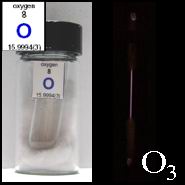
Oxygen photo
Basic properties
Atomic number8
Atomic weight15.99943 amu
Element familyNon-metals
Period2
Group16
Blockp-block
Discovery year1771
Isotope distribution
16O
99.762%
17O
0.038%
18O
0.200%
16O: 99.76%
16O (99.76%)
Physical properties
Density 0.001429 g/cm3 (STP)
Atomic hydrogen (H) 8.988E-5
Meitnerium (Mt) 28
Melting-222.65 °C
Helium (He) -272.2
Carbon (C) 3675
Boiling-182.9 °C
Helium (He) -268.9
Tungsten (W) 5927
Chemical properties
Oxidation states
(less common)
-2
(-1, 0, +1, +2)
First ionization potential 13.617 eV
Cesium (Cs) 3.894
Helium (He) 24.587
Electron affinity 1.461 eV
Nobelium (No) -2.33
Atomic chlorine (Cl) 3.612725
Electronegativity3.44
Cesium (Cs) 0.79
Atomic fluorine (F) 3.98
Atomic radius
Covalent radius 0.63 Å
Atomic hydrogen (H) 0.32
Francium (Fr) 2.6
Van der Waals radius 1.52 Å
Atomic hydrogen (H) 1.2
Francium (Fr) 3.48
8OWebQC.OrgCovalentVan der Waals
Compounds
FormulaNameOxidation state
H2OWater-2
CO2Carbon dioxide-2
NaOHSodium hydroxide-2
H2SO4Sulfuric acid-2
CaCO3Calcium carbonate-2
H2O2Hydrogen peroxide-1
Na2O2Sodium peroxide-1
CaO2Calcium peroxide-1
Cl2O2Dichlorine dioxide-1
O2F2Dioxygen difluoride+1
OFOxygen monofluoride+1
OF2Oxygen difluoride+2
Electronic properties
Electrons per shell2, 6
Electronic configuration[He] 2s22p4
Bohr atom model
Bohr atom model
Orbital box diagram
Orbital box diagram
Valence electrons6
Lewis dot structure Oxygen Lewis dot structure
Orbital Visualization
🏠
▶️
📐
Electrons-

Oxygen (O): Periodic Table Element

Scientific Review Article | Chemistry Reference Series

Abstract

Oxygen exhibits fundamental importance as the third most abundant element in the universe and the most abundant element in Earth's crust. This nonmetallic chalcogen possesses atomic number 8 with electron configuration [He] 2s² 2p⁴, existing predominantly as diatomic O₂ under standard conditions. The element demonstrates exceptional reactivity as a potent oxidizing agent, forming oxides with virtually all elements except noble gases under appropriate conditions. Oxygen's physical properties include colorless gaseous form at standard temperature and pressure, with distinctive pale blue coloration in liquid and solid phases. Critical thermodynamic parameters encompass melting point of 54.36 K (-218.79°C), boiling point of 90.20 K (-182.95°C), and density of 1.429 g/L at STP. Industrial significance extends across metallurgy, chemical synthesis, and life support systems, with annual production exceeding 150 million tonnes globally through air separation processes.

Introduction

Oxygen occupies position 8 in the periodic table within Group 16 (chalcogens), characterized by its exceptional electronegativity and oxidizing capacity. The element's electron configuration [He] 2s² 2p⁴ creates four unpaired electrons available for bonding, enabling formation of diverse compounds across oxidation states ranging from -2 to +2. Periodic trends demonstrate oxygen's high first ionization energy of 1313.9 kJ/mol and substantial electron affinity of 141 kJ/mol, reflecting its strong tendency to acquire electrons. Historical development commenced with Joseph Priestley's isolation in 1774 and Antoine Lavoisier's subsequent identification of its role in combustion. Modern understanding encompasses oxygen's fundamental role in atmospheric chemistry, biological respiration, and industrial oxidation processes. The element's chemical versatility manifests through multiple allotropic forms including diatomic oxygen (O₂), ozone (O₃), and the recently discovered tetraoxygen (O₄).

Physical Properties and Atomic Structure

Fundamental Atomic Parameters

Oxygen's atomic structure comprises 8 protons, 8 electrons, and typically 8 neutrons in the most abundant isotope 16O. The electron configuration exhibits ground state arrangement [He] 2s² 2p⁴, with two unpaired electrons in 2p orbitals following Hund's rule. Atomic radius measures 0.60 Å for the neutral atom, while the oxide ion O²⁻ expands to 1.40 Å due to increased electron-electron repulsion. Effective nuclear charge calculations yield Z*eff values of approximately 4.45 for 2s electrons and 4.85 for 2p electrons, accounting for inner shell shielding effects. First ionization energy reaches 1313.9 kJ/mol, second ionization energy 3388.3 kJ/mol, reflecting the stable noble gas configuration achieved upon removal of two electrons. Electronegativity values span 3.44 (Pauling scale) and 3.61 (Mulliken scale), positioning oxygen as the second most electronegative element after fluorine.

Macroscopic Physical Characteristics

Oxygen gas appears colorless and odorless under standard conditions, with liquid and solid phases exhibiting distinctive pale blue coloration attributed to magnetic dipole transitions between triplet and singlet electronic states. The element crystallizes in monoclinic β-oxygen structure at temperatures below 43.8 K, transitioning to cubic γ-oxygen under pressures exceeding 10 GPa. Phase behavior demonstrates normal boiling point of 90.20 K (-182.95°C) at 1 atm pressure, with corresponding melting point of 54.36 K (-218.79°C). Critical parameters include critical temperature 154.58 K, critical pressure 5.043 MPa, and critical density 436.1 kg/m³. Gas density at STP equals 1.429 g/L, approximately 1.1 times heavier than air. Specific heat capacity values encompass 0.918 J/g·K for gaseous oxygen and 1.71 J/g·K for liquid oxygen at respective normal conditions. Heat of vaporization reaches 6.82 kJ/mol, while heat of fusion equals 0.444 kJ/mol.

Chemical Properties and Reactivity

Electronic Structure and Bonding Behavior

Oxygen's chemical reactivity stems from its biradical ground state configuration with two unpaired electrons in π*₂p orbitals, creating paramagnetic properties and high oxidizing potential. Standard oxidation states encompass -2 (most common), -1 (peroxides), 0 (elemental), +1 (hypofluorites), and +2 (oxygen difluoride). Molecular orbital theory describes O₂ bonding through σ₂s, σ*₂s, σ₂p, π₂p, π*₂p, and σ*₂p orbitals, yielding bond order 2 and explaining the molecule's triplet ground state. Bond dissociation energy of O₂ measures 498.36 kJ/mol, with O-O bond length of 1.208 Å. Hybridization patterns in compounds typically involve sp³ geometry around oxygen centers, though sp² and sp hybridizations occur in specialized environments. Coordination chemistry demonstrates oxygen's capability to act as both monodentate and bridging ligand in metal complexes.

Electrochemical and Thermodynamic Properties

Electrochemical behavior manifests through diverse reduction potentials dependent upon pH and reaction conditions. Standard reduction potential for O₂ + 4H⁺ + 4e⁻ → 2H₂O equals +1.23 V versus standard hydrogen electrode, establishing oxygen as a powerful oxidizing agent in acidic solutions. Alkaline conditions yield O₂ + 2H₂O + 4e⁻ → 4OH⁻ with E° = +0.40 V. Thermodynamic stability of oxides generally decreases with increasing oxidation state, following trends in Gibbs free energy of formation. Electron affinity data reveal first electron affinity of -141 kJ/mol and second electron affinity of +744 kJ/mol, indicating favorable formation of O⁻ ions but unfavorable O²⁻ formation in gas phase. Redox behavior encompasses reactions with metals, nonmetals, and organic compounds, typically proceeding through electron transfer mechanisms involving oxygen-centered radicals as intermediates.

Chemical Compounds and Complex Formation

Binary and Ternary Compounds

Binary oxide formation occurs with virtually all elements except noble gases, producing compounds ranging from ionic metal oxides to covalent nonmetal oxides. Alkali and alkaline earth metal oxides exhibit ionic character with O²⁻ anions, demonstrating high melting points and electrical conductivity in molten state. Transition metal oxides display variable oxidation states and often demonstrate semiconductor properties through d-orbital interactions. Nonmetal oxides typically adopt covalent bonding patterns, frequently serving as acidic anhydrides in aqueous solution. Significant binary compounds include water (H₂O), carbon dioxide (CO₂), silicon dioxide (SiO₂), and aluminum oxide (Al₂O₃), each exhibiting distinctive structural and chemical properties. Ternary oxides encompass perovskites, spinels, and complex ceramic materials with applications in catalysis, electronics, and structural materials. Formation mechanisms proceed through direct combination reactions, thermal decomposition of precursors, and hydrothermal synthesis pathways.

Coordination Chemistry and Organometallic Compounds

Coordination complexes incorporate oxygen as ligand through lone pair donation from sp³ hybridized orbitals, typically exhibiting monodentate coordination geometry. Metal-oxygen bonds demonstrate variable ionic and covalent character depending on metal electronegativity and oxidation state. Oxo complexes feature multiply bonded oxygen atoms with bond orders exceeding unity, particularly common among high-valent transition metals. Peroxo and superoxo complexes contain O₂²⁻ and O₂⁻ ligands respectively, maintaining oxygen-oxygen bonding while coordinated to metal centers. Geometric arrangements span linear, bent, and bridging configurations with characteristic M-O-M angles influenced by steric and electronic factors. Organometallic chemistry encompasses metal alkoxides, phenoxides, and oxo-organometallic species with applications in catalysis and materials synthesis. Spectroscopic properties include characteristic ¹⁶O/¹⁸O isotope effects in vibrational spectroscopy and paramagnetic shifts in NMR spectra of oxygen-containing radicals.

Natural Occurrence and Isotopic Analysis

Geochemical Distribution and Abundance

Oxygen constitutes approximately 461,000 ppm (46.1%) of Earth's crust by mass, primarily combined in silicate minerals, oxides, and carbonates. Atmospheric concentration maintains 20.946% by volume in dry air, equivalent to partial pressure of 21.22 kPa at sea level. Hydrosphere contains oxygen both as H₂O and dissolved O₂, with oceanic concentrations varying from 0-8 mg/L depending on temperature, salinity, and biological activity. Geochemical cycling involves weathering of oxygen-bearing minerals, atmospheric exchange through photosynthesis and respiration, and hydrothermal processes at mid-ocean ridges. Continental crustal abundance reflects differentiation processes concentrating oxygen in felsic igneous rocks and sedimentary sequences. Mantle concentrations average approximately 44% by mass, primarily incorporated in olivine, pyroxene, and garnet crystal structures. Distribution patterns demonstrate enrichment in oxidized crustal environments and depletion in reduced deep Earth reservoirs.

Nuclear Properties and Isotopic Composition

Natural isotopic composition includes ¹⁶O (99.757%), ¹⁷O (0.038%), and ¹⁸O (0.205%) with respective atomic masses 15.994915 u, 16.999132 u, and 17.999160 u. Nuclear spin states encompass I = 0 for ¹⁶O and ¹⁸O, while ¹⁷O exhibits I = 5/2 with nuclear magnetic moment -1.8938 nuclear magnetons. Isotope fractionation occurs during evaporation, condensation, and biochemical processes, creating measurable variations in ¹⁸O/¹⁶O ratios used for paleoclimatic reconstructions. Artificial radioisotopes span mass numbers 12-28, with most significant isotopes including ¹⁵O (t₁/₂ = 122.2 s) for positron emission tomography and ¹⁹O (t₁/₂ = 26.9 s) for nuclear research applications. Nuclear cross-sections demonstrate low thermal neutron absorption, with ¹⁶O exhibiting σ = 0.00019 barns for (n,γ) reactions. Beta decay modes predominate for neutron-rich isotopes, while positron emission characterizes neutron-deficient species. Nuclear binding energy reaches maximum near ¹⁶O with 7.976 MeV per nucleon, reflecting nuclear stability optimization.

Industrial Production and Technological Applications

Extraction and Purification Methodologies

Commercial oxygen production relies predominantly on cryogenic air separation, achieving purities exceeding 99.5% through fractional distillation of liquefied air. Linde-Hampson cycle processes utilize Joule-Thomson expansion to achieve air liquefaction at approximately -196°C, followed by distillation column separation exploiting volatility differences between nitrogen (bp -195.8°C) and oxygen (bp -182.95°C). Alternative pressure swing adsorption (PSA) technology employs molecular sieves to selectively adsorb nitrogen while permitting oxygen passage, producing 90-95% purity oxygen at lower capital costs. Membrane separation techniques utilize polymeric materials with preferential oxygen permeability, typically achieving 35-50% oxygen concentration for specialized applications. Electrolytic production through water electrolysis generates high-purity oxygen as byproduct of hydrogen production, consuming approximately 4.5 kWh per cubic meter of oxygen at standard conditions. Global production capacity exceeds 150 million tonnes annually, with major producers concentrated in regions with abundant electricity and industrial demand. Economic factors include electricity costs for electrolytic processes and economies of scale favoring large cryogenic plants.

Technological Applications and Future Prospects

Metallurgical applications consume approximately 55% of industrial oxygen production, primarily for basic oxygen steelmaking where high-pressure oxygen injection removes carbon and sulfur impurities from molten iron. Chemical synthesis utilizes oxygen for oxidation reactions in pharmaceutical, petrochemical, and specialty chemical production, including synthesis of ethylene oxide, propylene oxide, and various oxygenated intermediates. Medical applications encompass respiratory therapy, anesthesia delivery, and hyperbaric oxygen treatment, requiring pharmaceutical-grade purity levels exceeding 99.0%. Aerospace industry employs liquid oxygen as oxidizer in rocket propulsion systems, combining with hydrocarbon or hydrogen fuels to achieve specific impulses up to 450 seconds. Water treatment processes utilize oxygen for biological wastewater treatment and ozonation, improving dissolved oxygen levels and oxidizing organic contaminants. Emerging technologies include oxygen-enhanced combustion for improved efficiency in power generation, oxy-fuel carbon capture systems, and solid oxide fuel cells for electrochemical energy conversion. Environmental applications extend to soil remediation through in-situ chemical oxidation and groundwater treatment using advanced oxidation processes.

Historical Development and Discovery

Oxygen's discovery emerged through parallel investigations by Joseph Priestley and Carl Wilhelm Scheele during the 1770s, with Priestley's isolation of "dephlogisticated air" in 1774 preceding Scheele's independent work on "fire air." Antoine Lavoisier's subsequent systematic studies established oxygen's fundamental role in combustion theory, overthrowing the prevailing phlogiston hypothesis and founding modern combustion chemistry. Lavoisier coined the term "oxygène" from Greek words meaning "acid former," initially believing oxygen essential for all acid formation. Early applications included Robert Hare's oxy-hydrogen blowpipe (1801) and Thomas Drummond's limelight illumination (1826), demonstrating oxygen's utility for high-temperature processes. Industrial development accelerated with Carl von Linde's air liquefaction process (1895), enabling large-scale oxygen production through cryogenic separation. Twentieth-century advances encompassed development of basic oxygen steelmaking (1948), revolutionizing steel production efficiency and quality. Modern research directions focus on oxygen storage materials, catalytic oxygen evolution reactions, and artificial photosynthesis systems for sustainable oxygen production. Atmospheric oxygen monitoring has revealed long-term variations correlated with climate change and biological evolution, establishing paleoenvironmental proxies for ancient Earth conditions.

Conclusion

Oxygen's unique combination of high electronegativity, biradical ground state, and multiple oxidation states establishes its fundamental importance across chemistry, biology, and technology. The element's position as the most abundant crustal constituent and powerful oxidizing agent drives diverse geological, atmospheric, and biological processes essential for planetary function. Industrial significance encompasses metallurgy, chemical synthesis, and energy production, with continuing technological developments expanding applications in environmental remediation and advanced materials. Future research opportunities include development of efficient oxygen evolution catalysts for renewable energy storage, novel oxygen carriers for medical applications, and advanced oxidation processes for environmental cleanup. Understanding oxygen chemistry remains crucial for addressing global challenges including sustainable energy production, climate change mitigation, and environmental restoration.

Periodict table
Please let us know how we can improve this web app.

Menu Balance Molar mass Gas laws Units Chemistry tools Periodic table Chemical forum Symmetry Constants Contribute Contact us
How to cite?