| Element | |
|---|---|
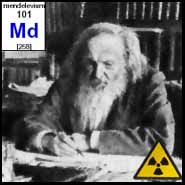
101MdMendelevium258.09862
8 18 32 31 8 2 |
|
| Basic properties | |
|---|---|
| Atomic number | 101 |
| Atomic weight | 258.0986 amu |
| Element family | Actinoids |
| Period | 7 |
| Group | 2 |
| Block | s-block |
| Discovery year | 1955 |
| Isotope distribution |
|---|
| None |
| Physical properties | |
|---|---|
| Density | 10.3 g/cm3 (STP) |
Atomic hydrogen (H) 8.988E-5 Meitnerium (Mt) 28 | |
| Melting | 827 °C |
Helium (He) -272.2 Carbon (C) 3675 | |
| Chemical properties | |
|---|---|
| Oxidation states (less common) | +3 (+2) |
| First ionization potential | 6.581 eV |
Cesium (Cs) 3.894 Helium (He) 24.587 | |
| Electron affinity | 0.980 eV |
Nobelium (No) -2.33 Atomic chlorine (Cl) 3.612725 | |
| Electronegativity | 1.3 |
Cesium (Cs) 0.79 Atomic fluorine (F) 3.98 | |
| Atomic radius |
|---|
| Electronic properties | |
|---|---|
| Electrons per shell | 2, 8, 18, 32, 31, 8, 2 |
| Electronic configuration | [Rn] 5f13 |
|
Bohr atom model
| |
|
Orbital box diagram
| |
| Valence electrons | 15 |
| Lewis dot structure |
|
| Orbital Visualization | |
|---|---|
|
| |
| Electrons | - |
Mendelevium (Md): Periodic Table Element
Abstract
Mendelevium is a synthetic radioactive metallic element with atomic number 101 and chemical symbol Md, representing the first element that cannot be produced in macroscopic quantities by neutron bombardment of lighter elements. This transuranium actinide element exhibits predominantly trivalent chemistry with an accessible divalent oxidation state, characterized by short-lived isotopes ranging from mass numbers 244 to 260. The most stable isotope 258Md possesses a half-life of 51.59 days, while 256Md remains the most chemically useful isotope despite its shorter half-life of 77.7 minutes due to its greater production yields from einsteinium bombardment with alpha particles.
Introduction
Mendelevium occupies a unique position in the periodic table as the third-to-last actinide and the ninth transuranic element, representing a crucial milestone as the first transfermium element. Named after Dmitri Mendeleev, the architect of the periodic table, mendelevium demonstrates the predictive power of periodic relationships in its chemical behavior. The element's synthesis marked the first instance of producing an element one atom at a time, establishing precedent for superheavy element research. Located in period 7, group III of the actinide series, mendelevium's electronic structure follows the systematic filling of the 5f subshell characteristic of transuranium elements. With seventeen known isotopes all exhibiting radioactive decay, mendelevium's chemistry is constrained by its inherent nuclear instability and extremely limited availability.
Physical Properties and Atomic Structure
Fundamental Atomic Parameters
Mendelevium possesses atomic number 101, placing it in the actinide series with the expected ground-state electron configuration [Rn]5f137s2 and term symbol 2F7/2. The fifteen valence electrons occupy the 5f and 7s subshells, with the 5f13 configuration characteristic of the late actinides. First ionization potential measurements establish an upper limit of 6.58 ± 0.07 eV, based on the assumption that 7s electrons ionize preferentially over 5f electrons. The ionic radius of hexacoordinate Md3+ measures approximately 89.6 pm, determined through distribution coefficient analysis and consistent with the actinide contraction. Enthalpy of hydration for Md3+ equals −3654 ± 12 kJ/mol, while Md2+ exhibits an ionic radius of 115 pm with hydration enthalpy of −1413 kJ/mol.
Macroscopic Physical Characteristics
Metallic mendelevium has not been prepared in bulk quantities, making direct physical property measurements impossible. Theoretical predictions based on actinide trends indicate a divalent metallic state with face-centered cubic crystal structure, similar to europium and ytterbium among the lanthanides. The metallic radius is predicted to be 194 ± 10 pm, with density estimated at 10.3 ± 0.7 g/cm³. Melting point calculations suggest approximately 800°C, identical to neighboring nobelium. Enthalpy of sublimation estimates range from 134 to 142 kJ/mol. The divalent nature results from relativistic stabilization of 5f electrons, which makes the energy required to promote electrons from 5f to 6d orbitals insufficient to compensate for the increased crystal stabilization energy of the trivalent state.
Chemical Properties and Reactivity
Electronic Structure and Bonding Behavior
Mendelevium's chemical behavior reflects its position as a late actinide with predominantly trivalent character in aqueous solution. The [Rn]5f12 electronic configuration in the Md3+ state follows the systematic trend established by other actinides. Chemical reactivity patterns demonstrate strong similarity to other trivalent lanthanides and actinides, with elution behavior in cation-exchange chromatography confirming trivalent character. The element forms insoluble hydroxides and fluorides that coprecipitate with trivalent lanthanide salts. Coordination chemistry studies reveal complex formation with chelating agents such as 1,2-cyclohexanedinitrilotetraacetic acid, indicating typical trivalent metal behavior with moderate to strong Lewis acid character.
Electrochemical and Thermodynamic Properties
Standard reduction potential measurements establish E°(Md3+→Md2+) = −0.16 ± 0.05 V, confirming the stability of divalent mendelevium under reducing conditions. This reduction potential enables facile conversion between oxidation states in appropriate chemical environments. Comparative analysis places E°(Md3+→Md0) around −1.74 V and E°(Md2+→Md0) near −2.5 V. The Md2+ ion exhibits elution behavior comparable to strontium(II) and europium(II), confirming its divalent character. Higher oxidation states remain inaccessible under normal conditions, with E°(Md4+→Md3+) predicted at +5.4 V, explaining the failure of strong oxidizing agents like sodium bismuthate to achieve tetravalent mendelevium.
Chemical Compounds and Complex Formation
Binary and Ternary Compounds
Limited quantities of mendelevium preclude extensive compound synthesis, but theoretical considerations and limited experimental evidence suggest standard actinide compound formation patterns. Hydroxide and fluoride precipitation occurs readily with Md3+, forming insoluble compounds analogous to other trivalent actinides. The element's behavior in various chemical environments indicates formation of typical trivalent metal compounds including halides, oxides, and sulfates under appropriate conditions. Thermodynamic stability calculations predict standard oxide, fluoride, and chloride compounds following trends established by neighboring actinides, though experimental confirmation remains limited by material availability.
Coordination Chemistry and Organometallic Compounds
Coordination complex formation with chelating ligands demonstrates typical trivalent metal behavior. Studies with α-hydroxyisobutyric acid reveal selective binding that enables chromatographic separation from other actinides. The Md3+ ion forms stable complexes with DCTA and similar polydentate ligands, indicating significant Lewis acid character. Thermochromatographic studies suggest volatile compound formation with hexafluoroacetylacetonate ligands, analogous to fermium compounds. These coordination studies provide the primary experimental foundation for understanding mendelevium chemistry given the impossibility of bulk compound synthesis.
Natural Occurrence and Isotopic Analysis
Geochemical Distribution and Abundance
Mendelevium does not occur naturally on Earth due to its short half-lives relative to geological timescales and the absence of natural nuclear processes capable of producing elements beyond fermium. The element exists only as artificially synthesized atoms in particle accelerators and research laboratories. Crustal abundance is effectively zero, with no detectable quantities in any natural materials. Unlike lighter actinides that may form through neutron capture processes in uranium ores, mendelevium production requires deliberate synthesis through charged particle bombardment of heavy actinide targets.
Nuclear Properties and Isotopic Composition
Seventeen radioactive isotopes of mendelevium are known, with mass numbers from 244 to 260, plus fourteen nuclear isomers. No stable isotopes exist. 258Md represents the most stable isotope with a half-life of 51.59 days, undergoing alpha decay and spontaneous fission. The chemically important 256Md exhibits a half-life of 77.7 minutes, decaying 90% by electron capture to 256Fm and 10% by alpha decay. 260Md possesses a half-life of 27.8 days, while 257Md, 259Md, and remaining isotopes show progressively shorter half-lives. Alpha decay energies for 256Md occur at 7.205 and 7.139 MeV, providing characteristic identification signatures. The longest-lived nuclear isomer 258mMd has a half-life of 57.0 minutes.
Industrial Production and Technological Applications
Extraction and Purification Methodologies
Mendelevium production requires particle accelerator bombardment of einsteinium targets with alpha particles, representing the standard synthesis route since its discovery. Typical targets contain microgram quantities of 253Es or 254Es deposited electrolytically on thin metal foils. Bombardment with 41 MeV alpha particles at beam densities of 6×10¹³ particles per second produces recoiling mendelevium atoms that are captured on beryllium, aluminum, platinum, or gold catcher foils. Production rates reach approximately one million atoms per hour under optimal conditions. Gas-jet transport systems using helium carriers with potassium chloride aerosols enable efficient collection and transport of mendelevium atoms over tens of meters to chemical analysis stations.
Technological Applications and Future Prospects
Current applications of mendelevium remain limited to fundamental nuclear and chemical research due to extremely limited availability and short half-lives. The element serves primarily as a probe for understanding actinide chemistry and nuclear structure in the transuranium region. Research applications include studies of electronic structure, chemical bonding, and periodic relationships among heavy elements. Future prospects depend on potential synthesis of longer-lived isotopes or development of more efficient production methods. The element's position as the first transfermium provides unique insights into superheavy element chemistry and may contribute to understanding of the predicted island of stability for superheavy nuclei.
Historical Development and Discovery
Mendelevium synthesis occurred in early 1955 at the University of California, Berkeley, through collaborative efforts by Albert Ghiorso, Glenn T. Seaborg, Gregory Robert Choppin, Bernard G. Harvey, and team leader Stanley G. Thompson. The discovery represented culmination of systematic transuranium element research begun in 1952. Initial experiments in September 1954 failed to detect alpha decay events, leading to revised experimental design targeting electron capture decay products. Successful synthesis occurred on February 19, 1955, through bombardment of one billion 253Es atoms with alpha particles in the 60-inch cyclotron. The discovery marked the first synthesis of an element one atom at a time, with seventeen mendelevium atoms produced in the initial experiment. Detection relied on observing spontaneous fission events from the electron-capture daughter 256Fm, establishing a precedent for superheavy element identification. The element's naming honored Dmitri Mendeleev despite Cold War political considerations, recognizing his fundamental contributions to periodic law.
Conclusion
Mendelevium occupies a distinctive position as the first element requiring particle accelerator synthesis and demonstrating the transition from neutron-rich to neutron-deficient nuclear synthesis pathways. Its predominantly trivalent chemistry with accessible divalent oxidation states exemplifies late actinide behavior while providing fundamental insights into relativistic effects on chemical bonding. The element's role as the first transfermium establishes crucial experimental foundations for superheavy element research and theoretical understanding of nuclear stability limits. Future investigations may reveal additional isotopes or enhanced production methods, potentially expanding research applications in nuclear chemistry and physics.

Please let us know how we can improve this web app.