| Element | |
|---|---|
57LaLanthanum138.9054772
8 18 18 9 2 |
|
| Basic properties | |
|---|---|
| Atomic number | 57 |
| Atomic weight | 138.905477 amu |
| Element family | N/A |
| Period | 6 |
| Group | 2 |
| Block | s-block |
| Discovery year | 1838 |
| Isotope distribution |
|---|
139La 99.91% |
| Physical properties | |
|---|---|
| Density | 6.145 g/cm3 (STP) |
Atomic hydrogen (H) 8.988E-5 Meitnerium (Mt) 28 | |
| Melting | 920 °C |
Helium (He) -272.2 Carbon (C) 3675 | |
| Boiling | 3454 °C |
Helium (He) -268.9 Tungsten (W) 5927 | |
| Chemical properties | |
|---|---|
| Oxidation states (less common) | +3 (0, +1, +2) |
| First ionization potential | 5.577 eV |
Cesium (Cs) 3.894 Helium (He) 24.587 | |
| Electron affinity | 0.558 eV |
Nobelium (No) -2.33 Atomic chlorine (Cl) 3.612725 | |
| Electronegativity | 1.1 |
Cesium (Cs) 0.79 Atomic fluorine (F) 3.98 | |
| Atomic radius | |
|---|---|
| Covalent radius | 1.8 Å |
Atomic hydrogen (H) 0.32 Francium (Fr) 2.6 | |
| Metallic radius | 1.87 Å |
Beryllium (Be) 1.12 Cesium (Cs) 2.65 | |
| Compounds | ||
|---|---|---|
| Formula | Name | Oxidation state |
| La2O3 | Lanthanum oxide | +3 |
| La2(CO3)3 | Lanthanum carbonate | +3 |
| La(NO3)3 | Lanthanum(III) nitrate | +3 |
| La(OH)3 | Lanthanum hydroxide | +3 |
| La2Hf2O7 | Lanthanum hafnate | +3 |
| La2O2S | Lanthanum oxysulfide | +3 |
| LaAlO3 | Lanthanum aluminate | +3 |
| LaB6 | Lanthanum hexaboride | +3 |
| LaBr3 | Lanthanum(III) bromide | +3 |
| LaC2 | Lanthanum carbide | +3 |
| LaCl3 | Lanthanum(III) chloride | +3 |
| LaF3 | Lanthanum trifluoride | +3 |
| Electronic properties | |
|---|---|
| Electrons per shell | 2, 8, 18, 18, 9, 2 |
| Electronic configuration | [Xe] 5d1 |
|
Bohr atom model

| |
|
Orbital box diagram

| |
| Valence electrons | 3 |
| Lewis dot structure |
|
| Orbital Visualization | |
|---|---|
|
| |
| Electrons | - |
Lanthanum (La): Periodic Table Element
Abstract
Lanthanum (La, atomic number 57) stands as the archetypal lanthanide element, exhibiting characteristic properties that define the rare earth series. With an electron configuration of [Xe]5d¹6s², lanthanum demonstrates unique electronic behavior among the f-block elements, containing no 4f electrons in its ground state atomic configuration. The element displays a standard atomic weight of 138.90547 ± 0.00007 u, melting point of 920°C, and density of 6.162 g/cm³ at room temperature. Lanthanum's chemical behavior is dominated by the +3 oxidation state, forming predominantly ionic compounds with high coordination numbers. Its physical properties include a silvery-white metallic appearance, hexagonal crystal structure at ambient conditions, and relatively high electrical resistivity of 615 nΩ·m. Industrial applications span from hybrid vehicle battery electrodes to optical glass additives, carbon arc lighting, and catalytic systems. The element occurs naturally at 39 mg/kg crustal abundance, primarily in monazite and bastnäsite minerals alongside other rare earth elements.
Introduction
Lanthanum occupies a unique position within the periodic table as the first element of the lanthanide series, serving as the prototype for understanding the chemical and physical properties of the 4f-block elements. Located in period 6, group 3, lanthanum exhibits atomic number 57 and represents the transition from the alkaline earth metals to the characteristic behavior of the rare earth elements. The element's significance extends beyond academic interest, as its properties directly influence the behavior of the entire lanthanide series and provide fundamental insights into f-orbital chemistry. Discovered in 1839 by Carl Gustaf Mosander through careful chemical analysis of cerium salts, lanthanum derives its name from the ancient Greek λανθάνειν (lanthanein), meaning "to lie hidden," reflecting the challenges associated with separating rare earth elements. Despite its classification as a rare earth element, lanthanum maintains a crustal abundance of approximately 39 mg/kg, ranking as the 28th most abundant element in the Earth's crust and exceeding the abundance of lead by nearly three-fold.
Physical Properties and Atomic Structure
Fundamental Atomic Parameters
Lanthanum's atomic structure exhibits the electron configuration [Xe]5d¹6s², distinguishing it from other lanthanides through the absence of 4f electrons in the ground state. This electronic arrangement results from strong interelectronic repulsion effects that favor 5d over 4f occupation, despite the proximity of these orbitals in energy. The atomic radius of lanthanum measures 187.7 pm, representing the largest among the lanthanide series and contributing to its enhanced chemical reactivity. Effective nuclear charge calculations indicate a value of approximately 13.8, significantly lower than transition metals due to efficient screening by inner electron shells. The first ionization energy of 538.1 kJ/mol, second ionization energy of 1067 kJ/mol, and third ionization energy of 1850.3 kJ/mol demonstrate the progressive difficulty in removing electrons from the La³⁺ ion. Ionic radius measurements show La³⁺ at 103.2 pm in six-coordinate environments, expanding to 116 pm in eight-coordinate geometries, reflecting the element's preference for high coordination numbers.
Macroscopic Physical Characteristics
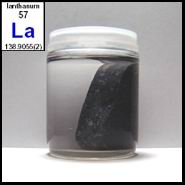
Lanthanum appears as a soft, silvery-white metal that tarnishes rapidly upon exposure to atmospheric conditions, developing a characteristic dark oxide layer within hours. The element crystallizes in a hexagonal close-packed (α-La) structure at room temperature with lattice parameters a = 3.774 Å and c = 12.171 Å. Upon heating to 310°C, lanthanum undergoes a polymorphic transition to face-centered cubic β-La structure, followed by body-centered cubic γ-La formation at 865°C. The melting point of 920°C and boiling point of 3464°C establish lanthanum's moderate thermal stability among the lanthanides. Density measurements yield 6.162 g/cm³ at 20°C, with thermal expansion coefficient of 12.1 × 10⁻⁶ K⁻¹. Heat capacity values include 27.11 J/(mol·K) at 25°C, while enthalpy of fusion reaches 6.20 kJ/mol and enthalpy of vaporization measures 414 kJ/mol. The element demonstrates relatively poor electrical conductivity with resistivity of 615 nΩ·m at room temperature, approximately 23 times higher than aluminum.
Chemical Properties and Reactivity
Electronic Structure and Bonding Behavior
Lanthanum's chemical reactivity stems primarily from its large atomic radius and low ionization energies, facilitating facile oxidation to the trivalent state. The [Xe]5d¹6s² configuration readily loses three electrons to achieve the stable noble gas configuration, although the 4f orbital becomes accessible for bonding in chemical environments. Electronegativity measurements place lanthanum at 1.10 on the Pauling scale, indicating highly electropositive character and predisposition toward ionic bonding. Standard reduction potential for the La³⁺/La couple equals -2.379 V, demonstrating strong reducing capability and spontaneous oxidation in aqueous solutions. Chemical bonding in lanthanum compounds occurs predominantly through electrostatic interactions, with minimal covalent character due to the diffuse nature of 5d and 6s orbitals. Coordination chemistry favors high coordination numbers, typically 8-12, with coordination geometries including square antiprism, dodecahedron, and icosahedral arrangements.
Electrochemical and Thermodynamic Properties
Electrochemical behavior of lanthanum exhibits characteristics typical of active metals, with standard electrode potential of -2.379 V versus the standard hydrogen electrode. The element readily undergoes oxidation in aqueous media, forming the colorless [La(H₂O)₉]³⁺ aqua ion under acidic conditions. Electron affinity measurements indicate minimal tendency toward anion formation at -48 kJ/mol, consistent with metallic character. Successive ionization energies follow the expected trend: first ionization (538.1 kJ/mol), second ionization (1067 kJ/mol), and third ionization (1850.3 kJ/mol), with the third ionization requiring significantly higher energy due to removal from the noble gas core proximity. Thermodynamic stability of La³⁺ compounds reflects high lattice energies and favorable hydration enthalpies. Standard formation enthalpies for common compounds include La₂O₃ (-1793.7 kJ/mol), LaF₃ (-1706.8 kJ/mol), and LaCl₃ (-1072.2 kJ/mol).
Chemical Compounds and Complex Formation
Binary and Ternary Compounds
Lanthanum oxide (La₂O₃) represents the most thermodynamically stable binary compound, adopting a hexagonal A-type structure with seven-coordinate La³⁺ ions at ambient conditions. This structure transforms to the cubic C-type (bixbyite) structure characteristic of smaller lanthanides upon heating above 2200°C. The compound exhibits basic character, reacting vigorously with water to produce lanthanum hydroxide La(OH)₃ and substantial heat evolution. Lanthanum halides display varying structural characteristics: LaF₃ crystallizes in the tysonite structure with nine-coordinate lanthanum, while LaCl₃, LaBr₃, and LaI₃ adopt the UCl₃-type structure with nine-coordinate geometry in the solid state. These trihalides exhibit high hygroscopicity and form numerous hydrated species, with LaCl₃·7H₂O representing the most common hydrated form. Lanthanum forms binary compounds with most nonmetals, including LaS (rock salt structure), La₂S₃, LaP, and LaC₂, demonstrating the element's broad chemical compatibility.
Coordination Chemistry and Organometallic Compounds
Coordination complexes of lanthanum typically feature high coordination numbers ranging from 8 to 12, accommodating the large ionic radius of La³⁺. Common donor atoms include oxygen, nitrogen, and fluorine, with minimal π-bonding capability due to the absence of accessible d orbitals. Chelating ligands such as ethylenediaminetetraacetic acid (EDTA), nitrilotriacetic acid (NTA), and crown ethers form stable complexes with coordination numbers approaching 12. Aqueous La³⁺ exists predominantly as [La(H₂O)₉]³⁺ with tricapped trigonal prismatic geometry, exhibiting rapid water exchange kinetics. Organometallic chemistry remains limited due to the ionic bonding preference, although cyclopentadienyl complexes such as La(C₅H₅)₃ and bis(cyclopentadienyl) derivatives demonstrate some stability. These compounds typically exhibit σ-bonding character with minimal metal-ligand π-interaction. Metallocene-type complexes display bent geometry due to electrostatic repulsion between electron-rich ligands.
Natural Occurrence and Isotopic Analysis
Geochemical Distribution and Abundance
Lanthanum occurs in the Earth's crust at an abundance of 39 mg/kg, primarily concentrated within phosphate, carbonate, and silicate mineral phases. The element exhibits lithophile character, preferentially associating with silicate melts during magmatic differentiation processes. Principal ore minerals include monazite (REPO₄, where RE represents rare earth elements), bastnäsite (REFCO₃), and xenotime (YPO₄), with lanthanum typically comprising 20-25% of the total rare earth content. Geochemical fractionation patterns show lanthanum enrichment in igneous rocks with high aluminum and potassium content, including granites, pegmatites, and alkaline intrusions. Sedimentary environments concentrate lanthanum through weathering processes, with clay minerals and secondary phosphates serving as important repositories. Ocean water contains dissolved lanthanum at concentrations of approximately 3.4 ng/L, exhibiting scavenging-type behavior with residence times of several hundred years.
Nuclear Properties and Isotopic Composition
Natural lanthanum consists primarily of the stable isotope ¹³⁹La (99.910% natural abundance) accompanied by trace amounts of the long-lived radioisotope ¹³⁸La (0.090% abundance, t₁/₂ = 1.05 × 10¹¹ years). The ¹³⁹La nucleus contains 82 neutrons and exhibits nuclear spin I = 7/2 with magnetic moment μ = +2.783 μₙ. Nuclear magnetic resonance studies utilize ¹³⁹La as a probe for coordination environment analysis, although quadrupolar relaxation effects limit resolution. The ¹³⁸La isotope undergoes electron capture decay to ¹³⁸Ce and β⁻ decay to ¹³⁸Ba with approximately equal probabilities. Artificial isotopes span mass numbers from 119 to 155, with most exhibiting half-lives measured in minutes or hours. Notable synthetic isotopes include ¹⁴⁰La (t₁/₂ = 1.68 days), ¹³⁷La (t₁/₂ = 6.0 × 10⁴ years), and ¹³⁵La (t₁/₂ = 19.5 hours). Nuclear cross-sections for thermal neutron absorption measure 8.97 barns for ¹³⁹La, indicating moderate neutron absorption capability.
Industrial Production and Technological Applications
Extraction and Purification Methodologies
Industrial lanthanum production begins with beneficiation of rare earth-bearing mineral concentrates through flotation, magnetic separation, and density concentration techniques. Monazite processing involves treatment with concentrated sulfuric acid at 150-220°C, producing water-soluble rare earth sulfates while decomposing the phosphate matrix. The resulting acidic solution undergoes partial neutralization to pH 3-4 with sodium hydroxide, precipitating thorium hydroxide and other impurities. Bastnäsite processing utilizes hydrochloric acid leaching following roasting at 500-600°C to decompose carbonate and fluoride components. Separation of individual rare earth elements employs solvent extraction with tributyl phosphate (TBP) or bis(2-ethylhexyl)phosphoric acid (D2EHPA) organic phases. Lanthanum isolation involves selective stripping from loaded organic phases using dilute hydrochloric acid, followed by precipitation as the oxalate La₂(C₂O₄)₃ and thermal decomposition to La₂O₃. Metal production requires reduction of anhydrous LaCl₃ with lithium, calcium, or electrolytic methods at 800-900°C under inert atmosphere.
Technological Applications and Future Prospects
Lanthanum applications encompass diverse technological sectors, with battery electrodes representing the largest consumption volume. Nickel-metal hydride batteries utilize LaNi₅-type intermetallic compounds as hydrogen storage anodes, with hybrid electric vehicles requiring 10-15 kg of lanthanum per battery pack. These electrodes demonstrate reversible hydrogen capacity of 300-400 mL H₂/g, enabling high energy density and extended cycle life. Optical applications include high refractive index glasses with n₁ values exceeding 1.9, utilized in camera lenses, telescopes, and precision optical instruments. Lanthanum oxide additions improve glass thermal stability and reduce dispersion characteristics. Catalytic applications employ lanthanum-containing zeolites and mixed oxides for petroleum refining processes, particularly fluid catalytic cracking where La-exchanged Y-type zeolites enhance selectivity and thermal stability. Carbon arc lighting consumes lanthanum in electrode cores, providing high-intensity illumination for motion picture projection and stadium lighting. Emerging applications include thermoelectric materials, supercapacitor electrodes, and solid oxide fuel cell components, leveraging lanthanum's unique electronic properties.
Historical Development and Discovery
The discovery of lanthanum emerged from systematic investigations of cerium-containing minerals during the early 19th century expansion of analytical chemistry. In 1839, Carl Gustaf Mosander, working at the Karolinska Institute in Stockholm, subjected cerium nitrate samples to partial thermal decomposition followed by selective dissolution techniques. Mosander's careful fractional crystallization procedures revealed spectroscopic evidence for an additional element exhibiting similar but distinct chemical properties compared to cerium. The new element initially proved difficult to separate completely, leading to the designation "lanthanum" from the Greek λανθάνειν, meaning "to lie hidden." Mosander's contemporaneous discovery of didymium (later separated into praseodymium and neodymium) established the foundation for rare earth element chemistry. Pure metallic lanthanum remained elusive until 1923, when improved reduction techniques and high-temperature methods enabled isolation of gram quantities. The development of ion exchange chromatography during the 1940s revolutionized rare earth separations, facilitating large-scale purification processes. Modern understanding of lanthanum's electronic structure evolved through 20th-century quantum mechanical treatments, explaining the anomalous 4f⁰ configuration and coordination chemistry preferences.
Conclusion
Lanthanum's position as the prototypical lanthanide element establishes its fundamental importance in understanding f-block chemistry and rare earth element behavior. The element's unique ground-state electronic configuration, large ionic radius, and pronounced electropositive character contribute to distinctive physical and chemical properties that influence both academic research and industrial applications. Current technological demands, particularly in energy storage and optical materials, continue to drive lanthanum consumption and motivate research into improved extraction and processing methodologies. Future developments may expand applications in quantum materials, advanced ceramics, and environmental remediation technologies, capitalizing on lanthanum's coordination chemistry and catalytic properties.

Please let us know how we can improve this web app.
