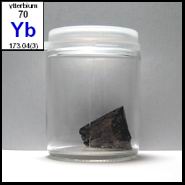
| Element | |
|---|---|
70YbYtterbium173.0432
8 18 32 8 2 |
|
| Basic properties | |
|---|---|
| Atomic number | 70 |
| Atomic weight | 173.043 amu |
| Element family | N/A |
| Period | 6 |
| Group | 2 |
| Block | s-block |
| Discovery year | 1878 |
| Isotope distribution |
|---|
168Yb 0.13% 170Yb 3.05% 171Yb 14.3% 172Yb 21.9% 173Yb 16.12% 174Yb 31.8% 176Yb 12.7% |
170Yb (3.05%) 171Yb (14.30%) 172Yb (21.90%) 173Yb (16.12%) 174Yb (31.80%) 176Yb (12.70%) |
| Physical properties | |
|---|---|
| Density | 6.965 g/cm3 (STP) |
Atomic hydrogen (H) 8.988E-5 Meitnerium (Mt) 28 | |
| Melting | 824 °C |
Helium (He) -272.2 Carbon (C) 3675 | |
| Boiling | 1193 °C |
Helium (He) -268.9 Tungsten (W) 5927 | |
| Chemical properties | |
|---|---|
| Oxidation states (less common) | +3 (0, +1, +2) |
| First ionization potential | 6.254 eV |
Cesium (Cs) 3.894 Helium (He) 24.587 | |
| Electron affinity | -0.020 eV |
Nobelium (No) -2.33 Atomic chlorine (Cl) 3.612725 | |
| Electronegativity | 1.1 |
Cesium (Cs) 0.79 Atomic fluorine (F) 3.98 | |
| Atomic radius | |
|---|---|
| Covalent radius | 1.7 Å |
Atomic hydrogen (H) 0.32 Francium (Fr) 2.6 | |
| Metallic radius | 1.76 Å |
Beryllium (Be) 1.12 Cesium (Cs) 2.65 | |
| Compounds | ||
|---|---|---|
| Formula | Name | Oxidation state |
| YbBiPt | YbBiPt | +2 |
| YbCl2 | Ytterbium(II) chloride | +2 |
| YbF2 | Ytterbium(II) fluoride | +2 |
| YbH2 | Ytterbium hydride | +2 |
| YbS | Ytterbium sulfide | +2 |
| Yb2O3 | Ytterbium(III) oxide | +3 |
| LaYbO3 | Lanthanum ytterbium oxide | +3 |
| Yb(CH3COO)3 | Ytterbium(III) acetate | +3 |
| Yb(NO3)3 | Ytterbium(III) nitrate | +3 |
| Yb2(SO4)3 | Ytterbium(III) sulfate | +3 |
| Yb2S3 | Ytterbium(III) sulfide | +3 |
| YbBr3 | Ytterbium(III) bromide | +3 |
| Electronic properties | |
|---|---|
| Electrons per shell | 2, 8, 18, 32, 8, 2 |
| Electronic configuration | [Xe] 4f14 |
|
Bohr atom model
| |
|
Orbital box diagram
| |
| Valence electrons | 16 |
| Lewis dot structure |
|
| Orbital Visualization | |
|---|---|
|
| |
| Electrons | - |
Ytterbium (Yb): Periodic Table Element
Abstract
Ytterbium (Yb, atomic number 70) represents the fourteenth element in the lanthanide series, distinguished by its unique closed-shell electron configuration [Xe] 4f14 6s2. This configuration confers exceptional stability to the +2 oxidation state, making ytterbium one of the few lanthanides that readily forms divalent compounds. The element exhibits a standard atomic weight of 173.045 ± 0.010 u and exists as seven naturally occurring stable isotopes. Ytterbium demonstrates lower density (6.973 g/cm³), melting point (824°C), and boiling point (1196°C) compared to neighboring lanthanides, characteristics directly attributable to its electronic structure. Industrial applications focus primarily on laser technology, atomic clocks, and specialized metallurgical processes.
Introduction
Ytterbium occupies a distinctive position within the lanthanide series, demonstrating chemical behavior that deviates significantly from typical rare earth elements. The element's fourteen f-electrons create a closed-shell configuration that stabilizes lower oxidation states, particularly the +2 state that is uncommon among lanthanides. This electronic arrangement influences not only chemical reactivity but also physical properties, resulting in density and thermal characteristics that differ markedly from neighboring elements. The element crystallizes in a face-centered cubic structure at room temperature, contrasting with the hexagonal close-packed arrangement typical of most lanthanides. Discovered by Jean Charles Galissard de Marignac in 1878, ytterbium has evolved from a laboratory curiosity to an element of considerable technological importance, particularly in precision timing applications and high-power laser systems.
Physical Properties and Atomic Structure
Fundamental Atomic Parameters
Ytterbium exhibits an atomic number of 70 with an electron configuration of [Xe] 4f14 6s2. The completely filled 4f subshell creates exceptional electronic stability and influences the element's chemical behavior profoundly. The atomic radius measures 176 pm, while the ionic radius for Yb³⁺ is 86.8 pm and for Yb²⁺ is 102 pm. These ionic radii reflect the lanthanide contraction effect, though less pronounced due to the filled f-shell configuration. The effective nuclear charge experiences minimal screening from the 4f electrons, contributing to the element's unique properties. The first ionization energy is 603.4 kJ/mol, the second ionization energy reaches 1174.8 kJ/mol, and the third ionization energy climbs to 2417 kJ/mol. The large gap between the second and third ionization energies demonstrates the relative stability of the Yb²⁺ ion.
Macroscopic Physical Characteristics
Ytterbium appears as a silvery-white metal with a pale yellow tint when freshly prepared. The element exhibits three allotropic forms designated alpha, beta, and gamma. The beta allotrope predominates at room temperature with a density of 6.966 g/cm³ and a face-centered cubic crystal structure. The alpha form, stable below -13°C, possesses a hexagonal structure with density of 6.903 g/cm³. The gamma allotrope, existing above 795°C, demonstrates body-centered cubic symmetry and density of 6.57 g/cm³. These density values are significantly lower than those of thulium (9.32 g/cm³) and lutetium (9.841 g/cm³), reflecting the influence of the closed-shell electronic configuration on metallic bonding. The melting point of 824°C and boiling point of 1196°C represent the smallest liquid range among all metals, spanning merely 372°C. Thermal conductivity measures 38.5 W/(m·K) at 300 K, while electrical resistivity at room temperature is 25.0 × 10⁻⁸ Ω·m.
Chemical Properties and Reactivity
Electronic Structure and Bonding Behavior
The chemical behavior of ytterbium is dominated by its [Xe] 4f14 6s2 electronic configuration, which permits both +2 and +3 oxidation states with unusual facility. The fully occupied f-shell provides exceptional stability to the divalent state, making Yb²⁺ analogous to alkaline earth metal cations in many respects. Unlike other lanthanides where three electrons participate in metallic bonding, only two 6s electrons are available in ytterbium, resulting in increased metallic radius and decreased cohesive energy. The element forms ionic compounds predominantly, though some covalent character exists in organometallic complexes. Coordination numbers typically range from 6 to 9, with preference for higher coordination numbers in aqueous solution where nonahydrate complexes [Yb(H₂O)₉]³⁺ predominate. Bond lengths in ytterbium compounds reflect the ionic radii, with Yb-O bonds typically measuring 2.28-2.35 Å for octahedral coordination.
Electrochemical and Thermodynamic Properties
Ytterbium demonstrates electronegativity values of 1.1 on the Pauling scale and 1.06 on the Allred-Rochow scale, indicating highly electropositive character. The standard reduction potential for the Yb³⁺/Yb couple is -2.19 V, while the Yb²⁺/Yb potential measures -2.8 V. These values reflect the element's strong reducing character, particularly in the divalent state. The electron affinity is approximately 50 kJ/mol, consistent with metallic behavior. Successive ionization energies demonstrate the stability of different oxidation states, with the large increase from second to third ionization energy (1174.8 to 2417 kJ/mol) highlighting the preference for divalent compounds. Thermodynamic calculations show that ytterbium(II) compounds are thermodynamically unstable in aqueous solution, readily decomposing water to liberate hydrogen gas. The enthalpy of formation for Yb₂O₃ is -1814.2 kJ/mol, while YbO exhibits -580.7 kJ/mol, demonstrating the greater thermodynamic stability of trivalent compounds in solid state.
Chemical Compounds and Complex Formation
Binary and Ternary Compounds
Ytterbium forms an extensive series of binary compounds, with halides representing the most thoroughly characterized examples. The trihalides YbF₃, YbCl₃, YbBr₃, and YbI₃ all crystallize in characteristic lanthanide structures, with YbF₃ adopting the tysonite structure and the heavier trihalides exhibiting the hexagonal UCl₃ structure. Formation enthalpies are -1670, -959, -863, and -671 kJ/mol for the fluoride, chloride, bromide, and iodide respectively. The dihalides YbF₂, YbCl₂, YbBr₂, and YbI₂ exhibit fluorite-type structures similar to alkaline earth halides, though they demonstrate thermal instability at elevated temperatures, disproportionating according to 3YbX₂ → 2YbX₃ + Yb. Oxide chemistry includes both sesquioxide Yb₂O₃ with the C-type rare earth structure and monoxide YbO with sodium chloride structure. Sulfides, selenides, and tellurides follow similar patterns, with YbS, YbSe, and YbTe adopting rock salt structures. Ternary compounds include garnets such as Yb₃Al₅O₁₂ and perovskite derivatives like YbAlO₃.
Coordination Chemistry and Organometallic Compounds
Ytterbium coordination chemistry encompasses both divalent and trivalent complexes, with ligand field effects playing minimal roles due to the filled f-shell configuration. Aqueous chemistry is dominated by nonahydrate complexes [Yb(H₂O)₉]³⁺, though lower coordination numbers occur with bulky ligands. Crown ethers and cryptands stabilize the divalent state through size-selective coordination. Organometallic chemistry includes cyclopentadienyl complexes such as (C₅H₅)₂Yb and (C₅H₅)₃Yb, which serve as precursors for various synthetic applications. Bis(cyclooctatetraenyl)ytterbium represents an important sandwich complex exhibiting unusual magnetic properties. Mixed-ligand complexes incorporating phosphines, amines, and oxygen donors demonstrate varied geometries depending on steric requirements. The divalent organometallic compounds exhibit strong reducing properties and find application in organic synthesis for carbon-carbon bond formation reactions.
Natural Occurrence and Isotopic Analysis
Geochemical Distribution and Abundance
Ytterbium occurs in the Earth's crust at an average concentration of 3.0 mg/kg (3.0 ppm), making it more abundant than tin, lead, or bismuth but less common than most other lanthanides. The element follows typical lanthanide geochemical behavior, concentrating in igneous rocks through fractional crystallization processes. Primary mineral sources include monazite [(Ce,La,Nd,Th)PO₄], where ytterbium substitutes for lighter lanthanides at concentrations of approximately 0.03%, xenotime (YPO₄), and euxenite [(Y,Ca,Ce,U,Th)(Nb,Ta,Ti)₂O₆]. Ion adsorption clays in southern China represent the most economically significant ytterbium source, with concentrations reaching 0.05-0.15% of total rare earth content. The element demonstrates moderate compatibility in common rock-forming minerals, with distribution coefficients favoring residual phases during partial melting. Weathering processes typically mobilize ytterbium, leading to secondary concentration in clay minerals and phosphate deposits.
Nuclear Properties and Isotopic Composition
Natural ytterbium comprises seven stable isotopes: ¹⁶⁸Yb (0.13%), ¹⁷⁰Yb (3.04%), ¹⁷¹Yb (14.28%), ¹⁷²Yb (21.83%), ¹⁷³Yb (16.13%), ¹⁷⁴Yb (31.83%), and ¹⁷⁶Yb (12.76%). The most abundant isotope, ¹⁷⁴Yb, possesses nuclear spin I = 0, while ¹⁷¹Yb and ¹⁷³Yb exhibit nuclear spins of I = 1/2. These isotopic properties prove crucial for nuclear magnetic resonance applications and quantum computing research. Thirty-two radioisotopes have been characterized, with ¹⁶⁹Yb representing the longest-lived artificial isotope (half-life 32.0 days). This isotope decays by electron capture to ¹⁶⁹Tm with gamma ray emission at energies of 63.1, 109.8, 177.2, and 307.7 keV. Other notable radioisotopes include ¹⁷⁵Yb (half-life 4.18 days) and ¹⁶⁶Yb (half-life 56.7 hours). The thermal neutron cross-section for ¹⁷⁴Yb is 69 barns, facilitating radioisotope production in nuclear reactors.
Industrial Production and Technological Applications
Extraction and Purification Methodologies
Industrial ytterbium production begins with mineral processing of monazite or ion-adsorption clays through acid digestion using concentrated sulfuric acid at 200-250°C. The resulting rare earth mixture undergoes separation through ion-exchange chromatography using synthetic resins loaded with ethylenediaminetetraacetic acid (EDTA) or similar complexing agents. Ytterbium separation exploits subtle differences in formation constants for various lanthanide-ligand complexes. Solvent extraction using di(2-ethylhexyl)phosphoric acid (D2EHPA) or tributyl phosphate provides alternative separation routes, particularly for large-scale operations. The purification process typically achieves 99.9% purity through repeated extraction cycles. Metal production involves reduction of anhydrous YbCl₃ with calcium or lanthanum metal at 1000°C under high vacuum conditions. Alternative methods include electrolysis of molten YbCl₃-NaCl-KCl eutectic mixtures at 800°C. Global production approximates 50 tonnes annually, primarily from Chinese sources accounting for over 90% of world supply.
Technological Applications and Future Prospects
Contemporary ytterbium applications capitalize on unique nuclear and electronic properties for specialized technological purposes. Atomic clocks incorporating laser-cooled ytterbium atoms achieve unprecedented stability, with frequency uncertainty below 10⁻¹⁹. These systems rely on the ¹S₀ → ³P₀ transition at 578 nm in ¹⁷¹Yb, providing narrow linewidth suitable for precision metrology. Fiber laser technology utilizes Yb³⁺ as an active dopant in silicate glass matrices, enabling high-power continuous-wave and pulsed operation at 1030-1100 nm wavelengths. The small quantum defect (≈6%) between pump and laser wavelengths minimizes thermal loading, permitting power scaling to kilowatt levels. Quantum computing research exploits ¹⁷¹Yb⁺ ions trapped in radiofrequency fields as qubits, with optical transitions enabling quantum gate operations and state manipulation. Nuclear medicine employs ¹⁶⁹Yb as a gamma ray source for portable radiography systems, competing favorably with conventional X-ray generators for specialized applications. Metallurgical applications include minor additions to stainless steel for grain refinement and stress monitoring through piezoresistive effects.
Historical Development and Discovery
The discovery of ytterbium traces to 1878 when Swiss chemist Jean Charles Galissard de Marignac isolated a new component from the mineral erbia, which he termed "ytterbia" in honor of Ytterby, Sweden, the village near the discovery site. Marignac suspected ytterbia contained a previously unknown element, which he designated ytterbium. The element's history became complicated in 1907 when three independent researchers—Georges Urbain in Paris, Carl Auer von Welsbach in Vienna, and Charles James in New Hampshire—simultaneously demonstrated that Marignac's ytterbia contained two distinct elements. Urbain separated "neoytterbia" (modern ytterbium) and "lutecia" (modern lutetium), while Welsbach identified "aldebaranium" and "cassiopeium" for the same elements. Priority disputes arose between Urbain and Welsbach, ultimately resolved in 1909 by the Commission on Atomic Mass favoring Urbain's nomenclature. The first relatively pure metallic ytterbium was obtained in 1953 using ion-exchange purification techniques developed during the Manhattan Project. Subsequent decades witnessed growing understanding of ytterbium's unique chemistry, particularly the stability of the divalent oxidation state and its applications in advanced technology.
Conclusion
Ytterbium occupies a distinctive niche within the lanthanide series due to its closed-shell 4f¹⁴ electronic configuration, which confers unusual stability to the +2 oxidation state and influences virtually all chemical and physical properties. The element's lower density, melting point, and coordination preferences distinguish it from other rare earth metals, while its unique nuclear properties enable cutting-edge applications in quantum computing and precision metrology. Future research directions include developing more efficient separation techniques, exploiting quantum properties for advanced computing applications, and expanding high-power laser capabilities. The element's role in emerging technologies suggests continued importance despite relatively limited natural abundance and complex extraction requirements.

Please let us know how we can improve this web app.