| Element | |
|---|---|
49InIndium114.81832
8 18 18 3 |
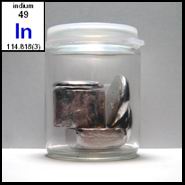
|
| Basic properties | |
|---|---|
| Atomic number | 49 |
| Atomic weight | 114.8183 amu |
| Element family | Other metals |
| Period | 5 |
| Group | 13 |
| Block | p-block |
| Discovery year | 1863 |
| Isotope distribution |
|---|
113In 4.29% |
| Physical properties | |
|---|---|
| Density | 7.31 g/cm3 (STP) |
Atomic hydrogen (H) 8.988E-5 Meitnerium (Mt) 28 | |
| Melting | 156.76 °C |
Helium (He) -272.2 Carbon (C) 3675 | |
| Boiling | 2080 °C |
Helium (He) -268.9 Tungsten (W) 5927 | |
| Chemical properties | |
|---|---|
| Oxidation states (less common) | +3 (-5, -2, -1, 0, +1, +2) |
| First ionization potential | 5.786 eV |
Cesium (Cs) 3.894 Helium (He) 24.587 | |
| Electron affinity | 0.384 eV |
Nobelium (No) -2.33 Atomic chlorine (Cl) 3.612725 | |
| Electronegativity | 1.78 |
Cesium (Cs) 0.79 Atomic fluorine (F) 3.98 | |
| Atomic radius | |
|---|---|
| Covalent radius | 1.42 Å |
Atomic hydrogen (H) 0.32 Francium (Fr) 2.6 | |
| Van der Waals radius | 1.93 Å |
Atomic hydrogen (H) 1.2 Francium (Fr) 3.48 | |
| Metallic radius | 1.67 Å |
Beryllium (Be) 1.12 Cesium (Cs) 2.65 | |
| Compounds | ||
|---|---|---|
| Formula | Name | Oxidation state |
| InBr | Indium(I) bromide | +1 |
| InCl | Indium(i) chloride | +1 |
| InI | Indium(i) iodide | +1 |
| In2O3 | Indium(III) oxide | +3 |
| InCl3 | Indium(III) chloride | +3 |
| InSb | Indium antimonide | +3 |
| InAs | Indium arsenide | +3 |
| InP | Indium phosphide | +3 |
| In(CH3COO)3 | Indium acetate | +3 |
| In(ClO4)3 | Indium perchlorate | +3 |
| In(NO3)3 | Indium(III) nitrate | +3 |
| In(OH)3 | Indium(III) hydroxide | +3 |
| Electronic properties | |
|---|---|
| Electrons per shell | 2, 8, 18, 18, 3 |
| Electronic configuration | [Kr] 4d10 |
|
Bohr atom model

| |
|
Orbital box diagram

| |
| Valence electrons | 3 |
| Lewis dot structure |
|
| Orbital Visualization | |
|---|---|
|
| |
| Electrons | - |
Indium (In): Periodic Table Element
Abstract
Indium (symbol: In, atomic number: 49) represents a soft, silvery-white post-transition metal distinguished by remarkable physical properties and specialized technological applications. Located in group 13 of the periodic table, indium exhibits predominantly trivalent oxidation behavior with significant monovalent chemistry under specific conditions. The element demonstrates exceptional softness (Mohs hardness 1.2), low melting point (156.6°C), and unique acoustic properties when deformed. Indium's scarcity in Earth's crust (approximately 0.25 ppm) necessitates extraction exclusively as a by-product from zinc and copper sulfide ore processing. Industrial significance centers on transparent conductive oxide applications, particularly indium tin oxide (ITO) for electronic displays, compound semiconductor technologies, and specialized metallurgical applications requiring low-temperature fusion characteristics.
Introduction
Indium occupies a unique position among the post-transition metals, demonstrating chemical properties that bridge typical metallic behavior with semiconductor characteristics essential to modern electronics. Positioned between gallium and thallium in group 13, indium manifests the increasing prevalence of the inert pair effect, wherein 5s electrons exhibit reluctance to participate in chemical bonding due to relativistic stabilization. The element's discovery in 1863 by Ferdinand Reich and Hieronymous Theodor Richter through spectroscopic analysis of zinc ores marked a significant advancement in analytical chemistry methodology. Indium's electronic configuration [Kr]4d105s25p1 provides three valence electrons, enabling both In+ and In3+ oxidation states with distinct thermodynamic stabilities. Contemporary technological applications exploit indium's exceptional properties in transparent conducting materials, III-V semiconductors, and precision soldering alloys where low melting points and excellent wetting characteristics prove advantageous.
Physical Properties and Atomic Structure
Fundamental Atomic Parameters
Indium exhibits atomic number 49 with a standard atomic weight of 114.818 ± 0.001 u, reflecting its position as the heaviest stable element in group 13 below the inert pair effect threshold. The electronic configuration [Kr]4d105s25p1 demonstrates complete d-shell filling with a single p-electron governing much of indium's chemical behavior. Atomic radius measurements yield 167 pm for the metallic radius and 80 pm for the In3+ ionic radius, consistent with periodic trends showing contraction upon oxidation. The effective nuclear charge experienced by valence electrons reaches approximately 3.1, moderated by substantial inner-shell shielding from the filled d orbitals. Covalent radius determinations place indium at 142 pm, intermediate between gallium (122 pm) and thallium (145 pm), reflecting the gradual increase in atomic size down the group despite relativistic contraction effects.
Macroscopic Physical Characteristics
Indium presents as a lustrous, silvery-white metal with exceptional malleability and ductility that permits cutting with common knives and leaves visible marks on paper surfaces. The element crystallizes in a body-centered tetragonal structure within space group I4/mmm, characterized by lattice parameters a = 325 pm and c = 495 pm, representing a slightly distorted face-centered cubic arrangement. Melting occurs at 429.75 K (156.6°C), significantly lower than most metals and reflecting weak metallic bonding attributable to limited electron delocalization. Boiling point measurements establish 2345 K (2072°C) under standard conditions, yielding an unusually large liquid range of approximately 1915 K. Density determinations provide 7.31 g cm-3 at 298 K, intermediate between gallium (5.91 g cm-3) and thallium (11.85 g cm-3). Thermal conductivity reaches 81.8 W m-1 K-1, while electrical resistivity measures 83.7 nΩ m at 293 K, indicating moderate metallic character. Notable acoustic emission occurs during mechanical deformation, producing audible "cries" similar to tin when bent, attributed to crystal twinning phenomena during plastic flow.
Chemical Properties and Reactivity
Electronic Structure and Bonding Behavior
Indium's chemical reactivity derives from its [Kr]4d105s25p1 configuration, wherein the single 5p electron participates readily in bonding while the 5s2 pair exhibits increasing reluctance toward chemical involvement. The element commonly adopts +3 oxidation states through donation of all three valence electrons, forming In3+ cations with noble gas configuration. Alternatively, indium manifests +1 oxidation through loss of only the 5p electron, retaining the 5s2 pair due to inert pair effect stabilization. Bond formation typically involves sp3 hybridization in tetrahedral In3+ complexes, though coordination numbers of 4, 6, and 8 occur depending on ligand size and electronic requirements. Covalent bonding in organometallic compounds demonstrates In-C bond energies averaging 280-320 kJ mol-1, substantially weaker than corresponding aluminum analogues. Coordination chemistry with nitrogen and oxygen donors produces stable complexes with formation constants typically ranging from 108 to 1012 M-1 for In3+ species.
Electrochemical and Thermodynamic Properties
Electronegativity measurements place indium at 1.78 on the Pauling scale, reflecting moderate electron-withdrawing capability between gallium (1.81) and thallium (1.62). Successive ionization energies demonstrate 558.3 kJ mol-1 for first ionization, 1820.8 kJ mol-1 for second ionization, and 2704 kJ mol-1 for third ionization, with the large increase between second and third values indicating preferential +2 rather than +3 oxidation from thermodynamic perspectives. Standard reduction potentials vary considerably with solution conditions: In3+ + 3e- → In exhibits E° = -0.3382 V, while In+ + e- → In shows E° = -0.14 V, indicating greater stability of metallic indium relative to In+ than In3+. Electron affinity reaches -28.9 kJ mol-1, reflecting minimal tendency toward anion formation. Thermodynamic stability calculations reveal In3+ species as generally more stable in aqueous solutions, though In+ compounds demonstrate significant reducing power with applications in synthetic chemistry.
Chemical Compounds and Complex Formation
Binary and Ternary Compounds
Indium oxide In2O3 represents the thermodynamically stable oxide, formed through direct oxidation at elevated temperatures or thermal decomposition of hydroxides and nitrates. The compound adopts a corundum-type structure with In3+ occupying octahedral sites, exhibiting amphoteric behavior that dissolves in both strong acids and concentrated alkalis. Enthalpy of formation measures -925.8 kJ mol-1, indicating substantial thermodynamic stability relative to constituent elements. Trihalides InF3, InCl3, InBr3, and InI3 form through direct halogenation, with melting points decreasing systematically: InF3 (1170°C) > InCl3 (583°C) > InBr3 (420°C) > InI3 (207°C), reflecting decreasing lattice energies with increasing anion size. These compounds function as Lewis acids, accepting electron pairs from donor molecules with binding constants comparable to aluminum trihalides. Chalcogenide formation yields In2S3, In2Se3, and In2Te3 through direct synthesis, with cubic crystal structures and semiconductor properties exploited in photoconductive applications.
Coordination Chemistry and Organometallic Compounds
Indium coordination complexes typically exhibit octahedral geometry around In3+ centers, though tetrahedral and square planar arrangements occur with specific ligand sets. Aqueous In3+ exists as [In(H2O)6]3+ with rapid water exchange kinetics (kex ≈ 108 s-1 at 298 K) facilitating ligand substitution reactions. Chelating ligands such as ethylenediaminetetraacetic acid (EDTA) form highly stable complexes with log Kf values exceeding 24, enabling analytical separations and radiopharmaceutical applications. Organometallic chemistry centers on trimethylindium In(CH3)3, a colorless liquid employed extensively in chemical vapor deposition of III-V semiconductors. The compound exhibits C3v symmetry with In-C bond lengths of 216 pm and demonstrates thermal decomposition above 200°C to deposit metallic indium films. Cyclopentadienylindium complexes adopt polymeric structures through bridging ligands, contrasting with monomeric aluminum analogues and reflecting reduced π-bonding capabilities in heavier group 13 elements.
Natural Occurrence and Isotopic Analysis
Geochemical Distribution and Abundance
Indium ranks among the rarest stable elements in Earth's crust with abundance estimates of 0.25 ± 0.05 ppm, comparable to silver and mercury concentrations. Geochemical distribution follows chalcophile behavior, concentrating in sulfide mineral phases during magmatic differentiation and hydrothermal processes. Principal occurrence involves trace incorporation into sphalerite (ZnS) structures through isomorphic substitution, with typical concentrations ranging from 10 to 100 ppm in economic zinc deposits. Additional occurrence in chalcopyrite (CuFeS2) provides secondary recovery opportunities, though concentrations rarely exceed 10 ppm. Rare indium minerals include roquesite (CuInS2) and dzhalindite (In(OH)3), though neither occurs in economically viable concentrations. Geochemical fractionation during ore-forming processes concentrates indium through hydrothermal fluids, with highest enrichments associated with epithermal and skarn-type deposits containing elevated zinc and copper mineralization.
Nuclear Properties and Isotopic Composition
Natural indium comprises two isotopes: 113In (4.29% abundance) representing the only stable isotope, and 115In (95.71% abundance) exhibiting extraordinarily long half-life of 4.41 × 10¹⁴ years through β- decay to 115Sn. The predominance of the radioactive isotope reflects nuclear synthesis through slow neutron capture processes in stellar environments, where 115In formation exceeds 113In production rates. Nuclear spin states assign I = 9/2 for both natural isotopes, with magnetic moments of +5.5289 μN for 113In and +5.5408 μN for 115In enabling nuclear magnetic resonance applications. Thermal neutron capture cross-sections reach exceptional values: 12.1 barns for 113In and 202 barns for 115In, facilitating neutron activation analysis and nuclear reactor control applications. Artificial isotopes range from 97In to 135In, with 111In (half-life 2.8 days) serving as important medical radioisotope for diagnostic imaging through gamma emission at 171 and 245 keV.
Industrial Production and Technological Applications
Extraction and Purification Methodologies
Indium production occurs exclusively as a by-product during zinc and copper smelting operations, with recovery rates typically ranging from 40% to 70% of contained metal depending on process optimization. Primary extraction begins with roasting sulfide concentrates at 900-1000°C, during which indium volatilizes partially and concentrates in flue dusts and residues. Subsequent leaching operations using sulfuric acid solutions dissolve indium along with zinc and other metals, requiring selective precipitation or solvent extraction for separation. Ion exchange resins and solvent extraction with bis(2-ethylhexyl)phosphoric acid achieve indium purification from mixed metal solutions, with stripping accomplished using dilute hydrochloric acid. Final purification employs electrolytic refining in acidic sulfate or chloride media, producing 99.99% pure indium metal suitable for electronic applications. Global production capacity reaches approximately 1,500 tonnes annually, with China (60%), South Korea (20%), and Japan (15%) dominating supply chains. Processing costs average $200-400 per kilogram, reflecting complex separation requirements and limited ore availability.
Technological Applications and Future Prospects
Transparent conducting applications consume approximately 75% of global indium production, primarily through indium tin oxide (ITO) coatings on glass substrates for liquid crystal displays, touch screens, and photovoltaic devices. ITO films exhibit sheet resistance values of 10-100 Ω/square while maintaining >85% optical transmission in visible wavelengths, properties unmatched by alternative materials. Compound semiconductor technologies utilize 15% of indium supply for producing InP, InAs, InSb, and related materials in high-frequency electronics, infrared detectors, and light-emitting diodes. Metallurgical applications account for 8% consumption through low-melting-point solders, bearing alloys, and specialized sealing materials exploiting indium's exceptional wetting characteristics and thermal properties. Nuclear reactor control rods incorporate silver-indium-cadmium alloys containing 15% indium, leveraging high thermal neutron absorption cross-sections for reactor regulation. Emerging applications include flexible electronics, quantum dot synthesis, and advanced photovoltaic technologies requiring specialized indium compounds. Supply security concerns drive research toward indium recycling from end-of-life electronics and exploration of alternative materials, though unique property combinations suggest continued technological importance despite scarcity constraints.
Historical Development and Discovery
Indium discovery emerged through systematic spectroscopic investigation of zinc ores from Freiberg, Saxony, conducted by Ferdinand Reich and Hieronymous Theodor Richter in 1863. Reich's color blindness necessitated collaboration with Richter for spectral line identification, leading to observation of an unknown bright blue emission at 451.1 nm during flame spectroscopy of dissolved ore samples. The distinctive indigo coloration prompted naming after the Latin "indicum," referencing the characteristic spectral signature rather than geographical associations with India. Richter achieved first metallic isolation in 1864 through electrolytic reduction, producing small quantities of pure indium for property characterization. Early investigations revealed exceptional softness, low melting point, and chemical similarities to aluminum and gallium, establishing indium's position in the emerging periodic classification system. Industrial applications remained limited until the 1920s when indium-bearing alloys found use in aircraft engine bearings during aviation development. Semiconductor applications emerged in the 1950s with transistor technology advancement, followed by transparent conductor applications beginning in the 1980s coinciding with liquid crystal display commercialization. Contemporary research focuses on quantum mechanical properties, advanced materials synthesis, and sustainable production methods reflecting indium's transition from laboratory curiosity to critical technological material.
Conclusion
Indium occupies a distinctive position among the elements through its combination of unusual physical properties, specialized chemical behavior, and critical technological applications. The element's post-transition metal characteristics, manifested through inert pair effects and variable oxidation states, provide fundamental insights into periodic trends and relativistic influences on chemical bonding. Technological significance in transparent conductors, compound semiconductors, and precision metallurgy establishes indium as essential for modern electronics despite extremely limited natural abundance. Future research directions encompass sustainable recovery methods, alternative material development, and exploitation of quantum mechanical properties in emerging technologies. The continuing expansion of electronic device markets suggests persistent demand for indium-based materials, necessitating continued investigation into efficient production, recycling, and substitution strategies to ensure adequate supply for technological advancement.

Please let us know how we can improve this web app.
