| Element | |
|---|---|
26FeIron55.84522
8 14 2 |
|
| Basic properties | |
|---|---|
| Atomic number | 26 |
| Atomic weight | 55.8452 amu |
| Element family | Transition metals |
| Period | 4 |
| Group | 2 |
| Block | s-block |
| Discovery year | 5000 BC |
| Isotope distribution |
|---|
54Fe 5.8% 56Fe 91.7% 57Fe 2.2% 58Fe 0.3% |
54Fe (5.80%) 56Fe (91.70%) 57Fe (2.20%) |
| Physical properties | |
|---|---|
| Density | 7.874 g/cm3 (STP) |
Atomic hydrogen (H) 8.988E-5 Meitnerium (Mt) 28 | |
| Melting | 1535 °C |
Helium (He) -272.2 Carbon (C) 3675 | |
| Boiling | 2750 °C |
Helium (He) -268.9 Tungsten (W) 5927 | |
| Chemical properties | |
|---|---|
| Oxidation states (less common) | +2, +3 (-2, -1, 0, +1, +4, +5, +6, +7) |
| First ionization potential | 7.903 eV |
Cesium (Cs) 3.894 Helium (He) 24.587 | |
| Electron affinity | 0.153 eV |
Nobelium (No) -2.33 Atomic chlorine (Cl) 3.612725 | |
| Electronegativity | 1.83 |
Cesium (Cs) 0.79 Atomic fluorine (F) 3.98 | |
| Atomic radius | |
|---|---|
| Covalent radius | 1.16 Å |
Atomic hydrogen (H) 0.32 Francium (Fr) 2.6 | |
| Metallic radius | 1.26 Å |
Beryllium (Be) 1.12 Cesium (Cs) 2.65 | |
| Compounds | ||
|---|---|---|
| Formula | Name | Oxidation state |
| FeCl2 | Iron(II) chloride | +2 |
| FeO | Iron(II) oxide | +2 |
| FeS | Iron(II) sulfide | +2 |
| Fe(BF4)2 | Iron(II) tetrafluoroborate | +2 |
| Fe(ClO4)2 | Iron(II) perchlorate | +2 |
| Fe3O4 | Iron(ii,iii) oxide | +2,+3 |
| Fe2O3 | Iron(III) oxide | +3 |
| FeCl3 | Iron(III) chloride | +3 |
| C54H105FeO6 | Ferric stearate | +3 |
| Fe(N3)3 | Iron(III) azide | +3 |
| BaFeO4 | Barium ferrate | +6 |
| K2FeO4 | Potassium ferrate | +6 |
| Electronic properties | |
|---|---|
| Electrons per shell | 2, 8, 14, 2 |
| Electronic configuration | [Ar] 3d6 |
|
Bohr atom model

| |
|
Orbital box diagram

| |
| Valence electrons | 8 |
| Lewis dot structure |
|
| Orbital Visualization | |
|---|---|
|
| |
| Electrons | - |
Iron (Fe): Periodic Table Element
Abstract
Iron (Fe), atomic number 26, represents the most abundant element on Earth by mass and the fourth most abundant element in the Earth's crust. This transition metal exhibits unique magnetic properties, forming ferromagnetic domains below its Curie temperature of 770°C. Iron displays multiple oxidation states ranging from -4 to +7, with +2 and +3 being most prevalent in chemical compounds. The element crystallizes in body-centered cubic structure at room temperature, transforming to face-centered cubic between 912-1394°C. Iron's nuclear stability at mass 56 marks the terminus of stellar fusion processes, making it the most stable nucleus and the endpoint of nucleosynthesis in massive stars. Industrial significance stems from its role in steel production, where carbon content determines mechanical properties and technological applications across construction, transportation, and manufacturing sectors.
Introduction
Iron occupies position 26 in the periodic table, residing in Group 8 of the first transition series with electronic configuration [Ar] 3d⁶ 4s². This d-block element demonstrates characteristic transition metal properties including variable oxidation states, complex formation capabilities, and magnetic behavior. The presence of six unpaired electrons in its d orbitals contributes to iron's ferromagnetic properties and coordination chemistry versatility. Positioned between manganese and cobalt, iron exhibits intermediate properties within the 3d series, showing lower melting and boiling points compared to earlier transition metals but higher thermodynamic stability than manganese due to electronic configuration effects. Discovery predates recorded history, with archaeological evidence indicating human utilization before 5000 BCE. The Iron Age, beginning around 1200 BCE, marked a technological revolution enabling advanced tool production and societal development through superior metallurgical capabilities.
Physical Properties and Atomic Structure
Fundamental Atomic Parameters
Iron's atomic structure centers on nucleus containing 26 protons, with electron configuration [Ar] 3d⁶ 4s² determining chemical behavior. The partially filled d orbitals create multiple spin states and oxidation possibilities. Atomic radius measures approximately 126 pm, while ionic radii vary significantly with oxidation state: Fe²⁺ exhibits 78 pm (high spin) to 61 pm (low spin), and Fe³⁺ demonstrates 69 pm (high spin) to 55 pm (low spin). Effective nuclear charge influences these values through d-orbital shielding effects. First ionization energy equals 762.5 kJ/mol, with successive ionization energies reflecting electronic shell structure and d-orbital stability patterns. The 3d⁶ configuration creates particular stability in certain oxidation states through crystal field stabilization energy considerations.
Macroscopic Physical Characteristics
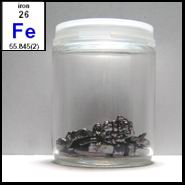
Pure iron displays lustrous metallic appearance with characteristic grayish tinge, developing mirror-like silvery-gray surface when freshly polished. At ambient conditions, iron adopts body-centered cubic (α-iron) crystal structure with lattice parameter 2.866 Å. Thermal expansion induces polymorphic transitions: γ-iron (face-centered cubic) stable between 912-1394°C, followed by δ-iron (body-centered cubic) until melting at 1538°C. High-pressure conditions produce ε-iron with hexagonal close-packed structure. Density varies with temperature and phase, measuring 7.874 g/cm³ at 20°C for α-iron. Melting point occurs at 1538°C (1811 K), while boiling point reaches approximately 2862°C (3134 K). Heat of fusion equals 13.81 kJ/mol, and heat of vaporization measures 340 kJ/mol. Specific heat capacity registers 0.449 J/(g·K) at standard conditions, reflecting thermal energy distribution among atomic vibrations and electronic excitations.
Chemical Properties and Reactivity
Electronic Structure and Bonding Behavior
Iron's 3d⁶ 4s² electronic configuration enables extensive oxidation state variability, ranging from -4 in certain carbonyl complexes to +7 in specialized oxidizing conditions. Common oxidation states +2 and +3 predominate in aqueous chemistry, with Fe²⁺ (ferrous) and Fe³⁺ (ferric) ions exhibiting distinct coordination preferences and redox behavior. High-spin and low-spin configurations depend on ligand field strength, creating variable magnetic moments and spectroscopic properties. Iron forms both ionic and covalent bonds depending on coordination environment, with metallic bonding dominating in pure metal through delocalized d-electrons. Coordination numbers typically range from 4 to 6, with octahedral and tetrahedral geometries most common. Bond energies vary significantly with oxidation state and ligand type, affecting complex stability and reaction kinetics.
Electrochemical and Thermodynamic Properties
Electronegativity values position iron at 1.83 on the Pauling scale, indicating moderate electron-attracting capability typical of transition metals. Successive ionization energies demonstrate electronic shell effects: first ionization (762.5 kJ/mol), second ionization (1561.9 kJ/mol), with dramatic increases upon d-orbital disruption. Standard reduction potential for Fe³⁺/Fe²⁺ couple equals +0.771 V versus standard hydrogen electrode, while Fe²⁺/Fe registers -0.447 V, establishing iron's position in electrochemical series. These potentials govern redox reactions in aqueous media and determine corrosion behavior. Thermodynamic stability varies among iron compounds, with oxides displaying particularly favorable formation energies. Electron affinity remains minimal at 15.7 kJ/mol, consistent with metallic character and tendency toward cation formation rather than anion acceptance.
Chemical Compounds and Complex Formation
Binary and Ternary Compounds
Iron forms extensive binary compound series with most elements across the periodic table. Oxides constitute the most significant class: FeO (wüstite), Fe₂O₃ (hematite), and Fe₃O₄ (magnetite) represent major phases with distinct crystal structures and magnetic properties. Magnetite exhibits inverse spinel structure with mixed oxidation states, creating unique electronic conductivity. Halides include FeCl₂, FeCl₃, FeBr₂, and corresponding iodides, each displaying characteristic colors and coordination geometries. Sulfides encompass FeS (pyrrhotite) and FeS₂ (pyrite), important in mineral systems and industrial processes. Ternary compounds include sulfates like FeSO₄·7H₂O (green vitriol) and complex oxides with technological applications in catalysis and electronics.
Coordination Chemistry and Organometallic Compounds
Iron demonstrates remarkable coordination chemistry diversity, forming complexes with virtually all ligand types. Hexacyanoferrate complexes [Fe(CN)₆]³⁻ and [Fe(CN)₆]⁴⁻ exhibit exceptional stability through strong π-backbonding interactions. Biological coordination includes heme complexes where iron coordinates with porphyrin ligands in hemoglobin and cytochrome systems. Organometallic chemistry features ferrocene Fe(C₅H₅)₂ as prototypical sandwich compound, demonstrating 18-electron rule compliance and aromatic character. Iron carbonyls Fe(CO)₅ and Fe₂(CO)₉ showcase π-acceptor ligand coordination with significant industrial catalytic applications. Coordination geometries span tetrahedral, square planar, trigonal bipyramidal, and octahedral arrangements depending on electronic requirements and steric considerations.
Natural Occurrence and Isotopic Analysis
Geochemical Distribution and Abundance
Iron constitutes approximately 5.63% of Earth's crust by weight, representing the fourth most abundant crustal element after oxygen, silicon, and aluminum. Geochemical distribution reflects preferential concentration in mafic and ultramafic rocks, where iron occurs primarily as ferrous silicates and oxides. Major iron ore deposits include banded iron formations containing hematite and magnetite, lateritic deposits with goethite and limonite, and hydrothermal systems producing various iron minerals. Crustal abundance reaches ~50,000 ppm, while seawater contains approximately 3.4 μg/L dissolved iron species. Geochemical cycling involves weathering, transport, and precipitation processes controlled by pH, redox potential, and complexation equilibria. Iron accumulation mechanisms include hydrothermal deposition, sedimentary concentration, and metamorphic redistribution, creating diverse ore types across geological environments.
Nuclear Properties and Isotopic Composition
Natural iron comprises four stable isotopes with distinct nuclear characteristics and abundance patterns. ⁵⁶Fe dominates at 91.754% natural abundance, representing the nuclear binding energy maximum and stellar nucleosynthesis endpoint. ⁵⁴Fe accounts for 5.845%, while ⁵⁷Fe at 2.119% provides the only isotope with nuclear spin I = 1/2, enabling NMR spectroscopic applications. ⁵⁸Fe constitutes 0.282% of natural iron. Twenty-four artificial isotopes have been synthesized, ranging from ⁴⁵Fe to ⁷²Fe with varying half-lives and decay modes. ⁶⁰Fe, an extinct radionuclide with 2.6-million-year half-life, served as chronometer for early solar system processes and meteorite dating. Nuclear cross-sections vary among isotopes, affecting neutron absorption behavior in reactor applications and astrophysical processes.
Industrial Production and Technological Applications
Extraction and Purification Methodologies
Industrial iron production centers on blast furnace reduction of iron oxides using carbon-based reducing agents. The process operates at temperatures exceeding 1500°C, enabling reduction reactions: Fe₂O₃ + 3CO → 2Fe + 3CO₂ and FeO + CO → Fe + CO₂. Direct reduction methods employ natural gas or hydrogen as alternatives to traditional coke reduction. Raw materials include iron ore (hematite, magnetite), limestone flux, and coke or alternative reductants. Thermodynamic considerations govern reduction efficiency, requiring careful temperature and gas composition control. Modern smelting produces over 1.8 billion tons annually, making iron the most produced metal globally. Purification involves removing silicon, phosphorus, sulfur, and other impurities through controlled oxidation and slag formation. Electric arc furnace technology enables scrap steel recycling, representing approximately 30% of steel production through secondary metallurgy processes.
Technological Applications and Future Prospects
Iron's technological significance stems from its transformation into steel through controlled carbon addition and thermal treatment. Carbon content determines mechanical properties: low-carbon steels provide ductility for construction applications, while high-carbon varieties offer hardness for cutting tools and machinery. Alloying elements including chromium, nickel, molybdenum, and vanadium create specialized steels with enhanced corrosion resistance, strength, and temperature stability. Stainless steel contains minimum 10.5% chromium, forming protective oxide layers preventing atmospheric corrosion. Cast iron applications exploit high carbon content for casting complex shapes with excellent machinability. Magnetic applications utilize iron's ferromagnetic properties in transformers, electric motors, and magnetic recording systems. Catalytic applications employ iron in Haber-Bosch ammonia synthesis and Fischer-Tropsch hydrocarbon production. Emerging technologies investigate iron-based superconductors, advanced high-strength steels, and novel magnetic materials for quantum computing applications.
Historical Development and Discovery
Iron utilization predates recorded history, with meteoritic iron artifacts dating before 5000 BCE providing earliest evidence of human interaction with metallic iron. Native terrestrial iron occurs rarely, necessitating smelting technology development for widespread use. Archaeological evidence indicates iron smelting emerged independently across multiple civilizations around 2000-1500 BCE, marking transition from Bronze Age to Iron Age. Chinese civilization achieved cast iron production by 5th century BCE through advanced furnace technology capable of reaching melting temperatures. European iron technology developed through bloomery furnaces producing wrought iron, eventually advancing to blast furnace designs enabling liquid iron production. Medieval period witnessed significant metallurgical advances including water-powered bellows and improved ore preparation techniques. Industrial Revolution catalyzed mass production methods, with Henry Bessemer's 1856 steel-making process revolutionizing iron processing efficiency. Modern understanding developed through 19th and 20th-century research into phase diagrams, crystal structures, and electronic properties, establishing theoretical foundations for contemporary alloy design and processing optimization.
Conclusion
Iron's unique position in the periodic table stems from its optimal nuclear stability, diverse oxidation chemistry, and exceptional technological versatility. The element's fundamental role in stellar nucleosynthesis, biological systems, and human civilization underscores its chemical significance beyond mere abundance. Future research directions encompass advanced steel metallurgy, iron-based superconductor development, and sustainable production methodologies addressing environmental concerns. Understanding iron's electronic structure, phase behavior, and coordination chemistry continues driving innovations in materials science, catalysis, and nanotechnology applications that will shape technological advancement in the decades ahead.

Please let us know how we can improve this web app.
