Printed from https://www.webqc.org

Lead @ Periodic Table of Chemical Elements

12345678 910111213141516 1718
IIIIIIbIVb VbVIbVIIbVIIIbIb IIbIIIIVVVI VIIVIII
1H
1.0079
2He
4.0026
3Li
6.9412
4Be
9.0121
5B
10.811
6C
12.010
7N
14.006
8O
15.999
9F
18.998
10Ne
20.179
11Na
22.989
12Mg
24.305
13Al
26.981
14Si
28.085
15P
30.973
16S
32.065
17Cl
35.453
18Ar
39.948
19K
39.098
20Ca
40.078
21Sc
44.955
22Ti
47.867
23V
50.941
24Cr
51.996
25Mn
54.938
26Fe
55.845
27Co
58.933
28Ni
58.693
29Cu
63.546
30Zn
65.409
31Ga
69.723
32Ge
72.641
33As
74.921
34Se
78.963
35Br
79.904
36Kr
83.798
37Rb
85.467
38Sr
87.621
39Y
88.905
40Zr
91.224
41Nb
92.906
42Mo
95.942
43Tc
98.906
44Ru
101.07
45Rh
102.90
46Pd
106.42
47Ag
107.86
48Cd
112.41
49In
114.81
50Sn
118.71
51Sb
121.76
52Te
127.60
53I
126.90
54Xe
131.29
55Cs
132.90
56Ba
137.32
57La
138.90
72Hf
178.49
73Ta
180.94
74W
183.84
75Re
186.20
76Os
190.23
77Ir
192.21
78Pt
195.08
79Au
196.96
80Hg
200.59
81Tl
204.38
82Pb
207.21
83Bi
208.98
84Po
208.98
85At
209.98
86Rn
222.01
87Fr
223.01
88Ra
226.02
89Ac
227.02
104Rf
261.10
105Db
262.11
106Sg
266.12
107Bh
264.12
108Hs
269
109Mt
278
110Ds
281
111Rg
282
112Cn
285
113Nh
286
114Fl
289
115Mc
290
116Lv
293
117Ts
294
118Og
294
Lanthanoids58Ce
140.11
59Pr
140.90
60Nd
144.24
61Pm
146.91
62Sm
150.36
63Eu
151.96
64Gd
157.25
65Tb
158.92
66Dy
162.50
67Ho
164.93
68Er
167.25
69Tm
168.93
70Yb
173.04
71Lu
174.96
Actinoids90Th
232.03
91Pa
231.03
92U
238.02
93Np
237.04
94Pu
244.06
95Am
243.06
96Cm
247.07
97Bk
247.07
98Cf
251.07
99Es
252.08
100Fm
257.09
101Md
258.09
102No
259.10
103Lr
260.10
Alkali metals Alkali earth metals Transition metals Other metals Metaloids Non-metals Halogens Noble gases
Element

82

Pb

Lead

207.21

2
8
18
32
18
4
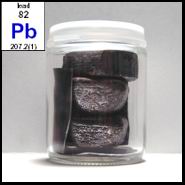
Lead photo
Basic properties
Atomic number82
Atomic weight207.21 amu
Element familyOther metals
Period6
Group14
Blockp-block
Discovery year7000 BC
Isotope distribution
206Pb
24.1%
207Pb
22.1%
208Pb
54.4%
206Pb: 23.96%207Pb: 21.97%208Pb: 54.08%
206Pb (23.96%)
207Pb (21.97%)
208Pb (54.08%)
Physical properties
Density 11.342 g/cm3 (STP)
Atomic hydrogen (H) 8.988E-5
Meitnerium (Mt) 28
Melting327.6 °C
Helium (He) -272.2
Carbon (C) 3675
Boiling1740 °C
Helium (He) -268.9
Tungsten (W) 5927
Chemical properties
Oxidation states
(less common)
+2, +4
(-4, -2, -1, 0, +1, +3)
First ionization potential 7.416 eV
Cesium (Cs) 3.894
Helium (He) 24.587
Electron affinity 0.357 eV
Nobelium (No) -2.33
Atomic chlorine (Cl) 3.612725
Electronegativity2.33
Cesium (Cs) 0.79
Atomic fluorine (F) 3.98
Atomic radius
Covalent radius 1.44 Å
Atomic hydrogen (H) 0.32
Francium (Fr) 2.6
Van der Waals radius 2.02 Å
Atomic hydrogen (H) 1.2
Francium (Fr) 3.48
82PbWebQC.OrgCovalentVan der Waals
Compounds
FormulaNameOxidation state
Pb(NO3)2Lead(II) nitrate+2
PbSO4Lead(II) sulfate+2
PbOLead(II) oxide+2
PbCl2Lead(II) chloride+2
PbI2Lead(II) iodide+2
PbSLead(II) sulfide+2
Pb3O4Lead(II,IV) oxide+2,+4
PbO2Lead(IV) oxide+4
Pb(C2H3O2)4Lead(IV) acetate+4
PbCl4Lead(IV) chloride+4
PbF4Lead tetrafluoride+4
PbH4Plumbane+4
Electronic properties
Electrons per shell2, 8, 18, 32, 18, 4
Electronic configuration[Xe] 4f145d106s26p2
Bohr atom model
Bohr atom model
Orbital box diagram
Orbital box diagram
Valence electrons4
Lewis dot structure Lead Lewis dot structure
Orbital Visualization
🏠
▶️
📐
Electrons-

Lead (Pb): Periodic Table Element

Scientific Review Article | Chemistry Reference Series

Abstract

Lead (atomic symbol Pb, atomic number 82) constitutes a heavy post-transition metal characterized by exceptional malleability, high density (11.34 g/cm³), and distinctive chemical inertness arising from relativistic effects. The element exhibits a face-centered cubic crystal structure and manifests predominantly +2 oxidation states due to the inert pair effect of 6s electrons. Lead demonstrates superconducting behavior below 7.19 K and serves as the terminal decay product for three major natural radioactive decay series. With a standard atomic weight of 207.2 ± 1.1 u, lead ranks among the most abundant heavy elements in Earth's crust at 14 ppm concentration. Industrial applications encompass lead-acid batteries, radiation shielding, and specialized alloys, though environmental regulations have restricted many traditional uses due to established neurotoxicity.

Introduction

Lead occupies position 82 in the periodic table, representing the heaviest stable element and terminating Group 14 of the post-transition metals. The element's chemical behavior reflects significant relativistic quantum mechanical effects that stabilize the 6s² electron pair, fundamentally altering its bonding characteristics compared to lighter congeners. This phenomenon, termed the inert pair effect, predominates in lead's chemistry and distinguishes its behavior from carbon, silicon, germanium, and tin. Lead's nuclear structure encompasses four stable isotopes that serve as endpoints for the uranium-thorium decay series, conferring unique radiochemical significance. Archaeological evidence demonstrates continuous human utilization spanning over 9,000 years, from ancient metallic beads in Anatolia to sophisticated Roman plumbing systems that established the etymological foundation for modern "plumbing" terminology. Contemporary understanding of lead's toxicological profile has necessitated comprehensive regulatory frameworks governing environmental exposure and industrial applications.

Physical Properties and Atomic Structure

Fundamental Atomic Parameters

Lead exhibits an electron configuration of [Xe]4f¹⁴5d¹⁰6s²6p², placing two electrons in the outermost 6p orbital beyond the filled 6s shell. The effective nuclear charge experienced by valence electrons reaches approximately 4.7, substantially attenuated by inner shell shielding effects. Atomic radius measures 175 pm for neutral lead atoms, while ionic radii span 119 pm for Pb²⁺ and 84 pm for Pb⁴⁺ ions. The substantial contraction observed for Pb⁴⁺ reflects the removal of all valence electrons and increased nuclear attraction. Relativistic stabilization of the 6s orbital creates an energy gap of approximately 2.7 eV between 6s and 6p levels, significantly exceeding analogous separations in lighter Group 14 elements. This relativistic contraction influences chemical reactivity and accounts for lead's preference for lower oxidation states.

Macroscopic Physical Characteristics

Lead demonstrates metallic gray coloration with distinctive blue-white luster when freshly exposed surfaces contact atmospheric moisture. The metal adopts face-centered cubic crystal structure (Fm3m space group) with lattice parameter a = 495.1 pm at standard conditions. Density reaches 11.34 g/cm³ at 20°C, placing lead among the most dense common metals. Thermal properties include melting point 327.5°C, boiling point 1,749°C, heat of fusion 4.77 kJ/mol, and heat of vaporization 179.4 kJ/mol. Specific heat capacity equals 0.129 J/(g·K) at room temperature. Mechanical properties reveal exceptional softness with Mohs hardness 1.5, enabling deformation by fingernail pressure. Tensile strength ranges 12-17 MPa with bulk modulus 45.8 GPa, reflecting high compressibility. Electrical resistivity measures 192 nΩ·m at 20°C, while thermal conductivity reaches 35.3 W/(m·K). Lead exhibits superconducting behavior below critical temperature 7.19 K, representing the highest transition temperature among type-I superconductors.

Chemical Properties and Reactivity

Electronic Structure and Bonding Behavior

Lead's chemical reactivity centers on the inert pair effect, wherein 6s electrons exhibit reluctance to participate in chemical bonding due to relativistic stabilization. This phenomenon favors +2 oxidation states over +4 states observed in lighter Group 14 analogues. Standard reduction potentials demonstrate Pb²⁺/Pb = -0.13 V and PbO₂/Pb²⁺ = +1.46 V, indicating thermodynamic stability of divalent lead compounds. Bond formation predominantly involves p-orbital electrons, generating covalent interactions with significant ionic character. Lead-oxygen bonds typically measure 210-240 pm depending on coordination environment and oxidation state. The element forms stable coordination complexes with coordination numbers ranging from 2 to 10, though 6-coordinate octahedral geometry predominates. Electronegativity values reach 1.87 (Pauling scale) for Pb²⁺ and 2.33 for Pb⁴⁺, reflecting increased positive charge density in higher oxidation states.

Electrochemical and Thermodynamic Properties

Lead demonstrates amphoteric behavior, dissolving in both acidic and basic media through distinct mechanisms. In acidic conditions, lead forms Pb²⁺ cations, while alkaline environments generate plumbite anions Pb(OH)₃⁻ or plumbate species PbO₃²⁻. Successive ionization energies measure 715.6 kJ/mol (first) and 1,450.5 kJ/mol (second), with dramatically increased values for third and fourth ionizations at 3,081.5 kJ/mol and 4,083 kJ/mol respectively. Electron affinity reaches 35.1 kJ/mol, indicating moderate tendency for electron capture. The element exhibits passivation behavior in atmospheric exposure, forming protective oxide and carbonate surface layers that inhibit further corrosion. Standard electrode potentials for various lead couples span -0.36 V (PbSO₄/Pb) to +1.69 V (PbO₂/PbO), encompassing broad electrochemical applications in battery technologies.

Chemical Compounds and Complex Formation

Binary and Ternary Compounds

Lead forms extensive binary compounds across multiple chemical systems. Primary oxides include lead(II) oxide (PbO) existing in yellow litharge and red massicot polymorphs, and lead(IV) oxide (PbO₂) demonstrating brown-black coloration and significant oxidizing properties. Mixed-valence compounds such as red lead (Pb₃O₄) contain both Pb²⁺ and Pb⁴⁺ centers in 2:1 stoichiometric ratios. Halide chemistry encompasses all four standard halides: colorless PbF₂, white PbCl₂, bright yellow PbI₂, and orange-red PbBr₂. Lead sulfide (PbS) constitutes the principal ore mineral galena, adopting rock salt crystal structure with exceptional thermal stability. Carbonate chemistry produces white cerussite (PbCO₃) through atmospheric weathering processes. Ternary compounds include sulfate minerals anglesite (PbSO₄), phosphate pyromorphite series Pb₅(PO₄)₃X (X = Cl, Br, F), and complex arsenates such as mimetite Pb₅(AsO₄)₃Cl. Industrial ternary phases encompass lead zirconate titanate ceramics PbZr₁₋ₓTiₓO₃ demonstrating piezoelectric properties.

Coordination Chemistry and Organometallic Compounds

Lead coordination chemistry spans diverse ligand types and coordination geometries reflecting the stereochemically active 6s² lone pair. Common coordination numbers range from 3 to 10, with 6-coordinate octahedral arrangements predominating in aqueous systems. Chelating ligands such as ethylenediaminetetraacetic acid (EDTA) form thermodynamically stable complexes utilized in lead poisoning treatment. Crown ether complexes demonstrate selectivity for Pb²⁺ ions in analytical applications. Organometallic lead chemistry historically centered on tetraethyllead Pb(C₂H₅)₄, employed as antiknock gasoline additive until environmental concerns mandated phase-out by 2000. Lead-carbon bond energies average 130-150 kJ/mol, substantially weaker than analogous tin compounds due to relativistic destabilization. Contemporary organolead research focuses on academic investigations rather than commercial applications. Cluster compounds such as [Pb₆]⁴⁻ Zintl anions demonstrate naked metal frameworks stabilized by electronic delocalization in polar intermetallic phases.

Natural Occurrence and Isotopic Analysis

Geochemical Distribution and Abundance

Lead ranks 36th in crustal abundance at 14 ppm concentration, classifying as a moderately abundant trace element. Geochemical behavior characterizes lead as a chalcophile element with strong affinity for sulfur-bearing minerals. Primary occurrence involves sulfide ores, particularly galena (PbS), which frequently contains silver, copper, zinc, and other trace metals as substitutional impurities. Secondary minerals form through oxidative weathering of primary sulfides, generating anglesite (PbSO₄), cerussite (PbCO₃), and pyromorphite group phosphates. Hydrothermal ore deposits constitute principal lead concentrations, associated with intermediate- to high-temperature mineralization processes. Sedimentary lead accumulations occur in evaporite sequences and sediment-hosted base metal deposits. Modern anthropogenic lead distribution significantly exceeds natural background concentrations due to historical mining, smelting, and fossil fuel combustion activities. Oceanic lead concentrations average 0.03 μg/L, while continental surface waters typically contain 0.1-10 μg/L depending on geological and anthropogenic influences.

Nuclear Properties and Isotopic Composition

Lead encompasses four stable isotopes: ²⁰⁴Pb (1.4% abundance), ²⁰⁶Pb (24.1%), ²⁰⁷Pb (22.1%), and ²⁰⁸Pb (52.4%). Isotope ²⁰⁴Pb represents primordial lead formed during stellar nucleosynthesis, while ²⁰⁶Pb, ²⁰⁷Pb, and ²⁰⁸Pb constitute radiogenic products of uranium-238, uranium-235, and thorium-232 decay series respectively. Lead-208 contains 126 neutrons, corresponding to a nuclear magic number that confers extraordinary stability as the heaviest stable nuclide. Nuclear binding energy per nucleon reaches 7.87 MeV for ²⁰⁸Pb, reflecting optimal nuclear stability. Radioactive isotopes span mass numbers 178-220, with lead-205 demonstrating greatest stability among artificial isotopes (half-life ~17 million years). Neutron capture cross-sections measure 0.17 barns for ²⁰⁴Pb and 0.03 barns for ²⁰⁸Pb, indicating low probability for thermal neutron interactions. Nuclear magnetic resonance active isotope ²⁰⁷Pb exhibits nuclear spin I = 1/2 and magnetic moment -0.59 nuclear magnetons, enabling structural investigations through NMR spectroscopy.

Industrial Production and Technological Applications

Extraction and Purification Methodologies

Primary lead production utilizes pyrometallurgical reduction of sulfide concentrates through roasting and smelting operations. Initial roasting converts galena to lead oxide and sulfur dioxide at temperatures 500-600°C according to the reaction: PbS + O₂ → PbO + SO₂. Subsequent reduction employs carbon-based reducing agents in blast furnace operations at 900-1000°C: PbO + C → Pb + CO. Alternative direct smelting processes utilize oxygen-enriched environments to simultaneously roast and reduce sulfide ores in single-stage operations. Secondary lead production accounts for approximately 60% of global supply through recycling of lead-acid batteries and other lead-containing materials. Purification techniques include pyrometallurgical refining through selective oxidation of impurities such as copper, tin, arsenic, and antimony. Electrolytic refining achieves high-purity lead (99.99%) through controlled electrodeposition from fluorosilicate electrolytes. Annual global production exceeds 10 million tonnes, with China, Australia, and the United States representing primary producing regions.

Technological Applications and Future Prospects

Contemporary lead applications center primarily on lead-acid battery technology, consuming approximately 85% of global lead production. These electrochemical systems utilize lead dioxide cathodes, metallic lead anodes, and sulfuric acid electrolytes to generate 2.1 V cell potentials through reversible reactions: Pb + PbO₂ + 2H₂SO₄ ⇌ 2PbSO₄ + 2H₂O. Radiation shielding applications exploit lead's high atomic number and density for attenuation of gamma radiation and X-rays in medical, nuclear, and industrial facilities. Construction applications include roofing materials, flashing, and sound dampening installations where durability and malleability provide advantages. Specialized alloys incorporate lead for fusible applications, type metal, and ammunition manufacturing. Emerging technologies investigate lead-based perovskite materials for photovoltaic applications, though stability and toxicity concerns limit commercial viability. Future prospects emphasize recycling optimization, alternative battery chemistries development, and environmental remediation technologies addressing legacy lead contamination. Regulatory frameworks continue restricting lead applications while promoting safer alternatives across consumer and industrial sectors.

Historical Development and Discovery

Lead represents one of humanity's earliest known metals, with archaeological evidence documenting utilization spanning 9,000 years. Earliest metallic lead artifacts include beads discovered in Çatalhöyük, Anatolia, dating to 7000-6500 BCE, suggesting initial extraction from galena ores through primitive smelting techniques. Ancient Egyptian civilizations employed lead for fishing weights, pottery glazes, and cosmetic applications including kohl eye makeup containing galena. Mesopotamian cultures developed lead-silver cupellation processes for precious metal refining by 3000 BCE. Greek and Roman civilizations established extensive lead metallurgy, with annual Roman production reaching 80,000 tonnes during peak periods. Roman engineering innovations included lead pipe plumbing systems, solder applications, and architectural components, establishing the etymological connection between "plumbum" and "plumbing." Medieval European alchemists investigated lead transmutation theories within early chemical frameworks. Industrial Revolution developments enhanced production through improved furnace designs and mechanized mining operations. Scientific understanding advanced through systematic chemical investigations during the 18th and 19th centuries, culminating in atomic theory applications and toxicological recognition. Modern comprehension integrates relativistic quantum mechanics, nuclear chemistry, and environmental science to address lead's complex chemical behavior and biological interactions.

Conclusion

Lead occupies a unique position as the heaviest stable element, demonstrating distinctive chemical behavior arising from relativistic electronic effects that fundamentally distinguish it from lighter Group 14 congeners. The inert pair effect governs lead's predominant +2 oxidation state chemistry, while nuclear properties establish its role as the terminal product of major radioactive decay series. Industrial significance persists primarily through lead-acid battery applications and specialized uses requiring high density or radiation shielding properties. However, well-documented neurotoxicity has prompted comprehensive regulatory restrictions on environmental exposure and consumer applications. Future research directions encompass sustainable recycling technologies, environmental remediation strategies, and investigation of lead-based materials for emerging energy applications. Understanding lead's multifaceted chemistry requires integration of relativistic quantum mechanics, coordination chemistry, and environmental science principles that continue to evolve with advancing theoretical and experimental capabilities.

Periodict table
Please let us know how we can improve this web app.

Menu Balance Molar mass Gas laws Units Chemistry tools Periodic table Chemical forum Symmetry Constants Contribute Contact us
How to cite?