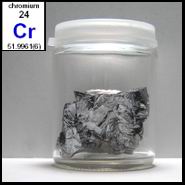
| Element | |
|---|---|
24CrChromium51.996162
8 13 1 |
|
| Basic properties | |
|---|---|
| Atomic number | 24 |
| Atomic weight | 51.99616 amu |
| Element family | Transition metals |
| Period | 4 |
| Group | 1 |
| Block | s-block |
| Discovery year | 1794 |
| Isotope distribution |
|---|
52Cr 83.79% 53Cr 9.50% 54Cr 2.36% |
52Cr (87.60%) 53Cr (9.93%) 54Cr (2.47%) |
| Physical properties | |
|---|---|
| Density | 7.15 g/cm3 (STP) |
Atomic hydrogen (H) 8.988E-5 Meitnerium (Mt) 28 | |
| Melting | 1857 °C |
Helium (He) -272.2 Carbon (C) 3675 | |
| Boiling | 2482 °C |
Helium (He) -268.9 Tungsten (W) 5927 | |
| Chemical properties | |
|---|---|
| Oxidation states (less common) | +3, +6 (-4, -2, -1, 0, +1, +2, +4, +5) |
| First ionization potential | 6.767 eV |
Cesium (Cs) 3.894 Helium (He) 24.587 | |
| Electron affinity | 0.676 eV |
Nobelium (No) -2.33 Atomic chlorine (Cl) 3.612725 | |
| Electronegativity | 1.66 |
Cesium (Cs) 0.79 Atomic fluorine (F) 3.98 | |
| Atomic radius | |
|---|---|
| Covalent radius | 1.22 Å |
Atomic hydrogen (H) 0.32 Francium (Fr) 2.6 | |
| Metallic radius | 1.28 Å |
Beryllium (Be) 1.12 Cesium (Cs) 2.65 | |
| Compounds | ||
|---|---|---|
| Formula | Name | Oxidation state |
| CrH | Chromium(I) hydride | +1 |
| CrCl2 | Chromium(II) chloride | +2 |
| Cr3C2 | Chromium(II) carbide | +2 |
| CrBr2 | Chromium(II) bromide | +2 |
| Cr2O3 | Chromium(III) oxide | +3 |
| CrCl3 | Chromium(III) chloride | +3 |
| CrPO4 | Chromium(III) phosphate | +3 |
| CrO2 | Chromium(IV) oxide | +4 |
| CrCl4 | Chromium(IV) chloride | +4 |
| CrF5 | Chromium pentafluoride | +5 |
| K2Cr2O7 | Potassium dichromate | +6 |
| K2CrO4 | Potassium chromate | +6 |
| Electronic properties | |
|---|---|
| Electrons per shell | 2, 8, 13, 1 |
| Electronic configuration | [Ar] 3d5 |
|
Bohr atom model
| |
|
Orbital box diagram
| |
| Valence electrons | 6 |
| Lewis dot structure |
|
| Orbital Visualization | |
|---|---|
|
| |
| Electrons | - |
Chromium (Cr): Periodic Table Element
Abstract
Chromium exhibits exceptional properties that establish its significance in modern metallurgy and chemistry. This steely-grey transition metal demonstrates unique antiferromagnetic behavior at room temperature, exceptional corrosion resistance through self-passivation, and remarkable hardness ranking third after diamond and boron. The element's distinctive electronic configuration [Ar] 3d⁵ 4s¹ violates the Aufbau principle, contributing to its unusual magnetic and optical characteristics. Chromium manifests primarily in +3 and +6 oxidation states, forming intensely colored compounds that inspired its Greek etymology meaning "color." Industrial applications center on stainless steel production and decorative chrome plating, which together constitute 85% of commercial usage. The element's high reflectance properties, reaching 90% in infrared wavelengths, combined with superior corrosion resistance, make chromium indispensable in protective coating technologies and optical applications.
Introduction
Chromium occupies position 24 in the periodic table as the inaugural member of group 6, distinguished by its exceptional combination of mechanical, optical, and chemical properties. The element's electronic structure [Ar] 3d⁵ 4s¹ represents the first deviation from the Aufbau principle in the transition series, establishing fundamental differences in bonding characteristics compared to preceding elements. This unique configuration contributes directly to chromium's remarkable resistance to oxidation and its distinctive magnetic behavior. Louis Nicolas Vauquelin's 1797 isolation of metallic chromium from crocoite ore marked the beginning of systematic investigation into the element's properties and applications. Modern understanding reveals chromium's critical role in metallurgical advances, particularly the development of stainless steel alloys that revolutionized industrial corrosion resistance. The element's significance extends beyond conventional applications to encompass advanced technologies including high-performance magnetic media, precision optical coatings, and specialized chemical processes where chromium's unique properties prove irreplaceable.
Physical Properties and Atomic Structure
Fundamental Atomic Parameters
Chromium's atomic structure centers on its nuclear composition of 24 protons with an atomic mass of 51.9961 ± 0.0006 u. The electron configuration [Ar] 3d⁵ 4s¹ deviates from the expected [Ar] 3d⁴ 4s² pattern, reflecting increased stability gained through half-filled d-orbital occupancy. This configuration results in a particularly stable d⁵ arrangement that influences the element's chemical behavior across multiple oxidation states. The atomic radius measures approximately 128 pm, with ionic radii varying significantly based on oxidation state and coordination environment. In the +3 oxidation state, chromium exhibits an ionic radius of 62 pm in octahedral coordination, while the +6 state shows substantially reduced ionic character due to extensive covalent bonding. The effective nuclear charge experienced by valence electrons increases progressively across the first transition series, with chromium demonstrating enhanced nuclear attraction that contributes to its compact atomic structure and high ionization energies.
Macroscopic Physical Characteristics
Chromium crystallizes in a body-centered cubic structure with lattice parameter a = 2.885 Å at room temperature. The element presents as a lustrous, steely-grey metal characterized by exceptional hardness approaching that of certain ceramics. Its Mohs hardness of 8.5 places chromium among the hardest metals, exceeded only by diamond and boron among pure elements. Vickers hardness measurements yield 950 HV, confirming chromium's resistance to plastic deformation. The melting point of 1907°C positions chromium as the second-highest melting element in Period 4, following vanadium by merely 3°C. The boiling point of 2671°C reflects relatively weaker metallic bonding compared to early transition metals, attributed to the beginning of d-electron localization. Density measurements yield 7.19 g/cm³, consistent with the progressive increase across the first transition series. Electrical resistivity of 125 nΩ·m at 20°C indicates moderate electrical conductivity, influenced by the element's magnetic structure and d-electron behavior.
Chemical Properties and Reactivity
Electronic Structure and Bonding Behavior
The d⁵ configuration of chromium creates distinctive bonding patterns characterized by variable coordination geometries and multiple accessible oxidation states. Chromium readily forms octahedral complexes in the +3 state, utilizing d²sp³ hybridization that accommodates six ligands in highly stable arrangements. The +6 oxidation state involves extensive π-bonding through d-orbital overlap with oxygen atoms, resulting in tetrahedral coordination in oxoanions like chromate (CrO₄²⁻) and dichromate (Cr₂O₇²⁻). Bond lengths in chromium compounds vary systematically with oxidation state: Cr-O bonds range from 1.99 Å in Cr₂O₃ to 1.65 Å in CrO₃, reflecting increased electrostatic attraction with higher formal charges. The +2 oxidation state demonstrates unusual Cr-Cr quadruple bonding in compounds like chromium(II) acetate, where the bond length of 2.36 Å represents one of the shortest metal-metal distances known. Coordination numbers span from 4 to 9, with 6-coordinate octahedral geometry predominating in aqueous chemistry.
Electrochemical and Thermodynamic Properties
Chromium's electrochemical behavior reflects the stability relationships among its various oxidation states. The standard reduction potential for Cr³⁺/Cr equals -0.744 V, indicating moderate reducing character for the metal itself. The Cr₂O₇²⁻/Cr³⁺ couple exhibits a potential of +1.33 V in acidic solution, establishing dichromate as a powerful oxidizing agent widely employed in analytical chemistry. Successive ionization energies reveal the progressive stabilization of d-electrons: first ionization requires 653.9 kJ/mol, second ionization 1590.6 kJ/mol, third ionization 2987 kJ/mol, and fourth ionization 4743 kJ/mol. The dramatic increase between third and fourth ionization energies reflects removal of electrons from the stable d³ configuration. Electronegativity values on the Pauling scale measure 1.66, positioning chromium as moderately electronegative among transition metals. Thermodynamic data for chromium compounds show particularly stable Cr₂O₃ with formation enthalpy of -1139.7 kJ/mol, contributing to the element's exceptional corrosion resistance through oxide passivation.
Chemical Compounds and Complex Formation
Binary and Ternary Compounds
Chromium forms an extensive series of binary compounds spanning multiple oxidation states. The most thermodynamically stable oxide, chromium(III) oxide Cr₂O₃, crystallizes in the corundum structure with exceptional thermal and chemical stability. This compound serves as the basis for chromium's passivation behavior and finds applications as an abrasive and refractory material. Chromium(VI) oxide CrO₃ represents a powerful oxidizing agent employed in chromic acid solutions for metal surface treatment and organic oxidation reactions. Halide compounds demonstrate systematic trends: chromium(III) chloride CrCl₃ forms purple crystalline structures, while chromium(II) chloride CrCl₂ yields characteristic blue solutions with considerable air sensitivity. Binary sulfides include Cr₂S₃ and CrS, with the latter showing metallic conductivity due to extensive sulfur-chromium orbital overlap. Ternary compounds encompass industrially significant materials like ferrochromium alloys and ceramic systems containing chromium aluminate spinels. The compound K₂Cr₂O₇ (potassium dichromate) exhibits remarkable solubility characteristics and redox chemistry that established its historical importance in analytical methods.
Coordination Chemistry and Organometallic Compounds
Chromium demonstrates rich coordination chemistry across multiple oxidation states with varied ligand preferences. Octahedral Cr(III) complexes dominate aqueous chemistry, forming kinetically inert species that undergo substitution through dissociative mechanisms. The aqua complex [Cr(H₂O)₆]³⁺ exhibits characteristic green coloration and serves as a starting material for numerous synthetic pathways. Chromium(III) forms stable complexes with multidentate ligands including ethylenediaminetetraacetate (EDTA) and acetylacetonate, demonstrating high thermodynamic stability constants. Organometallic chemistry centers on low-valent species such as bis(benzene)chromium Cr(C₆H₆)₂ and chromium hexacarbonyl Cr(CO)₆, both showing significant π-backbonding character. The latter compound undergoes photochemical ligand substitution reactions that find application in organometallic synthesis. Chromium(0) complexes serve as precursors for homogeneous catalysis systems, particularly in olefin polymerization and organic transformations. Chromium(II) chemistry features distinctive Cr-Cr bonding motifs, exemplified by chromium(II) acetate where quadruple bonding creates unusually short metal-metal distances and unique magnetic properties.
Natural Occurrence and Isotopic Analysis
Geochemical Distribution and Abundance
Chromium ranks as the twenty-first most abundant element in Earth's crust with an average concentration of 100-300 ppm by mass. Geochemical behavior reflects chromium's strong affinity for oxygen and its tendency to substitute for aluminum in octahedral coordination sites within silicate minerals. Primary chromium minerals include chromite FeCr₂O₄, which accounts for virtually all commercial chromium extraction. This spinel-structure mineral demonstrates exceptional chemical and thermal stability, persisting through extensive weathering and metamorphic processes. Chromium concentration mechanisms operate through magmatic differentiation, where chromite crystallizes early from mafic and ultramafic melts. The largest economic deposits occur in stratiform complexes associated with large igneous provinces, particularly the Bushveld Complex in South Africa, which contains approximately 70% of world chromium reserves. Podiform chromite deposits form through different mechanisms involving serpentinization and metamorphic processes in ophiolite complexes. Sedimentary concentrations remain generally low due to chromium's relatively immobile nature under most surficial conditions, though some placer deposits contain economically significant chromite concentrations.
Nuclear Properties and Isotopic Composition
Natural chromium consists of four stable isotopes with precisely determined abundances. The dominant isotope ⁵²Cr comprises 83.789% of natural chromium, followed by ⁵³Cr at 9.501%, ⁵⁰Cr at 4.345%, and ⁵⁴Cr at 2.365%. The isotope ⁵⁰Cr exhibits observational stability despite theoretical capacity for double electron capture decay to ⁵⁰Ti with a half-life exceeding 1.3 × 10¹⁸ years. Nuclear spin states vary among isotopes: ⁵⁰Cr and ⁵²Cr show zero spin, while ⁵³Cr exhibits spin I = 3/2 with nuclear magnetic moment μ = -0.47454 nuclear magnetons. Twenty-five radioisotopes have been characterized, with ⁵¹Cr representing the most significant due to its 27.7-day half-life and application in biological tracer studies. This isotope decays through electron capture to ⁵¹V, emitting characteristic gamma radiation at 320 keV. Cosmochemical applications exploit the ⁵³Mn-⁵³Cr decay system with a 3.74-million-year half-life to date early Solar System events and constrain nucleosynthetic processes. Neutron capture cross-sections show ⁵⁰Cr as the most reactive isotope toward thermal neutrons, facilitating various nuclear chemistry applications.
Industrial Production and Technological Applications
Extraction and Purification Methodologies
Industrial chromium production begins with chromite ore processing through high-temperature metallurgical operations. The dominant process involves carbothermic reduction of chromite in electric arc furnaces at temperatures approaching 1700°C, producing ferrochromium alloys containing 50-70% chromium by mass. This aluminothermic reaction proceeds according to the stoichiometry: FeCr₂O₄ + 4C → Fe + 2Cr + 4CO, though industrial practice employs more complex charge compositions including silica fluxes and aluminum additions. Ferrochromium production efficiency approaches 85-90% chromium recovery, with energy requirements of approximately 3000-4000 kWh per ton of product. Pure chromium metal production requires additional processing through roasting and leaching operations that separate chromium from iron components. The Bayer process converts chromite to sodium chromate through fusion with sodium carbonate at 1000°C, followed by leaching and crystallization steps. Subsequent reduction employs aluminum powder in thermite-type reactions that achieve temperatures sufficient to produce metallic chromium with purities exceeding 99%. Electrowinning methods provide alternative pathways for high-purity chromium, utilizing chromic acid solutions with carefully controlled current densities and temperature conditions.
Technological Applications and Future Prospects
Stainless steel production represents chromium's predominant application, consuming approximately 70% of global chromium output through ferrochromium additions that confer corrosion resistance and mechanical strength. The minimum chromium content of 10.5% by mass defines stainless steel classifications, with higher chromium levels providing enhanced performance characteristics. Decorative and functional chrome plating utilizes electrochemical deposition from chromic acid solutions to create protective and aesthetic surface layers. Thin decorative coatings typically measure 0.25-0.50 μm thickness, while functional hard chrome deposits reach 25-500 μm for wear-resistant applications. Advanced technological applications exploit chromium's unique optical properties in thin-film coatings that achieve selective wavelength reflection and transmission. Chromium dioxide CrO₂ demonstrates ferrimagnetic properties essential for high-quality magnetic recording media, offering superior signal-to-noise ratios compared to conventional iron oxide formulations. Laser technology employs chromium-doped synthetic ruby crystals that generate coherent 694.3 nm radiation through Cr³⁺ electronic transitions. Emerging applications include chromium-based superalloys for aerospace applications where high-temperature oxidation resistance proves critical, and specialized catalytic systems that utilize chromium's multiple oxidation states for selective organic transformations.
Historical Development and Discovery
The discovery chronology of chromium began with Johann Gottlob Lehmann's 1761 identification of "Siberian red lead" from Ural Mountain specimens, later recognized as the mineral crocoite (PbCrO₄). Louis Nicolas Vauquelin's systematic investigation of this mineral in 1797 led to isolation of a new oxide that exhibited unusual chemical properties and intense coloration when combined with various acids and bases. Vauquelin's successful reduction of chromium trioxide using charcoal heating produced the first samples of metallic chromium, confirming the existence of a previously unknown element. The name "chromium" derives from the Greek word χρῶμα (chrōma) meaning color, reflecting the striking array of hues displayed by chromium compounds in different oxidation states. Early industrial development followed rapidly, with commercial chromite mining established in Baltimore County, Maryland by 1827. The understanding of chromium's corrosion-resistant properties evolved through systematic studies by Harry Brearley and others in the early 20th century, culminating in stainless steel development that transformed metallurgical practice. Electroplating applications emerged in the 1920s, driven by chromium's superior decorative appearance and protective qualities. Modern scientific understanding encompasses chromium's role in advanced materials science, including high-temperature alloys, specialized optical coatings, and precision chemical processes that continue expanding the element's technological significance.
Physical Properties and Atomic Structure
Fundamental Atomic Parameters
The atomic architecture of chromium centers on 24 protons and typically 28 neutrons in the most abundant ⁵²Cr isotope. Electronic configuration follows the pattern [Ar] 3d⁵ 4s¹, representing the first violation of the Aufbau principle in the periodic table. This arrangement achieves enhanced stability through half-filled d-orbital occupancy, which provides exchange energy stabilization exceeding the energy cost of 4s→3d promotion. The atomic radius of 128 pm reflects the progressive contraction across the first transition series due to increasing nuclear charge. Ionic radii demonstrate systematic variation with oxidation state: Cr²⁺ measures 84 pm, Cr³⁺ exhibits 62 pm in octahedral coordination, while Cr⁶⁺ essentially lacks distinct ionic character due to extensive covalent bonding in oxoanions. Effective nuclear charge calculations reveal Z_eff values of approximately 3.5 for 4s electrons and 4.9 for 3d electrons, accounting for differential shielding effects. The first ionization energy of 653.9 kJ/mol surpasses that of the preceding element vanadium, consistent with increased nuclear attraction and d-electron stabilization effects.
Macroscopic Physical Characteristics
Bulk chromium exhibits a distinctive combination of mechanical hardness and optical brilliance that distinguishes it among metallic elements. The body-centered cubic crystal structure maintains lattice parameters of a = 2.885 Å with space group Im3m at ambient conditions. No allotropic transformations occur under normal pressure and temperature ranges, contributing to chromium's structural reliability in engineering applications. Mechanical properties include a Mohs hardness of 8.5, positioning chromium as the third hardest pure element after diamond and boron. Vickers hardness measurements consistently yield values near 950 HV, reflecting the material's resistance to plastic deformation under applied loads. The melting point of 1907°C represents moderate thermal stability among transition metals, while the boiling point of 2671°C indicates relatively volatile behavior at extreme temperatures. Thermal expansion coefficients measure 4.9 × 10⁻⁶ K⁻¹ in the 0-100°C range, providing dimensional stability across moderate temperature variations. Specific heat capacity equals 0.449 J/(g·K) at room temperature, with thermal conductivity reaching 93.9 W/(m·K). Density measurements yield 7.19 g/cm³, consistent with close-packed metallic structure and high atomic mass.
Chemical Properties and Reactivity
Electronic Structure and Bonding Behavior
Chromium's chemical versatility stems from its ability to access multiple oxidation states through systematic d-electron removal or addition. The ground-state d⁵ configuration provides particular stability in the +3 oxidation state, where three electrons are removed to yield the half-filled d³ arrangement. This configuration exhibits strong crystal field stabilization in octahedral environments, accounting for the prevalence and kinetic inertness of Cr(III) complexes. The +6 oxidation state involves complete d-electron removal, creating highly electrophilic species that form covalent bonds with oxygen through π-orbital overlap. Intermediate oxidation states show varying stability: Cr(II) compounds rapidly oxidize in air due to the high-spin d⁴ configuration's instability, while Cr(IV) and Cr(V) remain stable only in specialized coordination environments. Bond formation patterns reflect systematic changes in orbital availability and electrostatic factors. Covalent chromium-carbon bonds in organometallic compounds demonstrate significant π-backbonding character, particularly in carbonyl and arene complexes where filled metal d-orbitals donate electron density to ligand π* orbitals.
Electrochemical and Thermodynamic Properties
The electrochemical series positions chromium as a moderately active metal with standard reduction potential E°(Cr³⁺/Cr) = -0.744 V versus the standard hydrogen electrode. This value indicates thermodynamic tendency for chromium metal to reduce protons under acidic conditions, though kinetic factors often prevent rapid hydrogen evolution due to surface passivation. The Cr₂O₇²⁻/Cr³⁺ couple demonstrates markedly different behavior with E° = +1.33 V, establishing dichromate solutions as powerful oxidizing agents capable of oxidizing organic compounds and many metals. pH dependence creates additional complexity: the CrO₄²⁻/Cr(OH)₃ couple exhibits E° = -0.13 V in alkaline media, reflecting the relative stability of chromate under basic conditions. Electronegativity measurements yield χ = 1.66 on the Pauling scale, intermediate among first-row transition metals. Successive ionization energies follow the progression: I₁ = 653.9 kJ/mol, I₂ = 1590.6 kJ/mol, I₃ = 2987 kJ/mol, I₄ = 4743 kJ/mol, with the dramatic increase between I₃ and I₄ reflecting the stability of the d³ configuration. Electron affinity measurements indicate slightly positive values around 64.3 kJ/mol, suggesting weak tendency for anion formation under specific conditions.
Chemical Compounds and Complex Formation
Binary and Ternary Compounds
Binary chromium compounds span the complete range of accessible oxidation states, with thermodynamic stability varying systematically across the series. Chromium(III) oxide Cr₂O₃ represents the most stable binary compound, crystallizing in the corundum structure with exceptional resistance to reduction and thermal decomposition. This compound maintains structural integrity to temperatures exceeding 2000°C and demonstrates remarkable chemical inertness in both acidic and basic environments. Formation enthalpy measurements of -1139.7 kJ/mol establish Cr₂O₃ as among the most thermodynamically favorable metal oxides. Chromium(VI) oxide CrO₃ exhibits contrasting properties as a powerful oxidizing agent that decomposes above 196°C to release oxygen gas. Binary halides demonstrate systematic trends in stability and structure: CrF₆ exists only under specialized conditions due to the high oxidizing power of fluorine, while CrCl₃ forms stable purple crystals with layered structure. Chromium sulfides include CrS with metallic properties and Cr₂S₃ showing semiconductor behavior. Ternary systems encompass significant materials including chrome spinels of the type MCr₂O₄ where M represents divalent metals, and complex sulfides like CuCrS₂ that exhibit interesting electronic and magnetic properties.
Coordination Chemistry and Organometallic Compounds
Coordination complexes of chromium demonstrate remarkable diversity in structure, bonding, and reactivity patterns that reflect the element's variable oxidation states and d-electron configurations. Hexacoordinate Cr(III) complexes predominate in aqueous systems, where octahedral geometry maximizes crystal field stabilization energy for the d³ configuration. The aquahexachromium(III) ion [Cr(H₂O)₆]³⁺ undergoes slow ligand exchange reactions with characteristic half-lives of hours to days, enabling detailed kinetic investigations. Amine complexes such as [Cr(NH₃)₆]³⁺ exhibit enhanced kinetic stability and serve as synthetic precursors for more specialized coordination compounds. Multidentate ligands form particularly stable chromium(III) complexes: the ethylenediaminetetraacetate complex [Cr(EDTA)]⁻ shows formation constants exceeding 10²³ M⁻¹, reflecting both chelate effects and optimal size matching between metal ion and ligand cavity. Organometallic chromium chemistry centers on low-oxidation-state species that demonstrate extensive π-bonding interactions. Bis(benzene)chromium represents a classic sandwich compound where aromatic rings coordinate through π-electron donation balanced by metal-to-ligand backbonding. Chromium hexacarbonyl Cr(CO)₆ undergoes photochemical substitution reactions that proceed through initial CO dissociation followed by coordinative addition, providing synthetic access to mixed carbonyl complexes with various auxiliary ligands.
Natural Occurrence and Isotopic Analysis
Geochemical Distribution and Abundance
Chromium exhibits crustal abundance averaging 185 ppm by mass, ranking as the tenth most abundant transition metal in Earth's lithosphere. Geochemical distribution reflects chromium's strong lithophile character and preference for octahedral coordination sites in silicate and oxide mineral structures. Primary accumulation occurs in mafic and ultramafic igneous rocks where chromium substitutes for aluminum and iron in ferromagnesian minerals. The element's ionic radius and charge characteristics enable extensive solid solution formation in spinels, pyroxenes, and olivines under high-temperature conditions. Chromite ore bodies form through multiple mechanisms including magmatic segregation, where early crystallization concentrates chromium in cumulate layers within stratified intrusions. The Bushveld Complex in South Africa contains the world's largest chromium reserves, estimated at 5.5 billion tons of ore with grades ranging from 30-50% Cr₂O₃. Additional significant deposits occur in Kazakhstan, India, Russia, and Turkey, primarily associated with Archean and Proterozoic geological formations. Weathering and erosion redistribute chromium through mechanical transport of resistant chromite grains, creating secondary placer deposits in some regions. Seawater contains approximately 0.15 ppb chromium, predominantly in the +3 oxidation state due to reducing conditions and complexation with organic ligands.
Nuclear Properties and Isotopic Composition
Natural chromium isotopic composition reflects nucleosynthetic processes operating during stellar evolution and early Solar System formation. The four stable isotopes demonstrate mass-dependent fractionation effects during various geochemical processes, providing tools for tracing environmental and industrial contamination sources. Mass spectrometric determinations yield precise abundance ratios: ⁵²Cr/⁵⁰Cr = 19.27, ⁵³Cr/⁵²Cr = 0.11344, and ⁵⁴Cr/⁵²Cr = 0.02823. Nuclear properties include zero nuclear spin for ⁵⁰Cr, ⁵²Cr, and ⁵⁴Cr, while ⁵³Cr exhibits nuclear spin I = 3/2 with magnetic moment μ = -0.47454 μN. Thermal neutron absorption cross-sections vary significantly among isotopes: ⁵⁰Cr shows 15.8 barns, ⁵²Cr demonstrates 0.76 barns, ⁵³Cr exhibits 18.1 barns, and ⁵⁴Cr measures 0.36 barns. The radioisotope ⁵¹Cr serves important applications in biological and materials research through gamma emission at 320 keV following electron capture decay. Cosmochemical investigations utilize the extinct ⁵³Mn-⁵³Cr chronometer to date early Solar System processes, where initial ⁵³Mn/⁵⁵Mn ratios of approximately 3 × 10⁻⁶ enable timing of planetary differentiation events. Isotopic variations in meteoritic samples provide evidence for heterogeneous distribution of nucleosynthetic products in the early Solar System and constrain models of stellar evolution and element formation.
Industrial Production and Technological Applications
Extraction and Purification Methodologies
Commercial chromium extraction relies primarily on chromite ore processing through pyrometallurgical reduction techniques that operate at elevated temperatures approaching 1700°C. The standard industrial process employs electric arc furnaces where chromite undergoes carbothermic reduction according to: FeCr₂O₄ + 4C → Fe + 2Cr + 4CO, producing ferrochromium alloys with chromium content ranging from 50-70% by mass. Energy requirements for this process reach 3000-4000 kWh per metric ton of ferrochromium, with electrode consumption adding approximately 40-60 kg carbon per ton of product. Economic efficiency considerations favor high-grade chromite ores containing >48% Cr₂O₃, though lower-grade deposits undergo beneficiation through gravity separation and magnetic concentration techniques. Alternative reduction methods employ aluminum powder in aluminothermic reactions that achieve higher chromium purities but require careful temperature control to prevent excessive aluminum incorporation. Silicothermic processes utilize ferrosilicon additions that provide advantages in sulfur removal and energy efficiency. Pure chromium metal production involves additional pyrochemical operations including roasting in oxidizing atmospheres followed by aqueous leaching to separate chromium salts from iron residues, then electrowinning from chromic acid solutions at current densities of 20-50 A/dm².
Technological Applications and Future Prospects
Stainless steel manufacturing consumes approximately 70% of global chromium production through ferrochromium additions that create alloys with exceptional corrosion resistance and mechanical properties. Austenitic stainless steels typically contain 16-26% chromium combined with 8-35% nickel, while ferritic grades utilize 10.5-27% chromium without significant nickel content. The chromium-rich surface oxide layer forms spontaneously in oxidizing environments, creating a self-healing protective barrier that maintains integrity through mechanical damage and chemical exposure. Hard chrome electroplating applies thick chromium deposits of 25-500 μm for wear-resistant applications including hydraulic cylinders, machine tools, and engine components. Decorative chrome plating utilizes thinner deposits of 0.25-0.50 μm over copper or nickel substrates, providing lustrous finishes with exceptional durability and tarnish resistance. Advanced optical applications exploit chromium's wavelength-selective reflectance properties in interference coatings and laser mirrors where precise thickness control enables specific spectral characteristics. Chromium dioxide magnetic media demonstrates superior coercivity and remanence compared to conventional iron oxide formulations, though market applications have declined with digital storage advancement. Catalytic applications increasingly utilize chromium's multiple oxidation states in selective oxidation processes, polymerization catalysis, and environmental remediation technologies where controlled redox chemistry provides unique reaction pathways.
Historical Development and Discovery
Chromium's scientific recognition evolved through careful mineralogical investigations spanning several decades in the late 18th century. Johann Gottlob Lehmann first described unusual red crystalline specimens from Siberian locations in 1761, noting their distinctive lead-like density and unusual coloration that distinguished them from known minerals. These samples, later identified as crocoite (PbCrO₄), contained the first documented occurrence of chromium compounds in scientific literature. Systematic chemical analysis began with Martin Heinrich Klaproth's investigations in the 1790s, though Klaproth initially misidentified the new constituent as a lead compound variant. Louis Nicolas Vauquelin's definitive work in 1797 established the presence of a previously unknown metallic element through systematic decomposition of crocoite samples using various chemical reagents. Vauquelin's isolation of metallic chromium via reduction of chromium trioxide with charcoal demonstrated the element's distinct identity and properties. The naming convention "chromium" acknowledged the remarkable color diversity exhibited by chromium compounds across different oxidation states and chemical environments. Early industrial applications developed rapidly following discovery of chromite deposits in Maryland (1827) and subsequent recognition of chromium's utility in steel production. Electroplating applications emerged in the 1920s as understanding of chromium's surface properties advanced, leading to widespread adoption in decorative and functional coating applications that continue expanding in modern technological contexts.
Conclusion
Chromium maintains a unique position among transition metals through its exceptional combination of mechanical, chemical, and optical properties that derive from its distinctive d⁵ electronic configuration. The element's violation of the Aufbau principle creates stability relationships that enable multiple accessible oxidation states and extraordinary corrosion resistance through self-passivation mechanisms. Industrial significance centers on stainless steel production and protective coating applications that exploit chromium's fundamental resistance to environmental degradation. Emerging technologies increasingly recognize chromium's potential in advanced materials applications including high-temperature alloys, precision optical systems, and specialized catalytic processes. Future research directions encompass sustainable extraction methodologies, novel alloy compositions for extreme environments, and chromium-based nanomaterials that utilize the element's unique magnetic and optical characteristics. The continued expansion of chromium applications reflects growing appreciation for its irreplaceable role in technologies requiring exceptional durability, corrosion resistance, and optical performance.

Please let us know how we can improve this web app.