| Element | |
|---|---|
17ClChlorine35.45322
8 7 |
|
| Basic properties | |
|---|---|
| Atomic number | 17 |
| Atomic weight | 35.4532 amu |
| Element family | Halogens |
| Period | 3 |
| Group | 17 |
| Block | p-block |
| Discovery year | 1774 |
| Isotope distribution |
|---|
35Cl 75.77% 37Cl 24.23% |
35Cl (75.77%) 37Cl (24.23%) |
| Physical properties | |
|---|---|
| Density | 0.003214 g/cm3 (STP) |
Atomic hydrogen (H) 8.988E-5 Meitnerium (Mt) 28 | |
| Melting | -100.84 °C |
Helium (He) -272.2 Carbon (C) 3675 | |
| Boiling | -101 °C |
Helium (He) -268.9 Tungsten (W) 5927 | |
| Chemical properties | |
|---|---|
| Oxidation states (less common) | -1, +1, +3, +5, +7 (+2, +4, +6) |
| First ionization potential | 12.967 eV |
Cesium (Cs) 3.894 Helium (He) 24.587 | |
| Electron affinity | 3.613 eV |
Nobelium (No) -2.33 Atomic chlorine (Cl) 3.612725 | |
| Electronegativity | 3.16 |
Cesium (Cs) 0.79 Atomic fluorine (F) 3.98 | |
| Atomic radius | |
|---|---|
| Covalent radius | 0.99 Å |
Atomic hydrogen (H) 0.32 Francium (Fr) 2.6 | |
| Van der Waals radius | 1.75 Å |
Atomic hydrogen (H) 1.2 Francium (Fr) 3.48 | |
| Compounds | ||
|---|---|---|
| Formula | Name | Oxidation state |
| NaCl | Sodium chloride | -1 |
| HCl | Hydrochloric acid | -1 |
| HClO | Hypochlorous acid | +1 |
| Cl2O | Dichlorine monoxide | +1 |
| ClO | Chlorine monoxide | +2 |
| ClF3 | Chlorine trifluoride | +3 |
| Cl2O3 | Dichlorine trioxide | +3 |
| ClO2 | Chlorine dioxide | +4 |
| Cl2O5 | Dichlorine pentoxide | +5 |
| ClF5 | Chlorine pentafluoride | +5 |
| HClO4 | Perchloric acid | +7 |
| Cl2O7 | Dichlorine heptoxide | +7 |
| Electronic properties | |
|---|---|
| Electrons per shell | 2, 8, 7 |
| Electronic configuration | [Ne] 3s2 |
|
Bohr atom model

| |
|
Orbital box diagram

| |
| Valence electrons | 7 |
| Lewis dot structure |
|
| Orbital Visualization | |
|---|---|
|
| |
| Electrons | - |
Chlorine (Cl): Periodic Table Element
Abstract
Chlorine, with atomic number 17 and symbol Cl, represents the second-lightest halogen positioned between fluorine and bromine in the periodic table. This diatomic yellow-green gas exhibits extraordinary reactivity and serves as a powerful oxidizing agent with the highest electron affinity among all elements. Its electronegativity of 3.16 on the Pauling scale ranks third after oxygen and fluorine. The element crystallizes in an orthorhombic lattice with Cl-Cl bond distances of 199 pm in the gaseous state. Two stable isotopes, 35Cl (76% abundance) and 37Cl (24% abundance), comprise natural chlorine. Industrial production through the chloralkali process yields millions of tons annually, supporting extensive applications in chemical manufacturing, water treatment, and polymer production. The element's high reactivity ensures its natural occurrence exclusively as ionic chloride compounds.
Introduction
Chlorine occupies a pivotal position in modern chemistry as the most commercially significant halogen, demonstrating intermediate properties between its lighter homolog fluorine and heavier analog bromine. Located in Group 17 and Period 3 of the periodic table, chlorine exhibits the electronic configuration [Ne]3s23p5, positioning it one electron short of the stable noble gas configuration. This electronic deficiency drives its exceptional reactivity and explains its prevalence in ionic compounds throughout Earth's crust. The element's discovery by Carl Wilhelm Scheele in 1774 and subsequent identification as a pure element by Humphry Davy in 1810 marked crucial developments in halogen chemistry. Modern chlorine production exceeds 60 million tons annually, making it among the most industrially important elements. Its significance extends beyond commercial applications to fundamental roles in biological systems, where chloride ions maintain cellular electrochemical gradients and participate in essential metabolic processes.
Physical Properties and Atomic Structure
Fundamental Atomic Parameters
Chlorine possesses atomic number 17, corresponding to 17 protons and typically 17 electrons in neutral atoms. The electronic configuration [Ne]3s23p5 places seven valence electrons in the outermost shell, with five electrons occupying p orbitals. The nuclear charge of +17 is partially shielded by inner electron shells, resulting in an effective nuclear charge that increases across Period 3. Chlorine's atomic radius measures approximately 100 pm, while the chloride ion Cl- exhibits an ionic radius of 181 pm due to electron-electron repulsion in the completed octet. The element's position between fluorine and bromine establishes predictable trends in atomic properties, with chlorine demonstrating intermediate values for most parameters. Successive ionization energies reflect the electronic structure, with the first ionization energy of 1251 kJ/mol indicating moderate difficulty in electron removal compared to neighboring elements.
Macroscopic Physical Characteristics
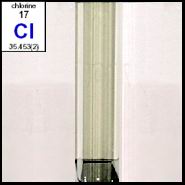
Elemental chlorine manifests as a diatomic gas Cl2 under standard conditions, exhibiting a distinctive yellow-green color derived from electronic transitions between antibonding molecular orbitals. The gas undergoes phase transitions at -101.0°C (melting point) and -34.0°C (boiling point), reflecting intermediate van der Waals forces relative to other halogens. Solid chlorine crystallizes in an orthorhombic structure with layered arrangements of Cl2 molecules. The density at standard temperature and pressure reaches 3.2 g/L, approximately 2.5 times heavier than air. Heat of fusion measures 6.41 kJ/mol, while heat of vaporization reaches 20.41 kJ/mol. Liquid chlorine under pressure displays pale yellow coloration, and solid chlorine at cryogenic temperatures approaches colorless appearance. The molecular structure maintains Cl-Cl bond lengths of 199 pm in gaseous phase and 198 pm in crystalline form, with intermolecular distances of 332 pm within crystal layers.
Chemical Properties and Reactivity
Electronic Structure and Bonding Behavior
The electronic configuration [Ne]3s23p5 creates a single vacancy in the outermost p orbital subshell, generating high affinity for additional electrons. Chlorine demonstrates multiple oxidation states ranging from -1 to +7, with -1 representing the most stable and common state achieved through electron acquisition. Positive oxidation states of +1, +3, +5, and +7 occur in compounds with more electronegative elements, particularly oxygen and fluorine. The element forms predominantly ionic bonds with metals and polar covalent bonds with nonmetals. Chlorine's high electronegativity of 3.16 creates substantial dipole moments in covalent compounds, influencing molecular geometry and intermolecular interactions. Bond formation typically involves sp3 hybridization in tetrahedral arrangements when acting as a central atom in compounds such as chlorates and perchlorates.
Electrochemical and Thermodynamic Properties
Chlorine exhibits a standard reduction potential of +1.395 V for the Cl2/Cl- couple, establishing it as a potent oxidizing agent. The electronegativity value of 3.16 on the Pauling scale positions chlorine behind only fluorine (3.98) and oxygen in electron-attracting ability. First ionization energy measures 1251 kJ/mol, reflecting the energy required to remove the highest-energy p electron. Electron affinity reaches -349 kJ/mol, representing the highest value among all elements and explaining chlorine's tendency to form stable anions. Successive ionization energies show dramatic increases: second ionization requires 2298 kJ/mol, and third ionization demands 3822 kJ/mol. These values reflect the increasing difficulty of removing electrons from progressively more stable electronic configurations. Thermodynamic stability favors chloride formation over other oxidation states in most chemical environments.
Chemical Compounds and Complex Formation
Binary and Ternary Compounds
Chlorine forms extensive binary compounds with virtually all metallic and nonmetallic elements. Metal chlorides represent the largest class, ranging from simple ionic compounds like NaCl to complex molecular species such as AlCl3. Sodium chloride crystallizes in a face-centered cubic lattice with lattice parameter 5.64 Å and demonstrates classical ionic bonding characteristics. Hydrogen chloride HCl exhibits polar covalent bonding with a dipole moment of 1.11 D and serves as a strong acid in aqueous solution. Chlorine oxides include Cl2O, ClO2, Cl2O6, and Cl2O7, displaying increasing oxidation states and decreasing thermal stability. Carbon tetrachloride CCl4 demonstrates tetrahedral geometry with C-Cl bond lengths of 177 pm. Interhalogen compounds such as ClF, ClF3, and ClF5 exhibit unusual molecular geometries dictated by VSEPR theory considerations.
Coordination Chemistry and Organometallic Compounds
Chloride ions demonstrate versatile coordination behavior, acting as monodentate ligands in numerous metal complexes. Coordination numbers typically range from four to six, depending on the metal center and steric requirements. Transition metal chloride complexes exhibit diverse geometries including tetrahedral [CoCl4]2- and octahedral [CrCl6]3- arrangements. The chloride ligand demonstrates moderate field strength in the spectrochemical series, producing intermediate crystal field splitting in d-block metal complexes. Organochlorine compounds span from simple alkyl chlorides to complex pharmaceutical intermediates. Metal-chlorine bonds in organometallic chemistry typically exhibit ionic character due to electronegativity differences. Catalytic applications frequently employ chloride-bridged dimeric structures in homogeneous and heterogeneous catalytic systems.
Natural Occurrence and Isotopic Analysis
Geochemical Distribution and Abundance
Chlorine ranks as the twentieth most abundant element in Earth's crust with concentrations averaging 130 ppm. The element never occurs in free form due to its extreme reactivity, instead appearing exclusively as chloride salts in sedimentary deposits and dissolved ions in aqueous systems. Evaporite deposits contain massive quantities of chloride minerals, primarily halite NaCl and sylvite KCl, formed through seawater evaporation in restricted basins. Ocean water contains approximately 19,000 ppm chloride, representing the largest terrestrial reservoir of this element. Groundwater systems exhibit variable chloride concentrations ranging from 1 ppm in pristine aquifers to over 100,000 ppm in brines. Volcanic emissions contribute chloride through hydrogen chloride degassing, while hydrothermal systems concentrate chloride in high-temperature mineral-forming solutions.
Nuclear Properties and Isotopic Composition
Natural chlorine consists of two stable isotopes: 35Cl comprising 75.76% abundance and 37Cl constituting 24.24% abundance. Both isotopes possess nuclear spin quantum numbers of 3/2, enabling nuclear magnetic resonance applications despite quadrupolar broadening effects from non-spherical nuclear charge distributions. The mass difference between isotopes creates measurable fractionation effects in natural systems and chemical processes. Cosmogenic 36Cl forms through cosmic ray spallation of atmospheric argon and subsurface neutron activation of 35Cl, existing in ratios of (7-10) × 10-13 relative to stable isotopes. This radioisotope serves as a valuable geochronological tracer with its 301,000-year half-life. Artificial radioisotopes include 38Cl (half-life 37.2 minutes) produced via neutron activation and used in nuclear chemistry research. Nuclear cross-sections for thermal neutron capture by 35Cl measure 44.1 barns, facilitating radioisotope production in research reactors.
Industrial Production and Technological Applications
Extraction and Purification Methodologies
Industrial chlorine production relies predominantly on the chloralkali process, wherein electrolytic cells decompose sodium chloride brines to yield chlorine gas, sodium hydroxide, and hydrogen. Modern membrane cell technology achieves current efficiencies exceeding 95% while producing chlorine with purities above 99.5%. Typical operating conditions include temperatures of 90-95°C and current densities of 2-4 kA/m2. Alternative production methods include the Weldon process using manganese dioxide and hydrochloric acid, though this approach is largely obsolete due to environmental concerns. Global production capacity approaches 80 million metric tons annually, with Asia accounting for approximately 60% of worldwide output. Purification involves fractional distillation to remove water vapor and other contaminants, followed by compression and liquefaction for efficient transportation and storage.
Technological Applications and Future Prospects
Chlorine serves as a fundamental building block in chemical manufacturing, with approximately 65% directed toward organic compound synthesis. Polyvinyl chloride production consumes the largest fraction, followed by chlorinated solvents, pesticides, and pharmaceutical intermediates. Water treatment applications utilize chlorine's biocidal properties for disinfection, with typical dosing rates of 0.5-2.0 mg/L in municipal systems. The semiconductor industry employs high-purity chlorine for silicon purification and etching processes in microelectronics fabrication. Emerging applications include lithium-ion battery electrolyte components and advanced materials for renewable energy systems. Environmental regulations increasingly drive development of chlorine-free alternatives, particularly in consumer products and packaging materials. Future technological directions emphasize recycling and circular economy approaches to reduce environmental impact while maintaining essential chemical industry functions.
Historical Development and Discovery
Medieval alchemists first encountered chlorine-containing substances through heating of sal ammoniac (ammonium chloride) and common salt, producing hydrogen chloride and various chlorinated products. Jan Baptist van Helmont recognized free chlorine gas as a distinct substance around 1630, though its elemental nature remained unestablished. Carl Wilhelm Scheele's systematic investigation in 1774 characterized chlorine through reaction of manganese dioxide with hydrochloric acid, observing its bleaching properties, toxicity, and characteristic odor. Scheele designated the substance "dephlogisticated muriatic acid air" following prevailing chemical theories. The compound nature of acids dominated chemical thinking, leading Claude Berthollet and others to propose chlorine as an oxygen-containing compound of an unknown element "muriaticum." Joseph Louis Gay-Lussac and Louis-Jacques Thénard attempted decomposition experiments in 1809 but reached inconclusive results. Humphry Davy's definitive experiments in 1810 established chlorine's elemental character, leading to its naming from the Greek "khloros" meaning pale green. Michael Faraday's liquefaction of chlorine in 1823 advanced understanding of its physical properties and enabled subsequent industrial developments.
Conclusion
Chlorine's unique combination of high reactivity, industrial accessibility, and chemical versatility establishes its fundamental importance in modern technology and chemical science. The element's position as the most electronegative Group 17 element after fluorine, coupled with its diatomic molecular structure and intermediate physical properties, creates an optimal balance for commercial applications. Current research directions focus on sustainable production methodologies, environmental impact mitigation, and development of chlorine-free alternatives for applications where toxicity concerns outweigh functional benefits. Advanced spectroscopic and computational methods continue to refine understanding of chlorine's electronic structure and bonding behavior in complex molecular systems.
Please let us know how we can improve this web app.
