| Element | |
|---|---|
20CaCalcium40.07842
8 8 2 |
|
| Basic properties | |
|---|---|
| Atomic number | 20 |
| Atomic weight | 40.0784 amu |
| Element family | Alkali earth metals |
| Period | 4 |
| Group | 2 |
| Block | s-block |
| Discovery year | 1808 |
| Isotope distribution |
|---|
40Ca 96.941% 42Ca 0.647% 43Ca 0.135% 44Ca 2.086% 46Ca 0.004% |
40Ca (97.12%) 42Ca (0.65%) 44Ca (2.09%) |
| Physical properties | |
|---|---|
| Density | 1.54 g/cm3 (STP) |
Atomic hydrogen (H) 8.988E-5 Meitnerium (Mt) 28 | |
| Melting | 839 °C |
Helium (He) -272.2 Carbon (C) 3675 | |
| Boiling | 1487 °C |
Helium (He) -268.9 Tungsten (W) 5927 | |
| Chemical properties | |
|---|---|
| Oxidation states (less common) | +2 (+1) |
| First ionization potential | 6.113 eV |
Cesium (Cs) 3.894 Helium (He) 24.587 | |
| Electron affinity | 0.025 eV |
Nobelium (No) -2.33 Atomic chlorine (Cl) 3.612725 | |
| Electronegativity | 1 |
Cesium (Cs) 0.79 Atomic fluorine (F) 3.98 | |
| Atomic radius | |
|---|---|
| Covalent radius | 1.71 Å |
Atomic hydrogen (H) 0.32 Francium (Fr) 2.6 | |
| Van der Waals radius | 2.31 Å |
Atomic hydrogen (H) 1.2 Francium (Fr) 3.48 | |
| Metallic radius | 1.97 Å |
Beryllium (Be) 1.12 Cesium (Cs) 2.65 | |
| Compounds | ||
|---|---|---|
| Formula | Name | Oxidation state |
| CaCO3 | Calcium carbonate | +2 |
| CaCl2 | Calcium chloride | +2 |
| Ca(OH)2 | Calcium hydroxide | +2 |
| CaO | Calcium oxide | +2 |
| CaSO4 | Gypsum | +2 |
| CaF2 | Calcium fluoride | +2 |
| CaC2 | Calcium carbide | +2 |
| CaH2 | Calcium hydride | +2 |
| CaC2O4 | Calcium oxalate | +2 |
| CaI2 | Calcium iodide | +2 |
| Ca(ClO3)2 | Calcium chlorate | +2 |
| CaHPO4 | Dicalcium phosphate | +2 |
| Electronic properties | |
|---|---|
| Electrons per shell | 2, 8, 8, 2 |
| Electronic configuration | [Ar] 4s2 |
|
Bohr atom model

| |
|
Orbital box diagram

| |
| Valence electrons | 2 |
| Lewis dot structure |
|
| Orbital Visualization | |
|---|---|
|
| |
| Electrons | - |
Calcium (Ca): Periodic Table Element
Abstract
Calcium, with atomic number 20 and symbol Ca, stands as the fifth most abundant element in Earth's crust and represents a quintessential alkaline earth metal. This silvery-white metallic element exhibits a face-centered cubic crystal structure below 443°C and demonstrates characteristic divalent behavior in virtually all its compounds. With electron configuration [Ar]4s2, calcium readily loses its two valence electrons to form Ca2+ ions, which play crucial roles in biological systems and industrial applications. The element displays a melting point of 842°C, boiling point of 1494°C, and density of 1.526 g/cm3 at 20°C. Calcium's high reactivity with water and atmospheric components necessitates careful handling, while its compounds, particularly calcium carbonate and calcium oxide, constitute fundamental materials in construction, metallurgy, and chemical industries.
Introduction
Calcium occupies a unique position within the periodic table as the fourth member of Group 2, the alkaline earth metals. Its atomic number of 20 places it in the fourth period, where it exhibits properties intermediate between the lighter magnesium and heavier strontium. The element's significance extends beyond mere abundance; calcium serves as an essential component in biological systems, industrial processes, and geological formations. Its discovery by Humphry Davy in 1808 through electrolysis marked a milestone in elemental chemistry. The name derives from the Latin "calx," meaning lime, reflecting humanity's long-standing familiarity with calcium compounds. Modern understanding of calcium chemistry reveals systematic relationships with other alkaline earth metals while highlighting its distinctive coordination behavior and biological importance.
Physical Properties and Atomic Structure
Fundamental Atomic Parameters
Calcium exhibits atomic number 20 with an electron configuration of [Ar]4s2, where the two outermost electrons occupy the 4s orbital. The atomic radius measures 197 pm, while ionic radius for Ca2+ equals 100 pm, demonstrating substantial contraction upon ionization. This contraction reflects the increased effective nuclear charge experienced by remaining electrons. First ionization energy equals 589.8 kJ/mol, with second ionization energy of 1145.4 kJ/mol, indicating moderate ease of electron removal characteristic of alkaline earth metals. The significant difference between first and second ionization energies confirms divalent behavior as thermodynamically favorable. Electronegativity on the Pauling scale measures 1.00, reflecting moderate electron-attracting ability. Nuclear properties include 20 protons and typically 20 neutrons in the most abundant isotope 40Ca.
Macroscopic Physical Characteristics
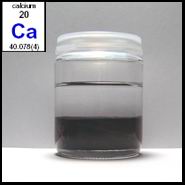
Calcium metal manifests as a silvery-white solid with metallic luster when freshly cut, though it rapidly develops an oxide-nitride coating in air. The element crystallizes in a face-centered cubic structure at room temperature, with lattice parameter a = 5.588 Å. Above 443°C, calcium undergoes allotropic transformation to body-centered cubic structure. Melting point occurs at 842°C, while boiling point reaches 1494°C under standard atmospheric pressure. These values exceed those of magnesium but remain lower than strontium and barium, following periodic trends. Density at 20°C measures 1.526 g/cm3, making calcium the least dense alkaline earth metal. Heat of fusion equals 8.54 kJ/mol, while heat of vaporization reaches 154.7 kJ/mol. Specific heat capacity measures 0.647 J/(g·K) at 25°C. Thermal conductivity equals 201 W/(m·K), while electrical conductivity demonstrates 298 × 105 S/m, making calcium a reasonable conductor despite high reactivity.
Chemical Properties and Reactivity
Electronic Structure and Bonding Behavior
Calcium's chemical behavior derives fundamentally from its [Ar]4s2 electron configuration, which promotes ready loss of valence electrons to achieve noble gas configuration. The element demonstrates exclusive divalent character in compounds, forming Ca2+ ions with remarkable stability. Bond formation typically involves ionic character due to large electronegativity differences with most elements. Coordination numbers ranging from 6 to 12 are common, reflecting the large ionic radius of Ca2+. The element readily forms compounds with oxygen, exhibiting strong affinity that leads to rapid atmospheric oxidation. Calcium carbide (CaC2) represents a notable exception, containing the acetylide ion C22- and demonstrating covalent character. Organocalcium compounds remain limited due to high ionic character and coordination preferences.
Electrochemical and Thermodynamic Properties
Electronegativity values demonstrate calcium's metallic character: 1.00 on the Pauling scale, 1.04 on the Mulliken scale, and 0.99 on the Allred-Rochow scale. Successive ionization energies reveal distinct patterns: first ionization energy of 589.8 kJ/mol reflects moderate metallic character, while second ionization energy of 1145.4 kJ/mol represents the energy required to remove an electron from Ca+. Third ionization energy jumps dramatically to 4912.4 kJ/mol, confirming that calcium doesn't form trivalent ions under normal conditions. Standard electrode potential Ca2+/Ca equals -2.87 V, indicating strong reducing character. Electron affinity measures -2.02 eV, reflecting calcium's tendency to lose rather than gain electrons. Thermodynamic data support divalent behavior: lattice energies of calcium compounds correlate strongly with Ca2+ charge density, while hydration enthalpy of Ca2+ equals -1579 kJ/mol.
Chemical Compounds and Complex Formation
Binary and Ternary Compounds
Calcium forms an extensive array of binary compounds exhibiting predominantly ionic character. Calcium oxide (CaO) represents the most significant binary compound, formed through direct oxidation or thermal decomposition of calcium carbonate. This compound exhibits rock salt structure with Ca2+ and O2- ions in octahedral coordination. Calcium hydroxide [Ca(OH)2] forms readily upon water addition to CaO, demonstrating strong basic character with limited solubility. Halides include CaF2 (fluorite structure), CaCl2 (rutile structure), CaBr2, and CaI2, all exhibiting high melting points and ionic conductivity. Calcium sulfide (CaS) crystallizes in rock salt structure, while calcium nitride (Ca3N2) forms through direct combination at elevated temperatures. Ternary compounds of particular importance include calcium carbonate (CaCO3), existing in polymorphic forms calcite and aragonite, and calcium sulfate (CaSO4), occurring naturally as gypsum when hydrated.
Coordination Chemistry and Organometallic Compounds
Calcium coordination chemistry reflects the large ionic radius and flexible coordination preferences of Ca2+. Common coordination numbers range from 6 in simple aqueous solutions to 8 or higher in solid compounds. Water coordinates to Ca2+ forming [Ca(H2O)6]2+ complexes in dilute solutions, though higher coordination numbers occur in concentrated solutions. Polydentate ligands such as EDTA form stable chelate complexes with formation constants exceeding 1010. Crown ethers and cryptands demonstrate remarkable selectivity for Ca2+ over other metal ions. Organocalcium chemistry remains limited compared to organomagnesium compounds due to high ionic character and polymerization tendencies. Calcium carbide (CaC2) serves as the primary organocalcium compound of industrial significance, containing C22- acetylide ions. Cyclopentadienyl calcium compounds exhibit polymeric structures unless sterically hindered ligands prevent aggregation.
Natural Occurrence and Isotopic Analysis
Geochemical Distribution and Abundance
Calcium ranks as the fifth most abundant element in Earth's crust at approximately 41,500 ppm (4.15%), surpassed only by oxygen, silicon, aluminum, and iron. This abundance reflects calcium's geochemical behavior during planetary differentiation and crustal formation processes. Calcium concentration in seawater averages 412 ppm, maintained through dynamic equilibrium between input from weathering and removal through precipitation. Continental crustal rocks contain calcium primarily in feldspar minerals, while oceanic crust exhibits higher calcium content in plagioclase feldspars. Sedimentary environments concentrate calcium through biological and chemical precipitation processes, forming extensive limestone and dolomite deposits. Metamorphic processes redistribute calcium among various silicate and carbonate phases. Igneous rocks display calcium content varying with silica saturation: mafic rocks contain higher calcium concentrations than felsic compositions.
Nuclear Properties and Isotopic Composition
Natural calcium comprises six isotopes: 40Ca (96.941%), 42Ca (0.647%), 43Ca (0.135%), 44Ca (2.086%), 46Ca (0.004%), and 48Ca (0.187%). The dominant 40Ca isotope possesses 20 protons and 20 neutrons, representing a doubly magic nucleus with exceptional stability. This isotope forms through silicon burning processes in massive stars and accumulates through 40K decay with a half-life of 1.248 × 10⁹ years. 42Ca and 44Ca originate from oxygen burning and alpha processes in stellar environments. 48Ca represents another doubly magic nucleus with 20 protons and 28 neutrons, produced through r-process nucleosynthesis. Its half-life for double beta decay exceeds 4 × 10¹⁹ years, making it effectively stable. Calcium possesses numerous radioactive isotopes ranging from 34Ca to 60Ca, with 41Ca (half-life ~105 years) serving as a cosmogenic tracer in geological systems.
Industrial Production and Technological Applications
Extraction and Purification Methodologies
Industrial calcium production employs two primary methodologies reflecting regional preferences and technical capabilities. Electrolytic reduction utilizes molten calcium chloride at temperatures near 800°C, applying direct current to separate calcium metal at the cathode. This process, developed from Davy's original method, requires careful control of electrolyte composition and temperature to prevent calcium vaporization. Current efficiency typically ranges from 85-95%, with power consumption approximately 15-20 kWh per kilogram of calcium. The aluminothermic reduction process, predominant in North American facilities, combines calcium oxide with aluminum powder in sealed retorts under vacuum conditions. This thermite-type reaction occurs at 1200°C according to the equation: 3CaO + 2Al → 3Ca + Al2O3. Product recovery involves condensation of calcium vapor in cooled retort sections, yielding 99.5-99.9% pure metal. Global production capacity reaches approximately 24,000 tonnes annually, with China, Russia, and the United States representing major producers.
Technological Applications and Future Prospects
Metallurgical applications consume the majority of produced calcium, primarily as a deoxidizer and desulfurizer in steel production. Calcium additions ranging from 0.001-0.01% effectively remove oxygen and sulfur impurities, improving steel quality and machinability. Calcium-lead alloys containing 0.04-0.08% calcium serve in maintenance-free automotive batteries, reducing water loss and self-discharge rates compared to conventional antimony-lead systems. Aluminum alloy applications utilize calcium additions to refine grain structure and improve mechanical properties. The element functions as a reducing agent in production of refractory metals including chromium, uranium, and zirconium through metallothermic processes. Emerging applications include hydrogen storage materials, where calcium hydride (CaH2) demonstrates reversible hydrogen capacity for energy storage systems. Advanced nuclear applications explore calcium isotopes for neutron detection and reactor coolant systems.
Historical Development and Discovery
Calcium compounds possessed practical significance millennia before elemental isolation, with lime mortars utilized in construction dating to 7000 BCE. Ancient civilizations recognized lime's binding properties, though chemical understanding remained rudimentary. Vitruvius documented lime preparation techniques in Roman architectural texts, noting weight reduction during limestone heating. Joseph Black's 1755 experiments identified carbon dioxide evolution during limestone calcination, establishing quantitative foundations for calcium chemistry. Antoine Lavoisier's 1789 classification included "chaux" among "salifiable earths," suspecting an unknown metallic element. Humphry Davy achieved first isolation in 1808 through electrolysis of calcium oxide mixed with mercury oxide, using platinum electrodes to produce calcium-mercury amalgam. Subsequent mercury distillation yielded pure calcium metal. Davy's systematic approach extended to other alkaline earth metals, establishing Group 2 chemistry fundamentals. Commercial production developments occurred gradually, with electrolytic processes emerging in the early 20th century and aluminothermic reduction gaining prominence by mid-century.
Conclusion
Calcium exemplifies the alkaline earth metals through its distinctive combination of high crustal abundance, essential biological functions, and diverse industrial applications. The element's divalent chemistry, stemming from its [Ar]4s2 configuration, governs both its coordination behavior and compound formation patterns. Technological significance spans from traditional steel production to emerging energy storage applications, while biological importance continues expanding through isotopic research methodologies. Future developments may emphasize calcium's role in sustainable technologies, including hydrogen storage systems and advanced materials applications. The element's fundamental position in Earth's geochemical cycles ensures continued scientific and practical relevance across multiple disciplines.
Please let us know how we can improve this web app.
