| Element | |
|---|---|
5BBoron10.81172
3 |
|
| Basic properties | |
|---|---|
| Atomic number | 5 |
| Atomic weight | 10.8117 amu |
| Element family | Metaloids |
| Period | 2 |
| Group | 13 |
| Block | p-block |
| Discovery year | 1808 |
| Isotope distribution |
|---|
10B 20.0% 11B 80.0% |
10B (20.00%) 11B (80.00%) |
| Physical properties | |
|---|---|
| Density | 2.34 g/cm3 (STP) |
Atomic hydrogen (H) 8.988E-5 Meitnerium (Mt) 28 | |
| Melting | 2300 °C |
Helium (He) -272.2 Carbon (C) 3675 | |
| Boiling | 2550 °C |
Helium (He) -268.9 Tungsten (W) 5927 | |
| Chemical properties | |
|---|---|
| Oxidation states (less common) | +3 (-5, -1, 0, +1, +2) |
| First ionization potential | 8.297 eV |
Cesium (Cs) 3.894 Helium (He) 24.587 | |
| Electron affinity | 0.280 eV |
Nobelium (No) -2.33 Atomic chlorine (Cl) 3.612725 | |
| Electronegativity | 2.04 |
Cesium (Cs) 0.79 Atomic fluorine (F) 3.98 | |
| Electronic properties | |
|---|---|
| Electrons per shell | 2, 3 |
| Electronic configuration | [He] 2s2 |
|
Bohr atom model

| |
|
Orbital box diagram

| |
| Valence electrons | 3 |
| Lewis dot structure |
|
| Orbital Visualization | |
|---|---|
|
| |
| Electrons | - |
Boron (B): Periodic Table Element
Abstract
Boron is a metalloid element with atomic number 5, characterized by its electron configuration of 1s² 2s² 2p¹ and unique chemical properties arising from electron deficiency in bonding. The element exhibits remarkable structural diversity with multiple allotropic forms, exceptional hardness (9.3 on Mohs scale), and distinctive three-coordinate chemistry. Boron's natural abundance in Earth's crust is approximately 0.001% by mass, primarily concentrated in borate minerals through hydrothermal processes. The element displays oxidation state +3 in most compounds and forms electron-deficient multicenter bonding arrangements. Industrial applications encompass semiconductor doping, nuclear neutron absorption, high-strength aerospace composites, and specialized glass production. Two stable isotopes, 10B (19.9%) and 11B (80.1%), exhibit distinctly different nuclear cross-sections, with 10B possessing exceptionally high neutron capture capability essential for nuclear applications.
Introduction
Boron occupies a unique position in the periodic table as the first element of Group 13 (IIIA), bridging metallic and nonmetallic character with pronounced metalloid properties. Its atomic structure, containing five electrons with the outermost p orbital singly occupied, establishes fundamental chemical behavior dominated by electron deficiency and three-coordinate bonding geometries. The element's significance extends from its role as an essential plant micronutrient to its critical applications in modern semiconductor technology and nuclear engineering. Boron's chemistry demonstrates exceptional diversity through the formation of complex hydride clusters, refractory metal borides, and sophisticated organoborane compounds that exhibit unique bonding paradigms challenging conventional valence theory. The simultaneous discovery of boron by Sir Humphry Davy, Joseph Louis Gay-Lussac, and Louis Jacques Thénard in 1808 marked the identification of an element whose industrial importance would become apparent only with twentieth-century technological advances.
Physical Properties and Atomic Structure
Fundamental Atomic Parameters
Boron possesses atomic number 5 with standard atomic weight of 10.806-10.821 u, reflecting natural isotopic variation. The ground-state electron configuration 1s² 2s² 2p¹ places boron in the p-block with one unpaired electron in the 2p orbital, establishing its chemistry as fundamentally different from the preceding s-block elements. The atomic radius of 87 pm and ionic radius of 27 pm for B³⁺ reflect strong nuclear charge effects, with effective nuclear charge calculations indicating significant penetration of 2s and 2p orbitals. Successive ionization energies of 800.6 kJ/mol (first), 2427 kJ/mol (second), and 3659.7 kJ/mol (third) demonstrate the preferred +3 oxidation state, as removal of the fourth electron requires disruption of the stable 1s² core. The electronegativity of 2.04 on the Pauling scale positions boron between typical metals and nonmetals, consistent with its metalloid classification.
Macroscopic Physical Characteristics
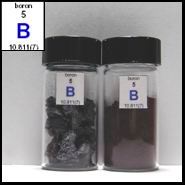
Crystalline boron appears as a black-brown, lustrous material exhibiting exceptional hardness of 9.3 on the Mohs scale, approaching that of diamond. The element manifests remarkable allotropic diversity with over ten known polymorphs, including α-rhombohedral (most stable), β-rhombohedral, γ-orthorhombic, and β-tetragonal forms. These structures feature complex icosahedral B₁₂ clusters as fundamental building units, connected through various bonding arrangements that create three-dimensional networks. Amorphous boron appears as a brown powder with distinctly different properties from crystalline forms. The melting point exceeds 2300 K, while the boiling point reaches approximately 4200 K, reflecting strong covalent bonding throughout the crystal lattice. Density varies from 2.08 g/cm³ for amorphous forms to 2.52 g/cm³ for crystalline β-rhombohedral boron. Electrical conductivity demonstrates semiconductor behavior with resistivity of 1.5 × 10⁶ Ω·cm at room temperature, decreasing exponentially with increasing temperature.
Chemical Properties and Reactivity
Electronic Structure and Bonding Behavior
Boron's chemical behavior stems from its electron-deficient nature, possessing only three valence electrons available for bonding in compounds typically requiring electron-pair bonds. This deficiency manifests in the formation of multicenter bonds, particularly three-center two-electron (3c-2e) bonds characteristic of boron hydrides and related compounds. The element preferentially adopts trigonal planar geometry in three-coordinate compounds, with sp² hybridization predominating. The vacant p orbital perpendicular to the molecular plane enables π-back-bonding with suitable ligands and facilitates the formation of electron-deficient cluster compounds. Standard reduction potential for the B³⁺/B couple is -0.87 V, indicating moderate reducing capability under standard conditions. Chemical reactivity patterns demonstrate resistance to attack by most acids at room temperature, though finely divided boron reacts slowly with hot concentrated oxidizing acids including nitric and sulfuric acid.
Electrochemical and Thermodynamic Properties
Electrochemical properties of boron reflect its intermediate position between metals and nonmetals. The Pauling electronegativity of 2.04 places boron below carbon (2.55) but above aluminum (1.61), consistent with formation of polar covalent bonds with most elements. Successive ionization energies follow expected trends with dramatic increases: 800.6 kJ/mol (B → B⁺), 2427 kJ/mol (B⁺ → B²⁺), and 3659.7 kJ/mol (B²⁺ → B³⁺), supporting the predominance of +3 oxidation state in ionic compounds. Electron affinity of 26.7 kJ/mol indicates weak tendency to form anions, contrasting with typical nonmetallic behavior. Thermodynamic stability of boron compounds generally increases with increasing electronegativity of the bonding partner, as evidenced by formation enthalpies: BF₃ (-1137 kJ/mol), BCl₃ (-404 kJ/mol), and BBr₃ (-240 kJ/mol). The element exhibits strong affinity for oxygen, forming thermodynamically stable oxides and oxyacids that dominate natural boron chemistry.
Chemical Compounds and Complex Formation
Binary and Ternary Compounds
Boron trihalides represent the most extensively studied binary compounds, with BF₃, BCl₃, BBr₃, and BI₃ forming a complete series. Boron trifluoride demonstrates exceptional Lewis acid strength due to effective π-back-bonding between fluorine lone pairs and the vacant boron p orbital, resulting in partial double-bond character and planar molecular geometry. The progressive decrease in Lewis acidity from BF₃ to BI₃ reflects increasing π-donation from halogen substituents. Boron nitride exhibits two primary forms: hexagonal BN with graphite-like layered structure and cubic BN with diamond-like arrangement, the latter possessing hardness comparable to diamond. Metal borides constitute an important class of refractory compounds, with transition metal borides such as TiB₂, ZrB₂, and HfB₂ exhibiting melting points exceeding 3000°C and exceptional chemical stability. Boron carbide (B₄C) represents one of the hardest known materials, finding applications in armor plating and abrasive materials.
Coordination Chemistry and Organometallic Compounds
Boron hydrides constitute a unique class of electron-deficient compounds featuring multicenter bonding arrangements that challenged conventional bonding theories. Diborane (B₂H₆) serves as the prototypical example, containing two three-center two-electron bonds bridging the boron atoms. Higher boranes including pentaborane (B₅H₉) and decaborane (B₁₀H₁₄) exhibit increasingly complex cage structures based on triangulated polyhedra. Organoborane compounds demonstrate versatile reactivity patterns, with trialkylboranes serving as important synthetic intermediates in organic chemistry. The hydroboration reaction, pioneered by Herbert C. Brown, provides stereoselective methods for alkene functionalization through anti-Markovnikov addition across carbon-carbon double bonds. Boron-containing heterocycles, including boroles and borepins, exhibit unique electronic properties with potential applications in materials science and catalysis.
Natural Occurrence and Isotopic Analysis
Geochemical Distribution and Abundance
Boron exhibits crustal abundance of approximately 10 ppm (0.001%), classifying it as a relatively rare element despite its technological importance. The element does not occur naturally in elemental form due to its high reactivity and strong tendency toward oxide formation. Primary boron concentration occurs through hydrothermal processes that transport boron as boric acid or borate complexes, leading to evaporite deposits containing high concentrations of borate minerals. Turkey possesses the world's largest boron reserves, containing approximately 72% of global resources, followed by Russia, Chile, and the United States. Principal borate minerals include borax (Na₂B₄O₇·10H₂O), colemanite (Ca₂B₆O₁₁·5H₂O), kernite (Na₂B₄O₇·4H₂O), and ulexite (NaCaB₅O₉·8H₂O), which collectively constitute over 90% of mined boron ore. Seawater contains approximately 4.5 mg/L boron, primarily as boric acid, representing a vast but dilute resource requiring specialized extraction techniques.
Nuclear Properties and Isotopic Composition
Natural boron comprises two stable isotopes: 11B (80.1% abundance) and 10B (19.9% abundance), both with zero nuclear spin. The significant difference in neutron capture cross-sections between these isotopes creates important technological applications, with 10B exhibiting thermal neutron absorption cross-section of 3840 barns compared to 0.005 barns for 11B. This enormous difference enables isotopic enrichment for nuclear applications, with 10B serving as neutron absorber in control rods and shielding materials. Thirteen boron isotopes are known, ranging from 7B to 19B, with radioactive isotopes exhibiting half-lives from 3.5 × 10⁻²² seconds (7B) to 20.2 milliseconds (8B). The exotic isotope 17B demonstrates nuclear halo properties with an unusually large nuclear radius due to weakly bound neutrons extending beyond the core nucleons. Nuclear magnetic resonance studies utilize 11B (I = 3/2) as a sensitive probe for coordination environment and molecular dynamics in boron-containing compounds.
Industrial Production and Technological Applications
Extraction and Purification Methodologies
Industrial boron production begins with mining of borate ores, primarily borax and colemanite, followed by chemical processing to produce boric acid or sodium borate. The reduction of boric oxide (B₂O₃) with metallic magnesium at elevated temperatures produces crude boron according to the reaction: B₂O₃ + 3Mg → 2B + 3MgO. Alternative production methods include electrolysis of fused borate salts and thermal decomposition of boron halides on heated surfaces. High-purity boron suitable for semiconductor applications requires zone refining or chemical vapor deposition techniques to achieve purities exceeding 99.999%. The decomposition of diborane (B₂H₆) or boron trichloride (BCl₃) on heated substrates provides epitaxial boron films for specialized electronic applications. Annual global boron production approaches 4 million tonnes, with Turkey accounting for approximately 74% of world production, followed by Russia and Chile.
Technological Applications and Future Prospects
Semiconductor technology relies extensively on boron for p-type doping of silicon and germanium crystals, creating the positive charge carriers essential for bipolar devices and CMOS circuits. The precise control of boron concentration through ion implantation or diffusion processes enables fabrication of transistors, diodes, and integrated circuits with predetermined electrical characteristics. Aerospace applications utilize boron fibers as reinforcement in composite materials, providing exceptional strength-to-weight ratios for aircraft structures and space vehicles. Nuclear industry applications exploit the high neutron capture cross-section of 10B for control rod fabrication, neutron shielding, and reactor safety systems. Borosilicate glass production consumes significant quantities of boric oxide, creating materials with low thermal expansion coefficients essential for laboratory glassware and optical components. Advanced ceramic applications include boron carbide for ballistic armor and cutting tools, while boron nitride serves in high-temperature lubricants and electronic substrates. Emerging applications encompass boron-containing pharmaceuticals, magnetic resonance imaging contrast agents, and boron neutron capture therapy for cancer treatment.
Historical Development and Discovery
The discovery of boron in 1808 resulted from simultaneous but independent research by three pioneering chemists working on different continents. Sir Humphry Davy in London achieved the first isolation through electrolysis of boric acid solutions using his newly developed voltaic pile, subsequently improving the method by reducing boric acid with potassium metal. Contemporaneously, Joseph Louis Gay-Lussac and Louis Jacques Thénard in Paris employed metallic iron to reduce boric acid at high temperatures, obtaining similar results. The element's name derives from the Arabic "buraq" and Persian "burah," referring to borax, the mineral source known to ancient civilizations for glassmaking and metallurgy. Jöns Jacob Berzelius definitively established boron as an element in 1824 through careful analytical studies that distinguished it from carbon and other light elements. Ezekiel Weintraub achieved the first production of substantially pure boron in 1909 through electric arc reduction of boric oxide, enabling systematic study of the element's properties. The development of boron chemistry accelerated dramatically during the twentieth century with Alfred Stock's pioneering research on boron hydrides, establishing the theoretical framework for electron-deficient bonding that influenced modern chemical bonding theory.
Conclusion
Boron's unique position in the periodic table establishes it as a metalloid element with exceptional chemical and physical properties derived from its electron-deficient bonding behavior. The element's technological significance spans semiconductor manufacturing, nuclear engineering, aerospace materials, and specialized glass production, reflecting its versatile chemistry and favorable nuclear properties. Current research directions encompass boron-containing nanomaterials, advanced ceramics for extreme environments, and pharmaceutical applications exploiting boron's distinctive biological interactions. The continuing development of boron nitride nanotubes, two-dimensional boron materials, and boron-based superconductors suggests expanding technological applications in electronics, energy storage, and quantum materials. Understanding boron's complex structural chemistry and multicenter bonding arrangements continues to provide insights into fundamental chemical bonding theory while enabling practical applications in cutting-edge technologies.

Please let us know how we can improve this web app.
