| Element | |
|---|---|
16SSulfur32.06552
8 6 |
|
| Basic properties | |
|---|---|
| Atomic number | 16 |
| Atomic weight | 32.0655 amu |
| Element family | Non-metals |
| Period | 3 |
| Group | 16 |
| Block | p-block |
| Discovery year | 2000 BC |
| Isotope distribution |
|---|
32S 95.02% 33S 0.75% 34S 4.21% 36S 0.02% |
32S (95.02%) 33S (0.75%) 34S (4.21%) |
| Physical properties | |
|---|---|
| Density | 2.067 g/cm3 (STP) |
Atomic hydrogen (H) 8.988E-5 Meitnerium (Mt) 28 | |
| Melting | 115.36 °C |
Helium (He) -272.2 Carbon (C) 3675 | |
| Boiling | 444.7 °C |
Helium (He) -268.9 Tungsten (W) 5927 | |
| Chemical properties | |
|---|---|
| Oxidation states (less common) | -2, +2, +4, +6 (-1, 0, +1, +3, +5) |
| First ionization potential | 10.360 eV |
Cesium (Cs) 3.894 Helium (He) 24.587 | |
| Electron affinity | 2.077 eV |
Nobelium (No) -2.33 Atomic chlorine (Cl) 3.612725 | |
| Electronegativity | 2.58 |
Cesium (Cs) 0.79 Atomic fluorine (F) 3.98 | |
| Atomic radius | |
|---|---|
| Covalent radius | 1.03 Å |
Atomic hydrogen (H) 0.32 Francium (Fr) 2.6 | |
| Van der Waals radius | 1.8 Å |
Atomic hydrogen (H) 1.2 Francium (Fr) 3.48 | |
| Compounds | ||
|---|---|---|
| Formula | Name | Oxidation state |
| H2S | Hydrogen sulfide | -2 |
| CS2 | Carbon disulfide | -2 |
| PbS2 | Lead(IV) sulfide | -1 |
| CuS | Copper(II) sulfide | -1,-2 |
| S2Cl2 | Disulfur dichloride | +1 |
| S2Br2 | Disulfur dibromide | +1 |
| S4N4 | Tetrasulfur tetranitride | +2 |
| S2N2 | Disulfur dinitride | +2 |
| SO2 | Sulfur dioxide | +4 |
| H2SO3 | Sulfurous acid | +4 |
| S2F10 | Disulfur decafluoride | +5 |
| H2SO4 | Sulfuric acid | +6 |
| Electronic properties | |
|---|---|
| Electrons per shell | 2, 8, 6 |
| Electronic configuration | [Ne] 3s2 |
|
Bohr atom model

| |
|
Orbital box diagram

| |
| Valence electrons | 6 |
| Lewis dot structure |
|
| Orbital Visualization | |
|---|---|
|
| |
| Electrons | - |
Sulfur (S): Periodic Table Element
Abstract
Sulfur, the sixteenth element of the periodic table with symbol S and atomic mass 32.06 ± 0.02 u, exhibits exceptional chemical versatility through its diverse oxidation states ranging from -2 to +6. This nonmetallic element demonstrates remarkable structural diversity in its allotropic forms, with octasulfur being the thermodynamically stable form under standard conditions. Sulfur's distinctive electronic configuration [Ne]3s²3p⁴ enables extensive covalent bonding capabilities, particularly in formation of sulfur-sulfur chains and rings. The element serves as the cornerstone of industrial chemistry, with approximately 85% of global sulfur production dedicated to sulfuric acid manufacture. Sulfur compounds exhibit extraordinary significance in biological systems, particularly through cysteine and methionine amino acids that provide structural integrity via disulfide bonds. The element demonstrates extensive geochemical occurrence in both native form and combined states, appearing in sulfide and sulfate minerals throughout the Earth's crust.
Introduction
Sulfur occupies position 16 in the periodic table, situated in Group 16 (chalcogens) and Period 3. This placement reflects its fundamental electronic structure and accounts for its distinctive chemical behavior patterns observed throughout chalcogen chemistry. The element's significance extends beyond academic interest, representing one of the most industrially important nonmetals in modern technology. Sulfur's unique position stems from its ability to form stable compounds across a broader range of oxidation states than most elements, coupled with its propensity for catenation that rivals carbon in complexity. The element's discovery predates recorded history, with civilizations from ancient China to Egypt utilizing sulfur compounds for metallurgy, medicine, and warfare applications. Modern sulfur chemistry encompasses diverse fields from petroleum refining to advanced battery technologies, establishing its fundamental role in contemporary industrial processes.
Physical Properties and Atomic Structure
Fundamental Atomic Parameters
Sulfur possesses atomic number 16 with electronic configuration [Ne]3s²3p⁴, placing four electrons in the outermost p orbitals. The atom exhibits a covalent radius of approximately 1.05 Å and an ionic radius of 1.84 Å for the S²⁻ ion. Successive ionization energies demonstrate the stability of the noble gas core, with the second ionization energy measuring 2,252 kJ/mol and the sixth ionization energy reaching 8,495.8 kJ/mol. The effective nuclear charge experienced by valence electrons results in moderate electronegativity values, enabling sulfur to form both ionic and covalent bonds depending on the chemical environment. Electron affinity data indicates sulfur's propensity to accept electrons, particularly in formation of sulfide ions where the element achieves the stable noble gas configuration of argon.
Macroscopic Physical Characteristics
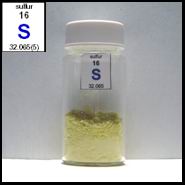
Elemental sulfur manifests as bright yellow crystalline solids under standard conditions, exhibiting multiple allotropic forms with octasulfur (cyclo-S₈) representing the thermodynamically favored structure. The element demonstrates a precise melting point of 115.21°C, though this value varies between 114.6°C and 120.4°C depending on heating conditions and allotropic composition. Boiling occurs at 444.6°C under atmospheric pressure. Density measurements vary with allotropic form but typically approximate 2.0 g/cm³ for crystalline modifications. The element undergoes distinctive phase transitions, including α-octasulfur to β-polymorph transformation at 95.2°C. Molten sulfur exhibits remarkable temperature-dependent viscosity changes, becoming dark red above 200°C due to formation of polymeric chains. Sublimation occurs readily between 20-50°C and becomes pronounced in boiling water at 100°C, contributing to sulfur's distinctive odor in volcanic regions.
Chemical Properties and Reactivity
Electronic Structure and Bonding Behavior
Sulfur's electronic configuration facilitates extraordinary bonding versatility through its partially filled 3p orbitals and accessible 3d orbitals for expanded octet formation. The element demonstrates oxidation states from -2 through +6, with particularly stable configurations at -2, +4, and +6 corresponding to filled, half-filled, and empty d orbital arrangements respectively. Covalent bonding predominates in sulfur compounds, characterized by single, double, and coordinate covalent interactions. The element exhibits exceptional catenation properties, forming chains and rings through S-S bonds with typical bond energies of 266 kJ/mol. Hybridization patterns include sp³ in tetrahedral sulfate ions, sp³d in sulfur tetrafluoride, and sp³d² in sulfur hexafluoride, demonstrating the element's ability to accommodate various geometries through d orbital participation. Bond lengths vary systematically with oxidation state, ranging from 2.05 Å in S₈ rings to shorter distances in multiple-bonded species.
Electrochemical and Thermodynamic Properties
Sulfur exhibits electronegativity values of 2.58 on the Pauling scale, positioning it between phosphorus and chlorine in the periodic table. Standard reduction potentials reveal the thermodynamic favorability of various sulfur species, with the S/S²⁻ couple showing -0.48 V and reflecting sulfur's moderate oxidizing character in neutral solutions. The element's successive ionization energies demonstrate increasing difficulty in electron removal, with the fourth ionization energy of 4,556 kJ/mol indicating the stability of the S⁴⁺ cation in strongly oxidizing environments. Electron affinity measurements confirm sulfur's ability to accommodate additional electrons, particularly in formation of polysulfide anions. Thermodynamic stability calculations indicate that sulfur dioxide and sulfur trioxide represent highly stable oxidation products, with formation enthalpies of -296.8 kJ/mol and -395.7 kJ/mol respectively, explaining sulfur's combustion behavior and industrial utility in acid production.
Chemical Compounds and Complex Formation
Binary and Ternary Compounds
Sulfur forms extensive binary compounds across multiple categories, including metal sulfides, nonmetal sulfides, and oxygen compounds. Metal sulfides exhibit predominantly ionic character with highly electropositive elements, while compounds with metalloids and nonmetals display increasing covalent character. Iron pyrite (FeS₂) exemplifies complex sulfide structures containing S₂²⁻ units, while zinc blende (ZnS) demonstrates tetrahedral coordination typical of II-VI semiconductors. Sulfur oxides represent particularly important binary compounds, with sulfur dioxide (SO₂) displaying angular geometry consistent with VSEPR theory predictions for four electron pairs. Sulfur trioxide (SO₃) exists in both monomeric trigonal planar form and polymeric modifications. Hydrogen sulfide (H₂S) demonstrates typical covalent bonding with bond angles of 92.1°, significantly less than tetrahedral due to lone pair repulsion effects. Ternary compounds include sulfuric acid (H₂SO₄), representing one of the most industrially significant chemicals globally, and metal sulfates exhibiting tetrahedral sulfate ion coordination.
Coordination Chemistry and Organometallic Compounds
Sulfur functions as a versatile ligand in coordination complexes, demonstrating both σ-donor and π-acceptor capabilities depending on oxidation state and molecular environment. Sulfur dioxide coordinates to transition metals through both sulfur and oxygen atoms, forming linkage isomers with distinct spectroscopic signatures. Polysulfide complexes exhibit extensive coordination modes, including terminal, bridging, and chelating arrangements that stabilize unusual metal oxidation states. Organosulfur compounds encompass diverse structural types including thiols, thioethers, and thioesters, with carbon-sulfur bond energies typically measuring 272 kJ/mol for C-S single bonds. Thiophene and related heterocyclic compounds demonstrate aromatic character through π-electron delocalization involving sulfur 3p orbitals. Metal complexes of organosulfur ligands exhibit unique catalytic properties, particularly in petroleum refining processes where sulfur coordination facilitates selective hydrodesulfurization reactions.
Natural Occurrence and Isotopic Analysis
Geochemical Distribution and Abundance
Sulfur represents the tenth most abundant element by mass in the universe and ranks as the fifth most common element on Earth, with crustal abundance approximating 350 ppm by weight. Geochemical distribution reflects sulfur's affinity for both lithophile and chalcophile behavior, appearing in sulfide ore deposits, evaporite formations, and volcanic emissions. Native sulfur deposits occur primarily in sedimentary environments, particularly in association with salt domes and limestone formations where bacterial reduction of sulfate minerals produces elemental accumulations. Major sulfide minerals include pyrite (FeS₂), galena (PbS), sphalerite (ZnS), and chalcopyrite (CuFeS₂), representing significant ore sources for base metals. Sulfate minerals such as gypsum (CaSO₄·2H₂O) and anhydrite (CaSO₄) form extensive evaporite sequences reflecting ancient marine environments. Volcanic regions exhibit elevated sulfur concentrations through degassing processes, with sulfur dioxide and hydrogen sulfide emissions indicating subsurface sulfur mobilization.
Nuclear Properties and Isotopic Composition
Sulfur possesses four stable isotopes among 23 known nuclides, with ³²S constituting 94.99 ± 0.26% of natural abundance. Minor isotopes include ³⁴S at 4.25 ± 0.24%, ³³S at 0.75 ± 0.02%, and ³⁶S at 0.01 ± 0.01%, reflecting nucleosynthetic processes in stellar environments. The predominant ³²S isotope exhibits zero nuclear spin, while ³³S possesses spin 3/2 enabling NMR spectroscopic applications. Radioactive isotopes demonstrate varying half-lives, with ³⁵S exhibiting the longest half-life of 87 days and serving as a valuable tracer in biochemical research. Other radioactive isotopes display half-lives typically less than three hours, limiting their practical applications. Isotopic fractionation occurs during natural processes, particularly in biological sulfur cycling where kinetic effects favor lighter isotopes during enzymatic reactions. Mass spectrometric analysis of sulfur isotope ratios provides valuable information for environmental studies, including pollution source identification and paleoenvironmental reconstruction.
Industrial Production and Technological Applications
Extraction and Purification Methodologies
Modern sulfur production relies predominantly on petroleum and natural gas processing, accounting for approximately 90% of global supply through hydrodesulfurization reactions that remove sulfur compounds from fossil fuels. The Claus process represents the primary recovery method, converting hydrogen sulfide to elemental sulfur through controlled partial oxidation at temperatures between 1000-1400°C, followed by catalytic conversion stages operating at 200-300°C over alumina catalysts. Traditional mining of native sulfur deposits employs the Frasch process, utilizing superheated water injection at 160°C to melt underground sulfur, which is then recovered through compressed air lifting systems. Production efficiency reaches 95-98% recovery rates under optimal conditions. Purification techniques include fractional distillation for removing organic impurities and crystallization methods for achieving analytical grade purity. Global sulfur production exceeds 70 million tonnes annually, with major producing regions including the Middle East, Russia, and North America where petroleum refining operations concentrate sulfur recovery infrastructure.
Technological Applications and Future Prospects
Sulfuric acid production represents the dominant application consuming 85% of global sulfur output, with the contact process utilizing sulfur dioxide oxidation over vanadium pentoxide catalysts at 400-500°C to achieve 99.5% conversion efficiency. Fertilizer manufacturing accounts for approximately 60% of sulfuric acid consumption, primarily for phosphoric acid production through phosphate rock digestion. Petroleum refining applications include alkylation catalysis and metallurgical processing for metal extraction and purification. Emerging technologies focus on lithium-sulfur battery development, where sulfur cathodes offer theoretical specific capacities of 1675 mAh/g, representing significant advantages over conventional lithium-ion systems. Rubber vulcanization utilizes sulfur cross-linking to enhance mechanical properties and temperature stability. Chemical synthesis applications encompass pharmaceutical intermediate production and polymer manufacturing. Environmental applications include flue gas desulfurization systems and wastewater treatment processes. Future prospects emphasize sustainable sulfur utilization in renewable energy storage systems and advanced materials development, particularly in high-capacity battery technologies and specialized polymer applications.
Historical Development and Discovery
Sulfur's utilization predates recorded history, with archaeological evidence indicating applications in ancient civilizations of India, Greece, China, and Egypt dating beyond 6000 years. Chinese alchemists recognized sulfur as shiliuhuang during the 6th century BC, incorporating the element into early gunpowder formulations by 1044 AD alongside charcoal and potassium nitrate. Ancient Greek and Roman civilizations employed sulfur for fumigation, medical treatments, and textile bleaching processes, with Homer referencing sulfur fumigation in the Odyssey. Medieval Islamic alchemists advanced sulfur chemistry through systematic investigations of metal sulfide formation and purification techniques. The historical name "brimstone," meaning "burning stone," reflects sulfur's distinctive combustion properties and biblical associations with divine judgment. European medieval period witnessed expanded sulfur applications in warfare, particularly in incendiary compositions and early firearms. Scientific revolution of the 17th century established sulfur's elemental nature through combustion studies by Lavoisier and others, distinguishing it from sulfur compounds previously confused with the element itself. Industrial revolution applications included sulfuric acid production via the lead chamber process developed in 1746, eventually superseded by the contact process in 1875. Modern understanding of sulfur's electronic structure and bonding emerged through 20th century quantum mechanical studies, culminating in current applications spanning industrial chemistry to advanced materials science.
Conclusion
Sulfur occupies a unique position in the periodic table through its exceptional chemical versatility, extensive industrial significance, and fundamental biological importance. The element's distinctive electronic configuration enables formation of compounds spanning oxidation states from -2 to +6, supporting diverse chemical bonding patterns and structural arrangements unmatched by most elements. Industrial applications, particularly sulfuric acid production, establish sulfur as one of the most economically important nonmetals in modern technology. Future research directions emphasize sustainable energy storage applications, advanced materials development, and environmental remediation technologies where sulfur's chemical properties offer unprecedented opportunities for technological advancement.

Please let us know how we can improve this web app.
