Printed from https://www.webqc.org

Arsenic @ Periodic Table of Chemical Elements

12345678 910111213141516 1718
IIIIIIbIVb VbVIbVIIbVIIIbIb IIbIIIIVVVI VIIVIII
1H
1.0079
2He
4.0026
3Li
6.9412
4Be
9.0121
5B
10.811
6C
12.010
7N
14.006
8O
15.999
9F
18.998
10Ne
20.179
11Na
22.989
12Mg
24.305
13Al
26.981
14Si
28.085
15P
30.973
16S
32.065
17Cl
35.453
18Ar
39.948
19K
39.098
20Ca
40.078
21Sc
44.955
22Ti
47.867
23V
50.941
24Cr
51.996
25Mn
54.938
26Fe
55.845
27Co
58.933
28Ni
58.693
29Cu
63.546
30Zn
65.409
31Ga
69.723
32Ge
72.641
33As
74.921
34Se
78.963
35Br
79.904
36Kr
83.798
37Rb
85.467
38Sr
87.621
39Y
88.905
40Zr
91.224
41Nb
92.906
42Mo
95.942
43Tc
98.906
44Ru
101.07
45Rh
102.90
46Pd
106.42
47Ag
107.86
48Cd
112.41
49In
114.81
50Sn
118.71
51Sb
121.76
52Te
127.60
53I
126.90
54Xe
131.29
55Cs
132.90
56Ba
137.32
57La
138.90
72Hf
178.49
73Ta
180.94
74W
183.84
75Re
186.20
76Os
190.23
77Ir
192.21
78Pt
195.08
79Au
196.96
80Hg
200.59
81Tl
204.38
82Pb
207.21
83Bi
208.98
84Po
208.98
85At
209.98
86Rn
222.01
87Fr
223.01
88Ra
226.02
89Ac
227.02
104Rf
261.10
105Db
262.11
106Sg
266.12
107Bh
264.12
108Hs
269
109Mt
278
110Ds
281
111Rg
282
112Cn
285
113Nh
286
114Fl
289
115Mc
290
116Lv
293
117Ts
294
118Og
294
Lanthanoids58Ce
140.11
59Pr
140.90
60Nd
144.24
61Pm
146.91
62Sm
150.36
63Eu
151.96
64Gd
157.25
65Tb
158.92
66Dy
162.50
67Ho
164.93
68Er
167.25
69Tm
168.93
70Yb
173.04
71Lu
174.96
Actinoids90Th
232.03
91Pa
231.03
92U
238.02
93Np
237.04
94Pu
244.06
95Am
243.06
96Cm
247.07
97Bk
247.07
98Cf
251.07
99Es
252.08
100Fm
257.09
101Md
258.09
102No
259.10
103Lr
260.10
Alkali metals Alkali earth metals Transition metals Other metals Metaloids Non-metals Halogens Noble gases
Element

33

As

Arsenic

74.921602

2
8
18
5
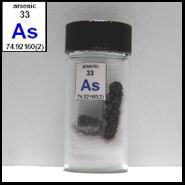
Arsenic photo
Basic properties
Atomic number33
Atomic weight74.921602 amu
Element familyMetaloids
Period4
Group15
Blockp-block
Discovery year815
Isotope distribution
75As
100%
Physical properties
Density 5.776 g/cm3 (STP)
Atomic hydrogen (H) 8.988E-5
Meitnerium (Mt) 28
Melting817 °C
Helium (He) -272.2
Carbon (C) 3675
Boiling613 °C
Helium (He) -268.9
Tungsten (W) 5927
Chemical properties
Oxidation states
(less common)
-3, +3, +5
(-2, -1, 0, +1, +2, +4)
First ionization potential 9.815 eV
Cesium (Cs) 3.894
Helium (He) 24.587
Electron affinity 0.805 eV
Nobelium (No) -2.33
Atomic chlorine (Cl) 3.612725
Electronegativity2.18
Cesium (Cs) 0.79
Atomic fluorine (F) 3.98
Atomic radius
Covalent radius 1.21 Å
Atomic hydrogen (H) 0.32
Francium (Fr) 2.6
Van der Waals radius 1.85 Å
Atomic hydrogen (H) 1.2
Francium (Fr) 3.48
33AsWebQC.OrgCovalentVan der Waals
Compounds
FormulaNameOxidation state
AsH3Arsine-3
BAsBoron arsenide-3
GaAsGallium arsenide-3
InAsIndium arsenide-3
NpAs2Neptunium diarsenide-2
LiAsLithium arsenide-1
As2O3Arsenic trioxide+3
As2S3Arsenic trisulfide+3
AsCl3Arsenic trichloride+3
As2O5Arsenic pentoxide+5
(NH4)3AsO4Ammonium arsenate+5
As2S5Arsenic pentasulfide+5
Electronic properties
Electrons per shell2, 8, 18, 5
Electronic configuration[Ar] 3d104s24p3
Bohr atom model
Bohr atom model
Orbital box diagram
Orbital box diagram
Valence electrons5
Lewis dot structure Arsenic Lewis dot structure
Orbital Visualization
🏠
▶️
📐
Electrons-

Arsenic (As): Periodic Table Element

Scientific Review Article | Chemistry Reference Series

Abstract

Arsenic (As), atomic number 33, represents a metalloid pnictogen with distinctive semiconducting properties and complex chemical behavior. This Group 15 element exhibits a standard atomic weight of 74.921595 ± 0.000006 u and occurs naturally as a single stable isotope, 75As. The element manifests three primary allotropic forms: grey arsenic (α-As) with metallic appearance and rhombohedral crystal structure, yellow arsenic comprising tetrahedral As4 molecules, and black arsenic resembling phosphorus allotropes. Arsenic demonstrates versatile oxidation chemistry with stable -3, +3, and +5 oxidation states, forming extensive binary and ternary compound systems. Industrial applications focus on semiconductor technology, particularly III-V compound semiconductors such as gallium arsenide (GaAs), and specialized alloy production. Geochemical abundance reaches approximately 1.5 ppm in the Earth's crust, with primary recovery from arsenopyrite (FeAsS) and associated sulfide minerals.

Introduction

Arsenic occupies a central position in Group 15 (pnictogens) of the periodic table, bridging metallic and nonmetallic chemical behavior through its metalloid character. The element's electron configuration follows the noble gas core arrangement [Ar] 3d10 4s2 4p3, conferring unique electronic properties that distinguish it from lighter homologs nitrogen and phosphorus while sharing fundamental valence characteristics. Its intermediate electronegativity between typical metals and nonmetals enables formation of both ionic and covalent bonding arrangements, resulting in diverse compound families with distinct structural and thermodynamic properties.

Historical significance extends from ancient civilizations utilizing arsenic sulfide minerals as pigments and metallurgical additives to modern high-technology applications in semiconductor manufacturing. The element's toxicological properties have influenced human civilization profoundly, serving simultaneously as medicinal compounds in controlled dosages and notorious poisons in higher concentrations. Contemporary industrial chemistry emphasizes arsenic's role in advanced materials science, particularly in compound semiconductors where its electronic properties enable critical technological applications in optoelectronics and microelectronics.

Physical Properties and Atomic Structure

Fundamental Atomic Parameters

Arsenic's atomic structure encompasses 33 protons, 42 neutrons in the most abundant isotope, and 33 electrons arranged in successive energy levels following Aufbau principles. The valence shell contains five electrons distributed as 4s2 4p3, enabling multiple oxidation states and diverse bonding arrangements. Effective nuclear charge calculations reveal progressive shielding effects from inner electron shells, with d-orbital electrons providing significant screening for valence interactions. This electronic configuration produces atomic and ionic radii intermediate between phosphorus and antimony: atomic radius 119 pm, covalent radius 120 pm, and ionic radii varying from 58 pm (As3+) to 46 pm (As5+).

Ionization energies demonstrate the progressive difficulty of electron removal: first ionization energy 947 kJ/mol, second ionization energy 1798 kJ/mol, and third ionization energy 2735 kJ/mol. These values reflect strong nuclear attraction modified by electronic repulsion and screening effects. Electron affinity measurements indicate moderate tendency to accept electrons, approximately 78 kJ/mol, supporting the formation of arsenide ions in electropositive environments. The electronegativity value of 2.18 on the Pauling scale positions arsenic between phosphorus (2.19) and antimony (2.05), consistent with its intermediate metalloid behavior.

Macroscopic Physical Characteristics

Grey arsenic, the thermodynamically stable allotrope under standard conditions, exhibits metallic luster and rhombohedral crystal structure (space group R3̄m) characterized by double-layered arrangements of interlocked six-membered rings. This structural motif produces density of 5.73 g/cm3 and distinctive brittleness with Mohs hardness 3.5. The crystal lattice parameters reflect van der Waals interactions between layers and covalent bonding within layers, creating anisotropic mechanical properties and electrical conductivity.

Thermal properties include sublimation at 887 K (614°C) under atmospheric pressure rather than conventional melting, indicating strong intramolecular bonding relative to intermolecular forces. The triple point occurs at 3.63 MPa and 1090 K (817°C), defining the pressure-temperature conditions where solid, liquid, and vapor phases coexist. Heat capacity and thermal conductivity values reflect the semimetallic electronic structure, with temperature-dependent electrical resistivity demonstrating semiconductor behavior in certain temperature ranges.

Yellow arsenic represents a metastable molecular form consisting of tetrahedral As4 units analogous to white phosphorus, exhibiting significantly lower density (1.97 g/cm3) and chemical stability. Black arsenic displays layered structure similar to black phosphorus, with intermediate properties between grey and yellow modifications. Transformation between allotropes requires specific temperature and pressure conditions, with kinetic barriers governing conversion rates and equilibrium distributions.

Chemical Properties and Reactivity

Electronic Structure and Bonding Behavior

Arsenic's chemical reactivity derives from its five valence electrons and intermediate electronegativity, enabling formation of compounds spanning ionic, covalent, and metallic bonding regimes. The most stable oxidation states include -3 in arsenides with electropositive metals, +3 in arsenites and trihalides, and +5 in arsenates and pentahalides. Electronic configuration analysis reveals that +3 oxidation state formation involves loss of three p electrons, producing stable d10 configuration with filled 3d subshell, while +5 state requires additional 4s electron removal.

Covalent bonding characteristics manifest in numerous molecular compounds where arsenic exhibits sp3 hybridization in tetrahedral environments (AsH3, AsCl3) and sp3d hybridization in trigonal bipyramidal arrangements (AsF5). Bond energies vary systematically with electronegativity differences: As-H bonds (247 kJ/mol), As-C bonds (272 kJ/mol), As-O bonds (301 kJ/mol), and As-F bonds (484 kJ/mol). These values reflect progressive ionic character and orbital overlap efficiency in different bonding environments.

Coordination chemistry encompasses diverse geometries and ligand arrangements, with preference for soft donor atoms following hard-soft acid-base principles. Arsenic(III) typically exhibits pyramidal geometry with lone pair electrons occupying tetrahedral positions, while arsenic(V) compounds display trigonal bipyramidal or octahedral coordination depending on ligand requirements and steric constraints.

Electrochemical and Thermodynamic Properties

Electrochemical behavior demonstrates complex pH-dependent equilibria involving multiple oxidation states and species distributions. Standard reduction potentials reveal thermodynamic stability relationships: As(V)/As(III) +0.56 V, As(III)/As(0) +0.30 V, and As(0)/AsH3 -0.61 V in acidic solutions. These values indicate moderate oxidizing power for higher oxidation states and reducing character for lower states, with significant pH dependence reflecting protonation equilibria of arsenic oxyanions.

Ionization energies follow expected periodic trends with successive removal becoming progressively more difficult due to increased nuclear charge effects. First through third ionization energies (947, 1798, 2735 kJ/mol respectively) establish the thermodynamic feasibility of various oxidation states under different chemical conditions. Electron affinity measurements support arsenide formation in highly reducing environments, particularly with alkali and alkaline earth metals.

Thermodynamic stability of arsenic compounds depends critically on environmental conditions, with oxide species predominating under oxidizing conditions and sulfide phases stable in reducing, sulfur-rich environments. Gibbs free energy calculations for formation reactions provide quantitative predictions for phase stability and equilibrium compositions under specified temperature and pressure conditions.

Chemical Compounds and Complex Formation

Binary and Ternary Compounds

Arsenic trioxide (As2O3) represents the most industrially significant binary compound, crystallizing in two polymorphic forms: cubic (arsenolite) and monoclinic (claudetite) structures. The cubic modification exhibits higher volatility and solubility, with vapor pressure reaching significant values at moderate temperatures enabling sublimation purification processes. Arsenic pentoxide (As2O5) demonstrates greater hygroscopic character and thermal instability, decomposing to the trioxide at temperatures above 315°C.

Sulfide compounds include the naturally occurring minerals orpiment (As2S3) and realgar (As4S4), both historically important as pigments and currently significant as ore minerals. These compounds exhibit layered crystal structures with van der Waals interactions between molecular units, resulting in characteristic optical properties and mechanical cleavage patterns. Synthetic sulfides with compositions As4S3 and As4S10 demonstrate mixed oxidation states and complex structural arrangements.

Halide formation follows systematic trends with electronegativity differences: all trihalides (AsF3, AsCl3, AsBr3, AsI3) exhibit pyramidal molecular geometry, while only arsenic pentafluoride (AsF5) maintains stability among pentahalides due to fluorine's exceptional electronegativity and small size. Trihalides demonstrate Lewis acid behavior through coordination with electron-rich species, forming adducts and complex ions with characteristic geometries.

Coordination Chemistry and Organometallic Compounds

Coordination complexes exhibit diverse structural types depending on oxidation state, ligand characteristics, and environmental conditions. Arsenic(III) complexes typically display pyramidal coordination with soft donor atoms such as sulfur and phosphorus, following hard-soft acid-base preferences. Common coordination numbers range from 3 to 6, with trigonal, tetrahedral, and octahedral geometries observed in crystalline compounds.

Organometallic chemistry encompasses various carbon-arsenic bonding arrangements, from simple alkyl and aryl derivatives to complex polydentate ligand systems. Trimethylarsine ((CH3)3As) and triphenylarsine ((C6H5)3As) serve as representative compounds demonstrating sp3 hybridization and pyramidal geometry. These compounds exhibit air sensitivity and toxicological properties requiring specialized handling procedures.

Arsenate complexes with biological molecules demonstrate specific binding preferences and structural requirements relevant to both toxicological mechanisms and potential therapeutic applications. Metal-arsenate coordination involves bridging and chelating arrangements with transition metals, producing polynuclear species and extended network structures in solid-state compounds.

Natural Occurrence and Isotopic Analysis

Geochemical Distribution and Abundance

Crustal abundance of arsenic averages approximately 1.5 ppm, ranking it 53rd among elements in terrestrial distribution. Geochemical behavior reflects chalcophile character with strong affinity for sulfur-rich environments, resulting in concentration within sulfide mineral assemblages and hydrothermal deposit systems. Primary ore minerals include arsenopyrite (FeAsS), the most economically important source, along with realgar (As4S4), orpiment (As2S3), and native arsenic in specialized geological environments.

Sedimentary processes concentrate arsenic through adsorption onto iron oxides and clay minerals, with typical concentrations ranging from 5-10 ppm in shales and 1-13 ppm in sandstones. Marine environments exhibit arsenic concentrations averaging 1.5 μg/L in seawater, with biological concentration through marine organisms producing elevated levels in certain seafood products. Atmospheric transport occurs primarily through volcanic emissions and industrial processes, with global atmospheric burden estimated at 18,000 tonnes annually.

Weathering and erosion release arsenic from primary minerals into surface and groundwater systems, creating environmental distribution patterns controlled by pH, redox conditions, and competing ion effects. Groundwater contamination represents a significant global health concern in regions with naturally elevated arsenic concentrations, particularly in alluvial aquifer systems where reducing conditions promote arsenic mobility.

Nuclear Properties and Isotopic Composition

Natural arsenic occurs exclusively as 75As, making it one of the monoisotopic elements with single stable nuclear configuration. The nucleus contains 33 protons and 42 neutrons arranged in shell model configurations that provide exceptional nuclear stability. Nuclear magnetic moment and quadrupole moment values enable nuclear magnetic resonance spectroscopy applications for structural determination and chemical analysis.

Radioactive isotopes span mass numbers from 64 to 95, with at least 32 identified nuclides exhibiting various decay modes including β+, β-, electron capture, and α emission. The most stable radioisotope, 73As, displays half-life 80.30 days through electron capture to 73Ge, enabling applications in medical imaging and tracer studies. Other significant isotopes include 74As (t1/2 = 17.77 days), 76As (t1/2 = 26.26 hours), and 77As (t1/2 = 38.83 hours).

Nuclear isomers demonstrate metastable excited states with measurable half-lives, including 68mAs with 111 seconds half-life representing the most stable isomeric configuration. These nuclear properties enable various analytical and research applications while providing fundamental insights into nuclear structure and stability relationships within the Chart of Nuclides.

Industrial Production and Technological Applications

Extraction and Purification Methodologies

Commercial arsenic production relies primarily on recovery from copper, gold, and lead smelting operations where arsenopyrite and other arsenic-bearing minerals constitute unwanted impurities requiring separation. Roasting processes convert arsenopyrite to arsenic trioxide through controlled oxidation at temperatures between 500-800°C, with volatile As2O3 collected in baghouse systems and electrostatic precipitators. Material balance calculations indicate typical recovery efficiencies exceeding 95% under optimized operating conditions.

Purification involves sublimation techniques utilizing the high vapor pressure of arsenic trioxide at moderate temperatures. Fractional condensation enables separation from other volatile compounds, producing technical grade arsenic trioxide with purity levels exceeding 99%. Subsequent reduction with carbon or hydrogen at elevated temperatures yields metallic arsenic suitable for specialized applications, though most industrial uses consume the oxide form directly.

Global production statistics indicate China's dominance with approximately 25,000 tonnes annual arsenic trioxide production representing roughly 70% of world supply. Secondary producers include Morocco, Russia, and Belgium, with total world production estimated at 35,000-40,000 tonnes annually. Economic factors driving production include demand for wood preservatives, semiconductor applications, and specialized chemical manufacturing.

Technological Applications and Future Prospects

Semiconductor technology represents the highest value application for elemental arsenic, particularly in III-V compound semiconductors such as gallium arsenide (GaAs), indium arsenide (InAs), and aluminum arsenide (AlAs). These materials exhibit superior electronic properties compared to silicon for specific applications including high-frequency electronics, optoelectronic devices, and solar cells. Direct bandgap characteristics enable efficient light emission and detection, while high electron mobility supports rapid switching applications in microwave electronics.

Traditional applications include lead alloy production for automotive batteries where arsenic improves mechanical strength and corrosion resistance. Typical concentrations range from 0.1-0.5% by weight, enhancing battery performance through improved grid structure and reduced antimony requirements. Glass industry utilization involves arsenic trioxide as fining agent and decolorizer, removing iron-induced coloration and eliminating bubbles during manufacturing processes.

Emerging technologies focus on advanced materials applications including thermoelectric devices where arsenic-containing compounds demonstrate promising figure-of-merit values for energy conversion applications. Research directions encompass nanostructured materials, quantum dots, and specialized coatings exploiting unique electronic and optical properties. Environmental considerations increasingly influence application development, with emphasis on recycling and containment strategies minimizing exposure risks.

Historical Development and Discovery

Ancient civilizations recognized arsenic compounds millennia before elemental isolation, utilizing naturally occurring orpiment and realgar as pigments, medicines, and metallurgical additives. Egyptian, Chinese, and Greek sources document extensive use of arsenic sulfides for cosmetics, paints, and therapeutic preparations, demonstrating empirical knowledge of chemical transformations without understanding underlying atomic structure.

Medieval alchemists achieved significant advances in arsenic chemistry, with Jabir ibn Hayyan (815 AD) describing isolation procedures and Albertus Magnus (1250 AD) documenting systematic preparation methods involving reduction of arsenic trisulfide with soap. These developments preceded modern chemical understanding by centuries, relying instead on empirical observations and practical applications within alchemical frameworks.

Scientific revolution contributions include Johann Schröder's detailed preparation procedures (1649) and subsequent investigations by Scheele, Lavoisier, and other systematic chemists. Development of quantitative analytical methods enabled determination of atomic weight, chemical composition, and systematic relationship to other elements. The establishment of periodic law by Mendeleev positioned arsenic within Group V (modern Group 15), predicting properties later confirmed through experimental investigations.

Twentieth century advances encompassed nuclear chemistry investigations revealing isotopic composition, semiconductor applications exploiting electronic properties, and environmental chemistry studies elucidating biogeochemical cycles and toxicological mechanisms. Contemporary research emphasizes advanced materials applications while addressing historical environmental contamination through remediation technologies and exposure assessment methodologies.

Conclusion

Arsenic demonstrates unique chemical behavior resulting from its intermediate position between metallic and nonmetallic elements, enabling diverse applications spanning traditional metallurgy to advanced semiconductor technology. The element's complex chemistry encompasses multiple oxidation states, extensive compound formation, and distinctive physical properties that continue to drive scientific investigation and technological development.

Future research directions emphasize sustainable applications minimizing environmental impact while exploiting beneficial properties for advanced materials and energy technologies. Understanding arsenic chemistry remains crucial for addressing environmental challenges, developing remediation strategies, and advancing technological applications requiring precise control of electronic and optical properties.

Periodict table
Please let us know how we can improve this web app.

Menu Balance Molar mass Gas laws Units Chemistry tools Periodic table Chemical forum Symmetry Constants Contribute Contact us
How to cite?