| Element | |
|---|---|
106SgSeaborgium266.121932
8 18 32 32 12 2 |
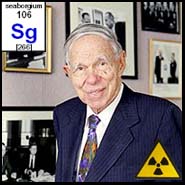
|
| Basic properties | |
|---|---|
| Atomic number | 106 |
| Atomic weight | 266.12193 amu |
| Element family | Transition metals |
| Period | 7 |
| Group | 2 |
| Block | s-block |
| Discovery year | 1974 |
| Isotope distribution |
|---|
| None |
| Physical properties | |
|---|---|
| Density | 23 g/cm3 (STP) |
Atomic hydrogen (H) 8.988E-5 Meitnerium (Mt) 28 | |
| Chemical properties | |
|---|---|
| Oxidation states (less common) | (+3, +4, +5, +6) |
| Atomic radius | |
|---|---|
| Covalent radius | 1.43 Å |
Atomic hydrogen (H) 0.32 Francium (Fr) 2.6 | |
| Electronic properties | |
|---|---|
| Electrons per shell | 2, 8, 18, 32, 32, 12, 2 |
| Electronic configuration | [Rn] 5f14 |
|
Bohr atom model

| |
|
Orbital box diagram

| |
| Valence electrons | 6 |
| Lewis dot structure |
|
| Orbital Visualization | |
|---|---|
|
| |
| Electrons | - |
Seaborgium (Sg): Periodic Table Element
Abstract
Seaborgium is a synthetic transactinide element with atomic number 106 and symbol Sg, positioned in group 6 of the periodic table. As the fourth member of the 6d transition metal series, seaborgium exhibits chemical properties consistent with its position as the heaviest congener of tungsten. The element demonstrates exclusively radioactive behavior with all known isotopes displaying half-lives ranging from microseconds to several minutes. Experimental investigations confirm seaborgium's formation of volatile hexavalent compounds and oxychlorides, following expected periodic trends. The element's chemical characterization relies on single-atom chemistry techniques due to its extremely limited production rates and short-lived isotopes.
Introduction
Seaborgium occupies position 106 in the periodic table, representing the culmination of the 6d transition metal series and the heaviest member of group 6. The element exhibits electronic configuration [Rn]5f146d47s2, characteristic of the late transactinide elements where relativistic effects significantly influence chemical behavior. As a superheavy element, seaborgium demonstrates the theoretical predictions regarding the stability of higher oxidation states in the heaviest transition metals. The element was first synthesized through ion bombardment techniques in 1974, marking a significant achievement in superheavy element research. Discovery claims by both Soviet and American research teams led to extensive verification studies before the International Union of Pure and Applied Chemistry officially recognized the name seaborgium in 1997, honoring nuclear chemist Glenn T. Seaborg.
Physical Properties and Atomic Structure
Fundamental Atomic Parameters
Seaborgium possesses atomic number 106 with electronic configuration [Rn]5f146d47s2, exhibiting four unpaired 6d electrons available for chemical bonding. The atomic radius is predicted at approximately 128 pm, while the ionic radius of hexacoordinate Sg6+ measures 65 pm. Relativistic effects substantially destabilize the 6d orbitals while stabilizing the 7s orbitals, creating an energy gap that favors electron removal from 6d before 7s orbitals. This electronic arrangement results in preferential formation of high oxidation states, with the +6 oxidation state demonstrating exceptional stability compared to lighter group 6 elements. The effective nuclear charge experienced by valence electrons exceeds 3.0, contributing to the element's chemical reactivity and bonding characteristics.
Macroscopic Physical Characteristics
Seaborgium is predicted to exhibit metallic character with a body-centered cubic crystal structure analogous to tungsten. Theoretical calculations suggest a density of 23-24 g/cm³, substantially lower than early predictions of 35.0 g/cm³. The element demonstrates extreme radioactivity with all isotopes undergoing rapid decay through alpha emission or spontaneous fission. Melting and boiling points remain undetermined experimentally due to the element's short half-life and limited synthesis quantities. Phase transition temperatures are estimated to exceed 3000 K for melting based on extrapolation from periodic trends, though experimental verification remains impossible under current production constraints.
Chemical Properties and Reactivity
Electronic Structure and Bonding Behavior
Seaborgium demonstrates remarkable chemical behavior dominated by the +6 oxidation state, which exhibits greater stability than corresponding states in lighter group 6 elements. The electronic configuration facilitates electron loss sequence Sg+ [Rn]5f146d37s2, Sg2+ [Rn]5f146d37s1, proceeding to Sg6+ [Rn]5f14. Relativistic destabilization of 6d orbitals renders the +4 oxidation state highly unstable and readily oxidized to +6. Chemical bonding exhibits predominantly covalent character in higher oxidation states, with d-orbital participation creating multiple bonding opportunities. Coordination chemistry demonstrates preference for octahedral geometries with oxygen and halogen ligands, following established group 6 patterns.
Electrochemical and Thermodynamic Properties
Electrochemical properties reflect seaborgium's position in group 6 with calculated standard reduction potentials indicating strong oxidizing character in aqueous solution. The potential for 2SgO₃ + 2H⁺ + 2e⁻ ⇌ Sg₂O₅ + H₂O equals -0.046 V, while Sg²⁺ + 2e⁻ ⇌ Sg shows +0.27 V. These values demonstrate thermodynamic favorability of high oxidation states and resistance to reduction under standard conditions. Ionization energies follow expected trends with first ionization energy approximately 757 kJ/mol, substantially higher than tungsten due to increased nuclear charge. Electron affinity remains minimal, consistent with metallic character and preference for electron loss rather than gain.
Chemical Compounds and Complex Formation
Binary and Ternary Compounds
Seaborgium forms volatile hexafluoride SgF₆ and moderately volatile hexachloride SgCl₆, following established group 6 trends. Experimental synthesis of seaborgium oxychloride SgO₂Cl₂ confirms theoretical predictions regarding compound formation and volatility. The oxychloride demonstrates decreased volatility compared to molybdenum and tungsten analogs, following the sequence MoO₂Cl₂ > WO₂Cl₂ > SgO₂Cl₂. Binary oxides include SgO₃ and SgO₂, formed through oxidation reactions with molecular oxygen. Pentachloride SgCl₅ and oxychlorides SgOCl₄ exhibit thermal instability at elevated temperatures, decomposing to lower oxidation state compounds.
Coordination Chemistry and Organometallic Compounds
Seaborgium demonstrates coordination chemistry consistent with group 6 elements through formation of carbonyl complexes. Experimental synthesis of seaborgium hexacarbonyl Sg(CO)₆ confirms zero oxidation state stability and π-back bonding capability. The carbonyl complex exhibits volatility comparable to molybdenum and tungsten analogs, with similar reactivity toward silicon dioxide surfaces. Aqueous coordination chemistry involves extensive hydrolysis of [Sg(H₂O)₆]⁶⁺ to form species such as [Sg(OH)₄(H₂O)]²⁺ and [SgO(OH)₃(H₂O)₂]⁺. Complex formation with fluoride ligands produces [SgO₂F₃]⁻ and neutral SgO₂F₂, demonstrating competitive hydrolysis and complexation equilibria.
Natural Occurrence and Isotopic Analysis
Geochemical Distribution and Abundance
Seaborgium does not occur naturally, with extensive searches in terrestrial materials yielding negative results. Theoretical crustal abundance approaches zero, with upper limits established at less than 5.1 × 10⁻¹⁵ atom(Sg)/atom(W) in natural tungsten samples. The element's absence from natural systems results from extremely short half-lives preventing primordial survival and lack of natural nuclear processes capable of seaborgium synthesis. Cosmic abundance remains undetectable due to insufficient stellar nucleosynthesis pathways for superheavy element formation. Environmental distribution studies focus on laboratory containment protocols rather than natural occurrence monitoring.
Nuclear Properties and Isotopic Composition
Fourteen seaborgium isotopes ranging from mass 257 to 271 have been identified, with four possessing metastable states. Half-lives span from 9.3 microseconds for ²⁶¹ᵐSg to approximately 9.8 minutes for ²⁶⁷Sg, following general trends toward increased stability with higher mass numbers. Alpha decay predominates in odd-mass nuclei, while spontaneous fission dominates even-mass isotopes due to nuclear pairing effects. Nuclear cross-sections for synthesis reactions typically measure 0.3 nanobarns for ²⁶³Sg production, requiring sophisticated detection systems for atom identification. Decay chains proceed through rutherfordium and nobelium isotopes, providing confirmation of seaborgium assignments through correlation analysis.
Industrial Production and Technological Applications
Extraction and Purification Methodologies
Seaborgium production relies exclusively on nuclear synthesis through ion bombardment of heavy actinide targets. The reaction ²⁴⁸Cm(²²Ne,5n)²⁶⁵Sg provides optimal production rates of several atoms per minute under current accelerator capabilities. Cold fusion reactions utilizing ²⁰⁶Pb(⁵⁴Cr,n)²⁵⁹Sg offer alternative synthesis routes with reduced excitation energies. Production efficiency remains extremely low with cross-sections measured in picobarns to nanobarns, requiring continuous beam operation for meaningful yields. Separation and purification involve gas-phase chemistry techniques utilizing volatile compound formation, with detection accomplished through alpha spectroscopy and spontaneous fission counting.
Technological Applications and Future Prospects
Current applications of seaborgium focus entirely on fundamental nuclear physics research and periodic table studies. Chemical investigations provide crucial data for theoretical model validation and relativistic effect understanding. The element serves as a benchmark for superheavy element prediction methodologies and nuclear structure calculations. Future applications remain limited by production constraints and radioactive decay, though potential roles in advanced nuclear physics experiments and fundamental constant measurements may emerge. Economic significance remains negligible due to synthesis costs exceeding millions of dollars per atom, restricting usage to specialized research facilities.
Historical Development and Discovery
Element 106 discovery involved competing claims from research teams at the Joint Institute for Nuclear Research in Dubna, Soviet Union, and Lawrence Berkeley National Laboratory in the United States during 1974. The Soviet team reported spontaneous fission events attributed to seaborgium-260 synthesis through ²⁰⁸Pb(⁵⁴Cr,2n) reactions, while American researchers identified seaborgium-263 through ²⁴⁹Cf(¹⁸O,4n) bombardment with alpha decay verification. Controversy regarding discovery priority persisted until 1992 when the IUPAC/IUPAP Transfermium Working Group credited Berkeley researchers based on superior experimental confirmation. Naming disputes continued through the 1990s with initial IUPAC resistance to honoring living persons, before final acceptance of "seaborgium" in 1997. Glenn T. Seaborg's recognition as the element's namesake represents unprecedented acknowledgment of contributions to transuranium element chemistry and nuclear science advancement.
Conclusion
Seaborgium represents the culmination of group 6 chemistry and demonstrates the profound influence of relativistic effects on superheavy element behavior. The element's preferential formation of hexavalent compounds and volatile species confirms theoretical predictions while establishing empirical foundations for further transactinide investigations. Chemical characterization through single-atom techniques reveals remarkable stability of high oxidation states and complex formation patterns consistent with periodic trends. Future research directions include synthesis of heavier isotopes approaching the predicted island of stability and expansion of chemical studies to explore coordination geometries and reaction mechanisms. Seaborgium's significance extends beyond fundamental chemistry to encompass nuclear structure understanding and relativistic quantum mechanics validation in extreme atomic systems.

Please let us know how we can improve this web app.
