| Element | |
|---|---|
94PuPlutonium244.06422
8 18 32 24 8 2 |
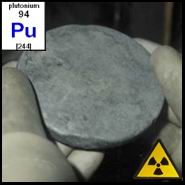
|
| Basic properties | |
|---|---|
| Atomic number | 94 |
| Atomic weight | 244.0642 amu |
| Element family | Actinoids |
| Period | 7 |
| Group | 2 |
| Block | s-block |
| Discovery year | 1940 |
| Isotope distribution |
|---|
| None |
| Physical properties | |
|---|---|
| Density | 19.84 g/cm3 (STP) |
Atomic hydrogen (H) 8.988E-5 Meitnerium (Mt) 28 | |
| Melting | 640 °C |
Helium (He) -272.2 Carbon (C) 3675 | |
| Boiling | 3327 °C |
Helium (He) -268.9 Tungsten (W) 5927 | |
| Chemical properties | |
|---|---|
| Oxidation states (less common) | +4 (+2, +3, +5, +6, +7, +8) |
| First ionization potential | 6.060 eV |
Cesium (Cs) 3.894 Helium (He) 24.587 | |
| Electron affinity | -0.500 eV |
Nobelium (No) -2.33 Atomic chlorine (Cl) 3.612725 | |
| Electronegativity | 1.28 |
Cesium (Cs) 0.79 Atomic fluorine (F) 3.98 | |
| Electronic properties | |
|---|---|
| Electrons per shell | 2, 8, 18, 32, 24, 8, 2 |
| Electronic configuration | [Rn] 5f6 |
|
Bohr atom model

| |
|
Orbital box diagram

| |
| Valence electrons | 8 |
| Lewis dot structure |
|
| Orbital Visualization | |
|---|---|
|
| |
| Electrons | - |
Plutonium (Pu): Periodic Table Element
Abstract
Plutonium (symbol Pu, atomic number 94) represents a unique actinide element characterized by complex electronic structure and exceptional nuclear properties. This synthetic transuranic element exhibits six distinct crystallographic allotropes at ambient pressure, with density variations ranging from 16.00 to 19.86 g/cm³. The element demonstrates multiple oxidation states from +3 to +7, with the +4 state being most prevalent in aqueous solution. All plutonium isotopes exhibit radioactivity, with ²³⁹Pu possessing a half-life of 24,100 years and serving as the primary fissile isotope for nuclear applications. The element's 5f electronic configuration places it at the boundary between localized and delocalized electron behavior, contributing to its unusual physical and chemical properties. Plutonium compounds include diverse binary and ternary species, with PuO₂ being the most thermodynamically stable oxide under standard conditions.
Introduction
Plutonium occupies position 94 in the periodic table within the actinide series, representing the second transuranium element discovered through artificial nuclear synthesis. The element exhibits 5f⁶7s² ground-state electronic configuration, placing it among the most electronically complex elements known to chemistry. Its discovery in December 1940 at the University of California, Berkeley, through deuteron bombardment of uranium-238, marked a pivotal moment in nuclear chemistry and physics. The element's unique position in the actinide series reflects the transitional nature of 5f electrons, which demonstrate characteristics intermediate between the localized 4f electrons of lanthanides and the delocalized d electrons of transition metals.
Plutonium's chemical behavior reflects the complex interplay between its electronic structure and nuclear instability. The element demonstrates remarkable polymorphism, existing in six distinct crystallographic modifications at ambient pressure, a property unmatched among metallic elements. This structural complexity, combined with its radioactive decay processes, results in time-dependent changes in physical properties through self-irradiation damage. The element's significance extends beyond fundamental chemistry into nuclear technology, where its fissile isotopes play crucial roles in both energy production and weapons applications.
Physical Properties and Atomic Structure
Fundamental Atomic Parameters
Plutonium possesses atomic number 94, with a complex electronic configuration of [Rn]5f⁶7s² in its ground state. However, the element exhibits significant configuration mixing, with competing 5f⁶7s² and 5f⁵6d¹7s² arrangements contributing to its electronic structure. The 5f orbitals in plutonium represent a unique case in the periodic table, as they exist at the boundary between localized and delocalized behavior. This intermediate character manifests in unusual magnetic properties and complex chemical bonding patterns distinct from both lanthanides and transition metals.
The atomic radius of plutonium metal varies significantly with temperature and allotropic form, reflecting the element's complex structural behavior. The metallic radius in the α-phase measures approximately 151 pm, with ionic radii dependent on oxidation state and coordination environment. For the prevalent Pu⁴⁺ ion in octahedral coordination, the ionic radius is approximately 86 pm, while the larger Pu³⁺ ion exhibits a radius of 101 pm. These values reflect the actinide contraction, similar to the lanthanide contraction but more pronounced due to poor shielding by 5f electrons.
Macroscopic Physical Characteristics
Plutonium metal demonstrates extraordinary structural complexity through its six distinct allotropic forms at atmospheric pressure. The α-phase, stable at room temperature, crystallizes in a monoclinic structure with exceptional complexity, containing 16 atoms per unit cell and exhibiting density of 19.86 g/cm³. This low-symmetry structure contributes to the metal's brittleness and poor mechanical properties. Upon heating to 125°C, the α-phase transforms to the β-phase, followed by successive transitions through γ, δ, δ', and ε phases before melting at 640°C.
The δ-phase, stable between 310°C and 452°C, exhibits face-centered cubic structure with significantly reduced density of 15.92 g/cm³. This phase demonstrates remarkable ductility and malleability compared to the brittle α-phase. The substantial density decrease of approximately 25% during the α→δ transformation represents one of the largest volume changes observed in metallic phase transitions. The metal's thermal conductivity of 6.74 W/m·K at room temperature reflects poor heat transport properties, while electrical resistivity of 146 μΩ·cm indicates semiconducting behavior rather than typical metallic conduction.
Plutonium metal exhibits silvery appearance when freshly prepared but rapidly tarnishes in air, developing a dull gray oxide surface layer. The boiling point of 3228°C provides a liquid range exceeding 2500 K, among the largest for metallic elements. Heat capacity measurements yield 35.5 J/mol·K at 298 K, with significant temperature dependence reflecting electronic and magnetic contributions from the 5f electrons.
Chemical Properties and Reactivity
Electronic Structure and Bonding Behavior
The chemical reactivity of plutonium derives primarily from its 5f electronic configuration and the unusual energy relationships between 5f, 6d, and 7s orbitals. The element readily exhibits oxidation states of +3, +4, +5, and +6 in aqueous solution, with less common +2 and +7 states observable under specific conditions. The +4 oxidation state predominates in acidic aqueous media, corresponding to the Pu⁴⁺ ion, which appears yellow-brown in solution. The +3 state manifests as blue-violet Pu³⁺ ions, while the +5 plutonyl ion PuO₂⁺ exhibits characteristic pink coloration.
Bonding in plutonium compounds involves complex orbital mixing between 5f, 6d, and 7p orbitals, resulting in covalent character superimposed on predominantly ionic interactions. The 5f orbitals participate more extensively in chemical bonding compared to 4f orbitals in lanthanides, contributing to greater structural diversity and unusual coordination geometries. Coordination numbers ranging from 6 to 12 are observed in solid compounds, with 8-coordinate geometries being particularly common for the larger Pu³⁺ and Pu⁴⁺ ions.
Electrochemical and Thermodynamic Properties
Plutonium's electrochemical behavior reflects the complex stability relationships among its various oxidation states. Standard reduction potentials demonstrate the relative stability of different species: the Pu⁴⁺/Pu³⁺ couple exhibits E° = +0.98 V, while the PuO₂⁺/Pu⁴⁺ couple shows E° = +0.92 V. These values indicate that Pu⁴⁺ is thermodynamically unstable with respect to disproportionation into Pu³⁺ and PuO₂⁺, though kinetic factors often maintain the +4 state in acidic solutions.
The element's electron affinity and ionization energies reflect the progressive removal of 5f electrons. The first ionization energy of 584.7 kJ/mol compares with uranium's 597.6 kJ/mol, demonstrating the expected decrease down the actinide series. Successive ionization energies show irregular patterns due to electron-electron repulsion effects and orbital reorganization, with the fourth ionization energy of 3900 kJ/mol being particularly high due to the stability of the 5f⁵ configuration.
Chemical Compounds and Complex Formation
Binary and Ternary Compounds
Plutonium oxide chemistry exhibits remarkable complexity, with multiple stoichiometric phases documented. The dioxide PuO₂ represents the most thermodynamically stable compound, crystallizing in the fluorite structure with lattice parameter a = 5.396 Å. This cubic phase remains stable up to approximately 2400°C, exhibiting exceptional thermal stability. The monoxide PuO crystallizes in the rock salt structure but displays narrow stability range and tendency toward disproportionation. The sesquioxide Pu₂O₃ adopts the hexagonal lanthanum sesquioxide structure and exhibits pronounced pyrophoric behavior.
Plutonium halides encompass all four halogens across multiple oxidation states. The trifluoride PuF₃ crystallizes in the LaF₃ structure with purple coloration, while the tetrafluoride PuF₄ adopts the monoclinic UF₄ structure. The corresponding chlorides PuCl₃ and PuCl₄ exhibit similar structural relationships, with the trichloride showing emerald green color and the tetrachloride appearing yellow-green. Plutonium hexafluoride PuF₆ exists as a volatile brown solid at room temperature, demonstrating the element's ability to achieve high oxidation states in fluorine-rich environments.
Ternary compounds include diverse oxyhalides, exemplified by PuOCl, PuOBr, and PuOI. These compounds typically adopt layered structures related to the parent binary oxides and halides. Plutonium carbide PuC crystallizes in the rock salt structure and exhibits metallic conductivity, while the nitride PuN demonstrates similar structural characteristics with enhanced thermal stability.
Coordination Chemistry and Organometallic Compounds
Plutonium coordination chemistry reflects the element's multiple accessible oxidation states and flexible coordination requirements. Aqueous Pu⁴⁺ readily forms hydrolysis products and polynuclear species, with the tendency to form hydroxo-bridged dimers and higher oligomers. Complexation with oxygen donor ligands such as acetate, oxalate, and EDTA produces stable chelate complexes with coordination numbers typically ranging from 8 to 10. The coordination geometry often approaches square antiprism or bicapped trigonal prism configurations.
Organometallic plutonium chemistry includes cyclopentadienyl derivatives, most notably plutonocene Pu(C₅H₅)₃ and related sandwich compounds. These complexes exhibit unusual bonding characteristics due to the participation of 5f orbitals in metal-ligand interactions. The plutonocene molecule demonstrates bent sandwich geometry rather than the parallel ring arrangement observed in ferrocene, reflecting the directional nature of 5f orbital involvement in bonding.
Phosphine and arsine complexes of plutonium provide examples of soft donor ligand coordination. These compounds often exhibit lower coordination numbers due to the bulky nature of the ligands and demonstrate significant covalent character in the metal-ligand bonds. The synthesis and characterization of such complexes require strict exclusion of air and moisture due to the reducing nature of many plutonium oxidation states.
Natural Occurrence and Isotopic Analysis
Geochemical Distribution and Abundance
Plutonium occurs naturally in extremely trace quantities, primarily through neutron capture by uranium-238 followed by successive beta decays. Natural uranium ores contain plutonium at concentrations typically below 10⁻¹² g/g, representing parts-per-trillion abundance levels. The Oklo natural reactor site in Gabon provides the most significant natural occurrence, where sustained nuclear fission reactions approximately 2 billion years ago generated measurable quantities of plutonium isotopes through neutron capture processes.
Deep-sea sediments contain traces of ²⁴⁴Pu from extraterrestrial sources, primarily supernova nucleosynthesis events. This long-lived isotope (half-life 80.8 million years) serves as a cosmochemical tracer for recent stellar activity. Marine sediment analysis reveals ²⁴⁴Pu/²⁴⁰Pu ratios that reflect both cosmic and anthropogenic contributions to environmental plutonium inventories.
Geochemical behavior of plutonium in terrestrial environments involves complex interactions with mineral phases, organic matter, and groundwater systems. The element's multiple oxidation states result in variable mobility, with Pu⁴⁺ species generally exhibiting strong sorption to mineral surfaces while PuO₂⁺ and PuO₂²⁺ demonstrate enhanced solubility and transport potential. Environmental plutonium concentrations remain dominated by atmospheric nuclear testing fallout rather than natural production mechanisms.
Nuclear Properties and Isotopic Composition
Plutonium possesses no stable isotopes, with all known nuclides exhibiting radioactive decay. The mass range extends from ²²⁸Pu to ²⁴⁷Pu, with ²⁴⁴Pu representing the longest-lived species at 80.8 million years half-life. The most significant isotope, ²³⁹Pu, exhibits a half-life of 24,100 years and decays primarily through alpha emission to ²³⁵U. This isotope demonstrates thermal neutron fission cross-section of 747 barns, making it highly effective for nuclear reactor and weapons applications.
²³⁸Pu provides exceptional specific activity with half-life of 87.74 years, generating 560 watts per kilogram through alpha decay. This property enables its use in radioisotope thermoelectric generators for space missions and remote power applications. The isotope's high decay heat requires careful thermal management in practical applications. ²⁴⁰Pu exhibits significant spontaneous fission activity with 6,560-year half-life, producing neutron backgrounds that complicate nuclear weapons design.
²⁴¹Pu represents the only beta-emitting plutonium isotope commonly encountered, with 14.4-year half-life and decay to ²⁴¹Am. This transformation creates americium buildup in plutonium samples over time, contributing to increased gamma radiation and chemical complications. The isotope's fissile properties and high specific activity of 4.2 W/kg make it valuable despite handling challenges associated with its decay product.
Industrial Production and Technological Applications
Extraction and Purification Methodologies
Plutonium production occurs primarily through neutron irradiation of uranium-238 in nuclear reactors, followed by chemical separation from fission products and unused uranium. The initial nuclear reaction produces ²³⁹Np through neutron capture, which subsequently undergoes beta decay to ²³⁹Pu with 2.36-day half-life. Continued neutron exposure generates higher isotopes through successive capture reactions, resulting in mixed isotopic compositions dependent on irradiation history and neutron flux conditions.
Chemical separation employs the PUREX (Plutonium Uranium Redox EXtraction) process, utilizing tributyl phosphate in hydrocarbon diluent for selective extraction of plutonium and uranium from nitric acid solutions. The process exploits differences in extraction coefficients among various oxidation states, with Pu⁴⁺ and UO₂²⁺ being preferentially extracted while fission products remain in the aqueous phase. Subsequent stripping operations using reducing agents convert plutonium to non-extractable Pu³⁺, enabling selective separation from uranium.
Purification to weapons-grade specifications requires isotopic separation techniques or careful reactor operation to minimize ²⁴⁰Pu content. Reactor-grade plutonium typically contains 6-19% ²⁴⁰Pu, while weapons-grade material maintains <7% ²⁴⁰Pu content. The separation process generates substantial radioactive waste streams requiring long-term storage and management due to the presence of long-lived fission products and actinides.
Technological Applications and Future Prospects
Nuclear power generation represents the primary civilian application of plutonium through mixed oxide (MOX) fuel assemblies combining PuO₂ and UO₂. These fuel assemblies enable plutonium consumption in existing light water reactors while generating additional energy. Fast breeder reactor concepts utilize plutonium as both fissile material and breeding source for additional plutonium production from uranium-238, potentially extending uranium resources by factors of 60-100.
Space power applications employ ²³⁸Pu in radioisotope thermoelectric generators (RTGs) for missions where solar power proves inadequate. The isotope's 87.74-year half-life provides decades of reliable power output, making it invaluable for deep space exploration. Current RTG designs achieve electrical power outputs of 110-300 watts using approximately 3.6-10.9 kg of ²³⁸Pu dioxide fuel.
Future technological developments focus on advanced reactor designs utilizing plutonium fuel cycles, including Generation IV reactor concepts and accelerator-driven subcritical systems. These technologies aim to enhance plutonium utilization efficiency while minimizing long-term waste production through transmutation of long-lived actinides. Research continues into plutonium-based superconducting materials, with PuCoGa₅ demonstrating unconventional superconductivity below 18.5 K.
Historical Development and Discovery
Plutonium discovery resulted from systematic investigations of transuranium elements conducted by Glenn T. Seaborg's research group at the University of California, Berkeley. The element's synthesis on December 14, 1940, involved deuteron bombardment of uranium-238 using the 60-inch cyclotron, initially producing ²³⁸Np which subsequently decayed to ²³⁸Pu. Chemical identification proved challenging due to the minute quantities produced and the unknown chemical properties of element 94.
The research team's February 1941 confirmation of the new element involved tracer-scale chemical separations and nuclear property measurements. Early experiments established plutonium's chemical similarity to uranium and neptunium while revealing distinct redox behavior. The element's name, announced after wartime secrecy restrictions ended in 1948, honored the dwarf planet Pluto following the astronomical naming convention established for uranium and neptunium.
World War II dramatically accelerated plutonium research through the Manhattan Project, focusing on ²³⁹Pu production for nuclear weapons applications. The Hanford Site in Washington State operated the first large-scale plutonium production reactors beginning in 1944, employing natural uranium fuel in graphite-moderated, water-cooled designs. Chemical separation facilities processed irradiated uranium to extract plutonium at kilogram quantities, marking the transition from laboratory curiosity to industrial-scale production.
Post-war plutonium research expanded into fundamental chemistry and physics investigations, revealing the element's extraordinary complexity. Studies of metal allotropism, compound synthesis, and electronic structure provided insights into actinide chemistry more broadly. The development of civilian nuclear power in the 1950s created new applications for plutonium in reactor fuel cycles, while continuing weapons programs maintained large-scale production capabilities.
Conclusion
Plutonium occupies a unique position among the chemical elements through its combination of complex electronic structure, remarkable polymorphism, and significant technological importance. The element's 5f electronic configuration places it at a critical transition point in the actinide series, resulting in unusual physical and chemical properties that continue to challenge theoretical understanding. Its role in nuclear technology, from power generation to space exploration, demonstrates the practical significance of fundamental actinide chemistry research.
Future research directions encompass advanced theoretical treatments of 5f electron behavior, development of improved separation technologies for nuclear waste management, and exploration of novel plutonium compounds with unique properties. The element's scientific and technological significance ensures continued investigation into its fundamental chemistry while emphasizing responsible stewardship of existing plutonium inventories through effective utilization and safe storage strategies.

Please let us know how we can improve this web app.
