| Element | |
|---|---|
44RuRuthenium101.0722
8 18 15 1 |
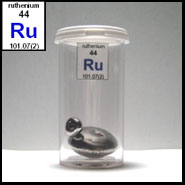
|
| Basic properties | |
|---|---|
| Atomic number | 44 |
| Atomic weight | 101.072 amu |
| Element family | Transition metals |
| Period | 5 |
| Group | 1 |
| Block | s-block |
| Discovery year | 1844 |
| Isotope distribution |
|---|
96Ru 5.52% 98Ru 1.88% 99Ru 12.7% 100Ru 12.6% 101Ru 17.0% 102Ru 31.6% 104Ru 18.7% |
96Ru (5.52%) 98Ru (1.88%) 99Ru (12.70%) 100Ru (12.60%) 101Ru (17.00%) 102Ru (31.60%) 104Ru (18.70%) |
| Physical properties | |
|---|---|
| Density | 12.37 g/cm3 (STP) |
Atomic hydrogen (H) 8.988E-5 Meitnerium (Mt) 28 | |
| Melting | 2250 °C |
Helium (He) -272.2 Carbon (C) 3675 | |
| Boiling | 3900 °C |
Helium (He) -268.9 Tungsten (W) 5927 | |
| Chemical properties | |
|---|---|
| Oxidation states (less common) | +3, +4 (-2, 0, +1, +2, +5, +6, +7, +8) |
| First ionization potential | 7.361 eV |
Cesium (Cs) 3.894 Helium (He) 24.587 | |
| Electron affinity | 1.046 eV |
Nobelium (No) -2.33 Atomic chlorine (Cl) 3.612725 | |
| Electronegativity | 2.2 |
Cesium (Cs) 0.79 Atomic fluorine (F) 3.98 | |
| Atomic radius | |
|---|---|
| Covalent radius | 1.25 Å |
Atomic hydrogen (H) 0.32 Francium (Fr) 2.6 | |
| Metallic radius | 1.34 Å |
Beryllium (Be) 1.12 Cesium (Cs) 2.65 | |
| Compounds | ||
|---|---|---|
| Formula | Name | Oxidation state |
| C43H72Cl2P2Ru | Grubbs catalyst | +2 |
| RuCl2 | Ruthenium(II) chloride | +2 |
| RuCl3 | Ruthenium(III) chloride | +3 |
| Ru(CH3COO)3 | Ruthenium(III) acetate | +3 |
| Ru(NO3)3 | Ruthenium(III) nitrate | +3 |
| RuBr3 | Ruthenium(III) bromide | +3 |
| BaRuO3 | Barium ruthenate | +4 |
| Li2RuO3 | Lithium ruthenate | +4 |
| RuCl4 | Ruthenium tetrachloride | +4 |
| RuF4 | Ruthenium(IV) fluoride | +4 |
| RuF6 | Ruthenium hexafluoride | +6 |
| RuO4 | Ruthenium(VIII) oxide | +8 |
| Electronic properties | |
|---|---|
| Electrons per shell | 2, 8, 18, 15, 1 |
| Electronic configuration | [Kr] 4d7 |
|
Bohr atom model

| |
|
Orbital box diagram

| |
| Valence electrons | 8 |
| Lewis dot structure |
|
| Orbital Visualization | |
|---|---|
|
| |
| Electrons | - |
Ruthenium (Ru): Periodic Table Element
Abstract
Ruthenium is a rare transition metal element with atomic number 44 and chemical symbol Ru, belonging to the platinum group metals in group 8 of the periodic table. This hard, lustrous silvery-white metal exhibits exceptional chemical inertness at ambient conditions and demonstrates remarkable resistance to corrosion and oxidation. Ruthenium possesses the electronic configuration [Kr] 4d7 5s1 and exhibits oxidation states ranging from −2 to +8, with +2, +3, and +4 being most common. The element displays unique physical properties including a melting point of 2607 K, boiling point of 4423 K, and density of 12.45 g/cm³. Industrial applications encompass electrical contacts, thick-film resistors, and catalytic processes. Annual global production approximates 35 tonnes, with South African and Russian deposits comprising primary commercial sources.
Introduction
Ruthenium occupies position 44 in the periodic table, situated in the second row of transition metals within group 8. The element exhibits the anomalous electron configuration [Kr] 4d7 5s1, diverging from the expected d6s2 pattern observed in neighboring iron. This configuration results from the stabilization energy associated with half-filled d subshells and contributes to ruthenium's distinctive chemical properties. Karl Ernst Claus discovered ruthenium in 1844 while analyzing platinum ore residues at Kazan University, naming the element after Ruthenia, the historical Latin designation for Russia. The discovery marked a significant advancement in platinum group metal chemistry and established ruthenium as the final member of the lighter platinum group triad, alongside rhodium and palladium.
Physical Properties and Atomic Structure
Fundamental Atomic Parameters
Ruthenium possesses atomic number 44 with an atomic mass of 101.07 u. The electronic structure follows the configuration [Kr] 4d7 5s1, presenting an anomaly within group 8 elements where the 5s orbital contains only one electron rather than two. This arrangement arises from exchange energy stabilization within the d7 configuration. The atomic radius measures 134 pm, while ionic radii vary with oxidation state: Ru3+ exhibits 68 pm and Ru4+ displays 62 pm radius. The effective nuclear charge experienced by valence electrons approximates 4.1, moderated by inner shell screening effects. First ionization energy equals 710.2 kJ/mol, second ionization energy measures 1620 kJ/mol, and third ionization energy reaches 2747 kJ/mol, reflecting the progressive increase in nuclear attraction upon electron removal.
Macroscopic Physical Characteristics
Ruthenium manifests as a lustrous, hard, silvery-white metal exhibiting remarkable mechanical durability. The element crystallizes in a hexagonal close-packed structure with lattice parameters a = 270.6 pm and c = 428.1 pm at ambient conditions. Four polymorphic modifications exist, with the hexagonal phase remaining stable under normal pressure and temperature conditions. Density equals 12.45 g/cm³ at 298 K, placing ruthenium among the denser elements. The melting point reaches 2607 K (2334°C), while the boiling point achieves 4423 K (4150°C). Heat of fusion measures 38.59 kJ/mol, heat of vaporization equals 591.6 kJ/mol, and specific heat capacity at constant pressure equals 24.06 J/(mol·K). Thermal conductivity measures 117 W/(m·K) at room temperature, while electrical resistivity equals 7.1 × 10⁻⁸ Ω·m.
Chemical Properties and Reactivity
Electronic Structure and Bonding Behavior
Ruthenium's d7s1 valence configuration enables oxidation states from −2 to +8, though +2, +3, and +4 predominate in stable compounds. The element exhibits variable coordination geometries including octahedral, tetrahedral, and square planar arrangements depending on ligand field strength and oxidation state. Bond formation involves primarily d orbital hybridization, with significant π-bonding capacity arising from filled and partially filled d orbitals. Average Ru−O bond lengths range from 197 pm in RuO4 to 205 pm in RuO2, while Ru−Cl bonds typically measure 235-245 pm. The element demonstrates strong affinity for π-acceptor ligands such as carbon monoxide and phosphines, forming stable coordination complexes through synergistic σ-donation and π-backbonding mechanisms.
Electrochemical and Thermodynamic Properties
Ruthenium exhibits electronegativity values of 2.2 on the Pauling scale and 4.5 eV on the Mulliken scale, indicating moderate electron-attracting capability. Standard electrode potentials in acidic aqueous solution demonstrate the element's redox versatility: Ru3+/Ru2+ couple exhibits +0.249 V, while RuO42−/Ru2+ reaches +1.563 V, indicating strong oxidizing capability of higher oxidation states. Electron affinity measures 101.3 kJ/mol, reflecting moderate tendency to accept electrons. Thermodynamic stability analysis reveals that ruthenium compounds generally exhibit negative formation enthalpies, with RuO2 showing ΔHf° = −305.0 kJ/mol. The element demonstrates exceptional stability toward atmospheric corrosion, remaining unreactive with oxygen, water, and most acids at ambient temperature. Oxidation begins only above 1073 K, forming volatile RuO4.
Chemical Compounds and Complex Formation
Binary and Ternary Compounds
Ruthenium forms diverse oxide compounds spanning multiple oxidation states. Ruthenium dioxide (RuO2) represents the most thermodynamically stable oxide, crystallizing in the rutile structure with tetragonal symmetry. The compound exhibits metallic conductivity and catalytic activity for oxygen evolution reactions. Ruthenium tetroxide (RuO4) constitutes a volatile yellow solid melting at 298 K, demonstrating powerful oxidizing properties analogous to osmium tetroxide. Halide formation encompasses all common halogens: ruthenium hexafluoride (RuF6) forms a dark brown solid with octahedral molecular geometry, while ruthenium trichloride (RuCl3) exists as polymeric red-brown crystals. Chalcogenide compounds include ruthenium disulfide (RuS2) adopting the pyrite structure and ruthenium diselenide (RuSe2) with similar crystallographic arrangement.
Coordination Chemistry and Organometallic Compounds
Ruthenium demonstrates extensive coordination chemistry with diverse ligand types. Pentaammine complexes [Ru(NH3)5L]n+ exhibit octahedral geometry with the sixth coordination site occupied by variable ligands. Polypyridyl complexes, exemplified by [Ru(bpy)3]2+, display luminescent properties and electron transfer capabilities. Organometallic compounds include ruthenocene (Ru(C5H5)2) with sandwich structure and ruthenium carbonyl clusters such as Ru3(CO)12. Carbene complexes, notably Grubbs catalysts containing ruthenium-carbon double bonds, enable olefin metathesis reactions with high selectivity and functional group tolerance. Phosphine-ligated species like RuCl2(PPh3)3 serve as versatile synthetic precursors for diverse ruthenium coordination compounds.
Natural Occurrence and Isotopic Analysis
Geochemical Distribution and Abundance
Ruthenium exhibits extremely low crustal abundance, approximately 0.001 ppm (1 ppb), ranking as the 78th most abundant element. Primary occurrence associates with ultramafic igneous rocks and platinum group metal deposits in layered intrusions. Major deposits concentrate in the Bushveld Complex of South Africa, containing approximately 95% of global ruthenium reserves, and the Norilsk-Talnakh region of Russia. Smaller economically significant deposits occur in the Sudbury Basin of Ontario, Canada, within sulfide ore bodies. Geochemical fractionation during magmatic processes concentrates ruthenium alongside other platinum group elements through sulfide liquid immiscibility. The element demonstrates highly siderophile behavior, preferentially partitioning into metallic phases during planetary differentiation processes.
Nuclear Properties and Isotopic Composition
Natural ruthenium comprises seven stable isotopes: 96Ru (5.54%), 98Ru (1.87%), 99Ru (12.76%), 100Ru (12.60%), 101Ru (17.06%), 102Ru (31.55%), and 104Ru (18.62%). The isotope 102Ru exhibits zero nuclear spin, while others possess various spin states contributing to NMR spectroscopic applications. Nuclear magnetic moments range from −0.6413 nuclear magnetons for 99Ru to +0.2875 for 101Ru. Thirty-four radioactive isotopes have been characterized, with 106Ru displaying the longest half-life at 373.59 days. This isotope undergoes beta decay to 106Rh and finds application in medical radiotherapy. Mass numbers of known isotopes span from 90 to 115, with thermal neutron cross-sections varying significantly: 104Ru exhibits 0.31 barns while 105Ru reaches 1200 barns.
Industrial Production and Technological Applications
Extraction and Purification Methodologies
Ruthenium extraction proceeds as a byproduct of platinum group metal recovery from copper and nickel refining operations. Primary feedstock consists of anode mud precipitates from electrorefining processes, containing 0.5-2% ruthenium by mass. Initial separation employs sodium peroxide fusion at 873 K followed by aqua regia dissolution to solubilize precious metals. Ruthenium remains insoluble with osmium and iridium, enabling preliminary separation through precipitation. Subsequent treatment with sodium bisulfate at 723 K dissolves ruthenium while leaving osmium and iridium undissolved. Oxidation to volatile RuO4 permits distillation purification, with collection efficiency exceeding 95%. Final reduction utilizes hydrogen gas at 773 K, yielding metallic ruthenium powder with purity approaching 99.9%. Annual global production approximates 35 tonnes, with South Africa contributing approximately 85% of total output.
Technological Applications and Future Prospects
Electrical applications constitute ruthenium's primary industrial use, consuming approximately 45% of annual production. Electrical contacts utilize ruthenium's wear resistance and oxidation stability, particularly in switching devices operating at high current densities. Thick-film resistors incorporate ruthenium dioxide with lead and bismuth ruthenates, providing stable resistance values across temperature ranges. Catalytic applications encompass Fischer-Tropsch synthesis, where ruthenium-promoted cobalt catalysts demonstrate superior selectivity for linear hydrocarbons. Olefin metathesis catalysts, notably Grubbs catalysts, enable pharmaceutical synthesis and polymer production with exceptional efficiency. Emerging applications include data storage media, where ruthenium films provide magnetic coupling in multilayer structures, and hydrogen storage materials through metal hydride formation. Future prospects involve fuel cell electrodes, supercapacitor materials, and advanced memory devices leveraging ruthenium's electronic properties.
Historical Development and Discovery
Ruthenium discovery originated from systematic analysis of platinum ore residues during the early 19th century expansion of platinum chemistry. Gottfried Osann claimed discovery in 1828 while examining Ural Mountain platinum ores, proposing three new elements including ruthenium. However, Jöns Jakob Berzelius disputed these findings, initiating a prolonged scientific controversy regarding residue composition. Karl Ernst Claus resolved this dispute in 1844 through definitive isolation and characterization at Kazan University. Claus obtained 6 grams of ruthenium from platinum ore insoluble in aqua regia, establishing the element's distinct identity through systematic chemical analysis. The naming honored Russia through the Latin designation Ruthenia, reflecting the element's discovery location in the Russian Empire. Subsequently, Theodore William Richards determined the precise atomic weight in 1905, while Henry Moseley's X-ray spectroscopy confirmed atomic number 44 in 1913. Modern industrial applications developed following World War II advances in electrical contact technology and catalytic chemistry.
Conclusion
Ruthenium represents a unique member of the platinum group metals, distinguished by its exceptional chemical stability, diverse oxidation chemistry, and specialized technological applications. The element's anomalous electronic configuration contributes to distinctive bonding properties and catalytic capabilities that continue to drive industrial innovation. Current applications in electronics, catalysis, and emerging technologies demonstrate ruthenium's critical role in advanced materials science. Future research directions encompass single-atom catalysis, quantum computing applications, and sustainable energy technologies where ruthenium's unique properties offer significant advantages. The element's scarcity and concentrated geographic distribution underscore the importance of recycling technologies and alternative material development. Understanding ruthenium's fundamental chemistry remains essential for optimizing existing applications and developing next-generation technologies requiring superior chemical and physical performance characteristics.

Please let us know how we can improve this web app.
