| Element | |
|---|---|
67HoHolmium164.9303222
8 18 29 8 2 |
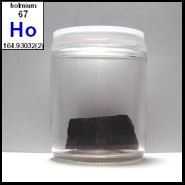
|
| Basic properties | |
|---|---|
| Atomic number | 67 |
| Atomic weight | 164.930322 amu |
| Element family | N/A |
| Period | 6 |
| Group | 2 |
| Block | s-block |
| Discovery year | 1878 |
| Isotope distribution |
|---|
165Ho 100% |
| Physical properties | |
|---|---|
| Density | 8.795 g/cm3 (STP) |
Atomic hydrogen (H) 8.988E-5 Meitnerium (Mt) 28 | |
| Melting | 1470 °C |
Helium (He) -272.2 Carbon (C) 3675 | |
| Boiling | 2720 °C |
Helium (He) -268.9 Tungsten (W) 5927 | |
| Chemical properties | |
|---|---|
| Oxidation states (less common) | +3 (0, +2) |
| First ionization potential | 6.021 eV |
Cesium (Cs) 3.894 Helium (He) 24.587 | |
| Electron affinity | 0.338 eV |
Nobelium (No) -2.33 Atomic chlorine (Cl) 3.612725 | |
| Electronegativity | 1.23 |
Cesium (Cs) 0.79 Atomic fluorine (F) 3.98 | |
| Electronic properties | |
|---|---|
| Electrons per shell | 2, 8, 18, 29, 8, 2 |
| Electronic configuration | [Xe] 4f11 |
|
Bohr atom model

| |
|
Orbital box diagram

| |
| Valence electrons | 13 |
| Lewis dot structure |
|
| Orbital Visualization | |
|---|---|
|
| |
| Electrons | - |
Holmium (Ho): Periodic Table Element
Abstract
Holmium represents the sixty-seventh element of the periodic table, characterized by exceptional magnetic properties and distinctive spectroscopic characteristics. This rare-earth metal exhibits the highest magnetic permeability and magnetic saturation of any naturally occurring element, manifesting unique ferromagnetic behavior below 19 K. Positioned as the eleventh member of the lanthanide series, holmium displays typical trivalent chemistry with electron configuration [Xe] 4f11 6s2. The element demonstrates significant technological applications in laser systems, magnetic pole pieces, and nuclear reactor control systems. Natural abundance remains limited at 1.4 parts per million in Earth's crust, with commercial extraction primarily from monazite deposits through ion-exchange processes. Holmium compounds exhibit characteristic yellow coloration and distinctive absorption spectra utilized in optical calibration standards.
Introduction
Holmium occupies a unique position within the lanthanide series, distinguished by its exceptional magnetic properties that exceed those of all other naturally occurring elements. Located in period 6 of the periodic table between dysprosium and erbium, holmium manifests the characteristic electronic structure of heavy lanthanides with eleven unpaired 4f electrons. The element's magnetic moment of 10.6 μB represents the maximum value achieved among naturally occurring elements. Discovery occurred through the collaborative efforts of Jacques-Louis Soret, Marc Delafontaine, and Per Teodor Cleve in 1878, utilizing spectroscopic techniques to identify distinctive absorption lines in yttrium-bearing minerals. The element's name derives from Holmia, the Latin designation for Stockholm, reflecting its Swedish discovery. Industrial significance has emerged through applications in high-field magnetic systems, laser technology, and nuclear reactor control, despite its relative scarcity and challenging separation from other rare-earth elements.
Physical Properties and Atomic Structure
Fundamental Atomic Parameters
Holmium exhibits atomic number 67 with electron configuration [Xe] 4f11 6s2, positioning thirteen valence electrons in the 4f and 6s subshells. The atomic radius measures 176 pm, while the trivalent ionic radius Ho3+ spans 90.1 pm in octahedral coordination. Effective nuclear charge calculations indicate substantial shielding effects from inner electron shells, characteristic of lanthanide elements. The 4f11 configuration produces maximum orbital angular momentum coupling, resulting in ground-state term symbol 5I8. Successive ionization energies demonstrate the stability of the trivalent oxidation state: first ionization energy 581 kJ/mol, second ionization energy 1140 kJ/mol, and third ionization energy 2204 kJ/mol. The significant increase between third and fourth ionization energies reflects the stability of the 4f10 configuration in the tetravalent state.
Macroscopic Physical Characteristics
Pure holmium displays a bright silvery-white metallic luster with relatively soft mechanical properties characteristic of heavy lanthanides. The element crystallizes in hexagonal close-packed structure at standard conditions with lattice parameters a = 357.73 pm and c = 561.58 pm. Density reaches 8.795 g/cm3 at room temperature, reflecting the substantial atomic mass of 164.93 u. Melting point occurs at 1734 K (1461°C), while boiling point reaches 2993 K (2720°C), positioning holmium as the sixth most volatile lanthanide after ytterbium, europium, samarium, thulium, and dysprosium. Heat of fusion measures 17.0 kJ/mol, with heat of vaporization reaching 265 kJ/mol. Specific heat capacity at constant pressure equals 27.15 J/(mol·K) at 298 K. The metal exhibits paramagnetic behavior at ambient temperature, transitioning to ferromagnetic ordering below the Curie temperature of 19 K.
Chemical Properties and Reactivity
Electronic Structure and Bonding Behavior
Chemical reactivity derives from the electropositive nature of holmium, with Pauling electronegativity of 1.23, indicating significant ionic character in compound formation. The 4f11 electron configuration produces minimal involvement of f-orbitals in bonding, resulting in predominantly ionic interactions through loss of 6s2 and one 4f electron to achieve the stable Ho3+ configuration. Coordination chemistry demonstrates typical lanthanide behavior with coordination numbers ranging from 6 to 12, commonly forming nine-coordinate complexes with water molecules as [Ho(OH2)9]3+. The absence of available d-orbitals precludes π-backbonding capabilities, restricting organometallic chemistry to ionic cyclopentadienyl and simple alkyl compounds. Covalent bonding contributions remain minimal due to poor orbital overlap between 4f electrons and ligand orbitals.
Electrochemical and Thermodynamic Properties
Standard reduction potential for the Ho3+/Ho couple measures -2.33 V versus standard hydrogen electrode, indicating strong reducing character typical of lanthanide elements. Successive ionization energies reflect the stability of the trivalent state: first ionization requires 581 kJ/mol, second ionization 1140 kJ/mol, and third ionization 2204 kJ/mol. Electron affinity remains negative at approximately -50 kJ/mol, characteristic of metallic elements with stable electron configurations. Thermodynamic stability of holmium compounds correlates with lattice energies and hydration enthalpies, favoring formation of ionic compounds with highly electronegative elements. Redox behavior in aqueous solution demonstrates stability of the +3 oxidation state across a wide pH range, with hydrolysis occurring only under strongly alkaline conditions to form holmium hydroxide precipitates.
Chemical Compounds and Complex Formation
Binary and Ternary Compounds
Holmium forms a comprehensive series of binary compounds following typical lanthanide stoichiometry patterns. Ho2O3 represents the most stable oxide, exhibiting distinctive color-changing properties from yellowish in daylight to pink under fluorescent illumination. The oxide crystallizes in cubic bixbyite structure with space group Ia3̄ and demonstrates high thermal stability up to decomposition near 2700 K. Halide compounds include HoF3 (pink crystalline solid), HoCl3 (yellow hygroscopic crystals with YCl3-type layer structure), HoBr3 and HoI3 (yellow crystalline materials). Chalcogenide compounds encompass Ho2S3 with monoclinic crystal structure and Ho2Se3 exhibiting antiferromagnetic properties below 6 K. Formation reactions proceed readily through direct combination of elements at elevated temperatures or through metathesis reactions involving holmium oxide and appropriate acids.
Coordination Chemistry and Organometallic Compounds
Coordination complexes demonstrate typical lanthanide preferences for high coordination numbers and hard donor ligands. Aqueous chemistry involves predominantly nine-coordinate [Ho(OH2)9]3+ species with rapid water exchange kinetics. Ligand field effects remain minimal due to shielded 4f orbitals, resulting in electronic spectra dominated by sharp f-f transitions. Common coordination geometries include tricapped trigonal prismatic and distorted square antiprismatic arrangements. Chelating ligands such as EDTA, diketones, and carboxylates form stable complexes through entropy-driven processes. Organoholmium chemistry remains limited to ionic cyclopentadienyl compounds [Ho(C5H5)3] and simple alkyl derivatives stabilized by bulky ligands. The absence of π-backbonding capability restricts formation of carbonyl and olefin complexes characteristic of transition metals.
Natural Occurrence and Isotopic Analysis
Geochemical Distribution and Abundance
Crustal abundance of holmium measures 1.4 parts per million by mass, positioning it among the less abundant lanthanides with similar scarcity to tungsten. Geochemical behavior follows the Oddo-Harkins rule, demonstrating lower abundance than neighboring even-numbered dysprosium and erbium. Primary mineral associations include monazite (Ce,La,Nd,Th)PO4 containing approximately 0.05% holmium, gadolinite (Ce,La,Nd,Y)2FeBe2Si2O10, and xenotime YPO4. Ion-adsorption clays in southern China represent the principal commercial source, containing holmium at concentrations near 1.5% of total rare-earth content. Weathering processes concentrate holmium in lateritic deposits through selective leaching and adsorption mechanisms. Marine concentrations remain extremely low at 400 parts per quadrillion, while atmospheric presence is essentially negligible.
Nuclear Properties and Isotopic Composition
Natural holmium consists exclusively of the stable isotope 165Ho with 100% abundance, representing a monoisotopic element. Nuclear properties include nuclear spin I = 7/2 and magnetic dipole moment μ = -4.173 μN. Theoretical predictions suggest extremely slow α-decay to 161Tb with half-life exceeding 1020 years, remaining experimentally unobserved. Artificial isotopes span mass numbers from 140 to 175, with 163Ho exhibiting the longest half-life of 4570 years through electron capture decay. The metastable state 166m1Ho demonstrates remarkable stability with half-life approximately 1200 years, finding application in gamma-ray spectrometer calibration due to its complex decay spectrum. Nuclear cross-sections for thermal neutron absorption reach 64.7 barns for 165Ho, enabling utilization as burnable neutron poison in reactor control systems.
Industrial Production and Technological Applications
Extraction and Purification Methodologies
Commercial holmium production utilizes ion-exchange separation techniques applied to monazite concentrates following initial acid dissolution and thorium removal processes. Separation from neighboring lanthanides requires extensive chromatographic procedures exploiting minor differences in ionic radii and complexation behavior. Cation exchange resins loaded with holmium are eluted using α-hydroxyisobutyric acid at controlled pH values, achieving separation factors of 1.5-2.0 relative to adjacent elements. Alternative approaches employ selective precipitation methods and solvent extraction using organophosphoric acid extractants. Metal production involves calcium reduction of anhydrous HoCl3 or HoF3 in inert atmosphere, followed by vacuum distillation purification. Annual global production approximates 10 tonnes with prices near $1000 per kilogram, reflecting separation complexity and limited demand.
Technological Applications and Future Prospects
Primary applications exploit holmium's exceptional magnetic properties in pole piece fabrication for high-field permanent magnets, achieving magnetic field enhancement through high saturation magnetization and permeability. Holmium-doped yttrium iron garnet (Ho:YIG) serves in solid-state laser systems operating at 2.1 μm wavelength, with applications in medical procedures including kidney stone lithotripsy and prostate surgery. Optical applications utilize holmium oxide solutions as wavelength calibration standards for spectrophotometers, exploiting characteristic sharp absorption lines across 200-900 nm spectral range. Nuclear applications include deployment as burnable poison in reactor control systems, utilizing high thermal neutron absorption cross-section for reactivity control. Emerging applications encompass quantum computing research exploiting single holmium atom magnetic states, data storage systems achieving single-atom bit storage, and NIR-II biological imaging utilizing holmium-sensitized lanthanide nanoparticles.
Historical Development and Discovery
Discovery of holmium resulted from collaborative spectroscopic investigations by Swiss chemists Jacques-Louis Soret and Marc Delafontaine, who identified anomalous absorption lines in erbium-bearing materials during 1878. Independent isolation efforts by Swedish chemist Per Teodor Cleve confirmed the new element's existence through systematic fractional crystallization of rare-earth sulfates. Cleve's methodology involved exhaustive purification of erbia (erbium oxide) using techniques developed by Carl Gustaf Mosander, ultimately yielding two distinct fractions: brown "holmia" and green "thulia" corresponding to holmium and thulium oxides respectively. Etymology derives from Holmia, the Latin name for Stockholm, honoring Cleve's institutional affiliation. Pure holmium oxide isolation required until 1911, while metallic holmium preparation awaited Heinrich Bommer's calcium reduction methods in 1939. Henry Moseley's X-ray spectroscopic studies initially assigned incorrect atomic number 66 to holmium due to dysprosium contamination in his samples, with proper identification achieved through subsequent chemical analysis. Modern understanding of electronic structure and magnetic properties developed through 20th-century advances in quantum mechanics and solid-state physics.
Conclusion
Holmium represents a unique lanthanide element distinguished by exceptional magnetic properties that find specialized technological applications despite its relative scarcity. The combination of highest natural magnetic moment, distinctive optical properties, and neutron absorption characteristics positions holmium in critical roles ranging from high-field magnet systems to quantum computing research. Future developments in rare-earth separation technologies and expanding applications in medical lasers, quantum devices, and advanced materials science suggest growing importance for this remarkable element in 21st-century technology.

Please let us know how we can improve this web app.
