| Element | |
|---|---|
87FrFrancium223.01972
8 18 32 18 8 1 |
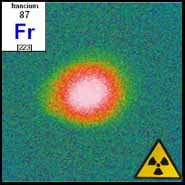
|
| Basic properties | |
|---|---|
| Atomic number | 87 |
| Atomic weight | 223.0197 amu |
| Element family | Alkali metals |
| Period | 7 |
| Group | 1 |
| Block | s-block |
| Discovery year | 1939 |
| Isotope distribution |
|---|
| None |
| Physical properties | |
|---|---|
| Density | 1.87 g/cm3 (STP) |
Atomic hydrogen (H) 8.988E-5 Meitnerium (Mt) 28 | |
| Melting | 27 °C |
Helium (He) -272.2 Carbon (C) 3675 | |
| Boiling | 677 °C |
Helium (He) -268.9 Tungsten (W) 5927 | |
| Chemical properties | |
|---|---|
| Oxidation states | +1 |
| First ionization potential | 3.938 eV |
Cesium (Cs) 3.894 Helium (He) 24.587 | |
| Electron affinity | 0.486 eV |
Nobelium (No) -2.33 Atomic chlorine (Cl) 3.612725 | |
| Electronegativity | 0.79 |
Cesium (Cs) 0.79 Atomic fluorine (F) 3.98 | |
| Electronic properties | |
|---|---|
| Electrons per shell | 2, 8, 18, 32, 18, 8, 1 |
| Electronic configuration | [Rn] 7s1 |
|
Bohr atom model

| |
|
Orbital box diagram

| |
| Valence electrons | 1 |
| Lewis dot structure |
|
| Orbital Visualization | |
|---|---|
|
| |
| Electrons | - |
| Reactions |
|---|
| 4 Fr + O2 = 2 Fr2O |
Francium (Fr): Periodic Table Element
Abstract
Francium, the heaviest known alkali metal with atomic number 87, exhibits the most electropositive character among all elements while remaining experimentally elusive due to its extreme radioactive instability. The most stable isotope, 223Fr, possesses a half-life of merely 22 minutes, rendering bulk chemical investigations impossible. This element demonstrates theoretical chemical properties consistent with alkali metal behavior, including the electronic configuration [Rn] 7s1 and predicted melting point of 27°C with density of 2.48 g·cm-3. Francium occurs naturally as the decay product of 227Ac with crustal abundance estimated at less than 30 grams globally. Modern research applications focus on precision atomic spectroscopy and fundamental physics investigations rather than conventional chemical studies.
Introduction
Francium occupies a unique position as the terminal member of the alkali metal group, representing the convergence of extreme metallic character with overwhelming nuclear instability. Located in period 7, group 1 of the periodic table, francium exhibits the electronic structure [Rn] 7s1, establishing its classification among the most electropositive elements known to chemistry. The element's discovery by Marguerite Perey in 1939 marked the identification of the final naturally occurring element, though subsequent investigations have been severely constrained by its radioactive properties. With all 37 known isotopes exhibiting radioactive decay, francium presents exceptional challenges for conventional chemical analysis while offering opportunities for specialized atomic physics research. The element's theoretical chemical behavior follows predictable trends from periodic relationships, yet experimental verification remains largely impossible due to sample sizes limited to individual atoms or small clusters. Modern understanding of francium derives primarily from theoretical calculations, spectroscopic measurements on trapped atoms, and extrapolation from lighter alkali metals.
Physical Properties and Atomic Structure
Fundamental Atomic Parameters
Francium possesses atomic number 87 with electronic configuration [Rn] 7s1, indicating a single valence electron occupying the 7s orbital. The atomic radius reaches approximately 270 pm, representing the largest atomic radius among all known elements and consistent with the periodic trend of increasing size down group 1. Relativistic effects significantly influence francium's electronic properties, with the 7s electron experiencing velocities approaching 60% of the speed of light, necessitating relativistic corrections in quantum mechanical calculations. The effective nuclear charge experienced by the valence electron amounts to approximately 2.2, heavily shielded by the 86 core electrons. Ionic radius calculations predict Fr+ to measure approximately 194 pm, substantially larger than the Cs+ ion at 181 pm. The element's position below caesium in group 1 establishes francium as the most metallic element, with theoretical calculations confirming the lowest electronegativity value of 0.70 on the Pauling scale.
Macroscopic Physical Characteristics
Theoretical predictions indicate francium would exist as a silvery metallic solid under standard conditions, exhibiting body-centered cubic crystal structure consistent with other alkali metals. The predicted melting point of 27°C (300 K) positions francium near room temperature, though experimental verification remains impossible due to the element's radioactive heat generation and brief existence. Density calculations using various theoretical methods converge on 2.48 g·cm-3, representing the lowest density among all alkali metals and reflecting the large atomic volume. Boiling point estimates range from 620°C to 677°C based on extrapolation methods, though the element's radioactive decay heat would likely cause immediate vaporization of any macroscopic sample. The surface tension of hypothetical liquid francium has been calculated as 0.05092 N·m-1 at the melting point. Heat capacity predictions suggest values consistent with other alkali metals, approximately 31 J·mol-1·K-1, though thermal measurements remain experimentally inaccessible.
Chemical Properties and Reactivity
Electronic Structure and Bonding Behavior
The single 7s valence electron of francium exhibits minimal binding energy, resulting in the lowest first ionization energy among all elements at 392.8 kJ·mol-1, marginally higher than caesium's 375.7 kJ·mol-1 due to relativistic stabilization of the 7s orbital. This electronic configuration predicts extreme chemical reactivity, with francium expected to react explosively with water, releasing hydrogen gas and forming francium hydroxide FrOH. The +1 oxidation state dominates francium chemistry, though theoretical calculations suggest possible higher oxidation states may exist under extreme conditions due to relativistic effects on the 6p3/2 orbitals. Covalent bonding participation remains minimal, with francium compounds exhibiting predominantly ionic character. Bond dissociation energies for Fr-X bonds are predicted to be the lowest among alkali metal halides, reflecting weak electrostatic interactions due to the large ionic radius. The element's metallic bonding is expected to be weak, consistent with the low predicted melting point and density values.
Electrochemical and Thermodynamic Properties
Francium exhibits the most negative standard electrode potential among alkali metals, with the Fr+/Fr couple estimated at -2.92 V, indicating powerful reducing capability. Electronegativity values place francium at 0.70 on the Pauling scale, identical to early estimates for caesium but subsequently refined calculations suggest marginally higher values due to relativistic effects. Electron affinity measurements remain experimentally impossible, though theoretical calculations predict values consistent with other alkali metals, approximately 46 kJ·mol-1. The standard enthalpy of formation for francium compounds can only be estimated through theoretical methods, with FrF predicted to exhibit formation enthalpy of approximately -520 kJ·mol-1. Thermodynamic stability calculations indicate francium compounds should demonstrate similar patterns to caesium analogues, with hydroxides, halides, and nitrates showing high thermal stability. Gibbs free energy values for francium reactions remain theoretical, limiting quantitative predictions of chemical equilibrium behavior.
Chemical Compounds and Complex Formation
Binary and Ternary Compounds
Francium halides represent the most extensively characterized compound class, with FrF, FrCl, FrBr, and FrI all predicted to exist as white crystalline solids exhibiting rock salt structure. Formation occurs through direct combination of francium with halogen gases, though experimental synthesis remains limited to tracer quantities. Francium chloride demonstrates coprecipitation behavior with caesium chloride, enabling separation techniques based on crystallographic similarities. Francium oxide Fr2O is predicted to undergo disproportionation reactions forming the peroxide and metallic francium, following the pattern observed for heavier alkali metals. Sulfide formation yields Fr2S, expected to crystallize in the antifluorite structure with significant ionic character. Binary nitrides and carbides have not been experimentally characterized but theoretical calculations suggest considerable thermodynamic stability. Ternary compounds including francium silicotungstate and francium chloroplatinate demonstrate insolubility patterns useful for analytical separation procedures.
Coordination Chemistry and Organometallic Compounds
Coordination complex formation with francium remains largely theoretical due to experimental limitations, though the large ionic radius suggests potential for high coordination numbers with appropriate ligands. Crown ethers, particularly those designed for caesium coordination, are predicted to form stable complexes with Fr+ ions through ion-dipole interactions. Cryptand ligands demonstrate selective binding affinity for large alkali metal cations, with molecular modeling indicating favorable energetics for francium incorporation. Organometallic chemistry of francium has not been experimentally explored, though theoretical studies suggest potential for ionic organometallic compounds similar to those formed by caesium. The extreme electropositive character predicts minimal covalent bonding contribution in any organometallic species. Complexation with biological macromolecules remains uninvestigated, though the ionic radius suggests potential interference with potassium-dependent biological processes. Theoretical calculations indicate francium coordination with oxygen-donor ligands should exhibit weaker binding than observed for caesium complexes due to the larger ionic radius and reduced charge density.
Natural Occurrence and Isotopic Analysis
Geochemical Distribution and Abundance
Francium exhibits the second-lowest natural abundance among all elements, with crustal concentration estimated at less than 1 × 10-18 parts per billion by mass. Total francium content in Earth's crust remains below 30 grams at any given time, distributed primarily within uranium-bearing minerals as the decay product of 227Ac. Geochemical behavior follows patterns predicted for large, highly electropositive cations, with expected concentration in late-stage crystallization products and hydrothermal solutions. Mineral associations remain undefined due to the element's transient existence, though theoretical predictions suggest potential incorporation into alkali-rich pegmatites and evaporite deposits if sufficient quantities existed. Weathering processes would rapidly mobilize any francium present, leading to incorporation into groundwater systems and eventual oceanic distribution. Sedimentary concentration mechanisms cannot operate effectively given the 22-minute half-life of the most stable isotope. Marine geochemistry of francium has not been studied, though the high solubility of francium salts suggests homogeneous distribution in oceanic systems.
Nuclear Properties and Isotopic Composition
Francium encompasses 37 known isotopes spanning mass numbers 197 through 233, with no stable isotopes identified. The most stable isotope, 223Fr, exhibits a half-life of 21.8 minutes and undergoes beta decay to 223Ra with 99.994% probability and alpha decay to 219At with 0.006% probability. 221Fr represents the second-most stable isotope with a 4.9-minute half-life, decaying through alpha emission to 217At. Nuclear properties reflect the general instability of heavy nuclei, with neutron-to-proton ratios deviating significantly from the valley of beta stability. Seven metastable nuclear isomers have been identified, though all exhibit half-lives substantially shorter than the corresponding ground states. Nuclear cross-sections for francium isotopes remain largely theoretical, limiting applications in nuclear chemistry research. Production occurs naturally through alpha decay of 227Ac in the uranium-235 decay series, maintaining steady-state concentrations in uranium ores. Artificial production utilizes nuclear reactions including 197Au + 18O → 209,210,211Fr + n, enabling laboratory synthesis of specific isotopes for research applications.
Industrial Production and Technological Applications
Extraction and Purification Methodologies
Industrial extraction of francium remains impractical due to the element's extreme scarcity and radioactive instability, with production limited to specialized research facilities. Laboratory synthesis employs ion bombardment techniques, utilizing gold-197 targets bombarded with oxygen-18 beams to produce francium isotopes through nuclear fusion reactions. Purification procedures rely on chemical separation methods exploiting francium's alkali metal properties, including coprecipitation with caesium salts and ion exchange chromatography. The most successful approach utilizes magneto-optical trapping techniques, confining neutral francium atoms in electromagnetic fields for periods approaching the nuclear half-life. Production rates remain extremely low, with the largest experimental quantities reaching approximately 300,000 atoms, corresponding to mass measurements in the attogram range. Separation from competing nuclear reaction products requires sophisticated radiochemical techniques, including selective elution from cation exchange resins and volatility-based separations. Economic considerations render large-scale francium production impossible, with estimated costs exceeding billions of dollars per gram even if technical challenges were overcome.
Technological Applications and Future Prospects
Current applications of francium focus exclusively on fundamental physics research, particularly precision measurements of atomic properties and investigations of symmetry violations in nature. Laser spectroscopy experiments utilizing trapped francium atoms provide critical tests of quantum electrodynamics predictions and enable measurements of atomic transition frequencies with unprecedented precision. The element's simple electronic structure makes it valuable for studying parity violation in atomic systems and searching for permanent electric dipole moments. Potential medical applications in targeted alpha therapy remain speculative due to the brief half-lives and production difficulties. Future research directions include investigations of francium's role in testing fundamental physical constants and potential applications in quantum information processing. The unique combination of heavy nuclear mass and simple electronic structure positions francium as an ideal system for studying relativistic effects in atomic physics. Technological development focuses on improved trapping and cooling techniques to extend observation times and increase sample sizes for more precise measurements.
Historical Development and Discovery
The discovery of francium culminated decades of speculation regarding the existence of element 87, initially termed eka-caesium based on Mendeleev's periodic predictions. Multiple erroneous claims preceded the legitimate discovery, including reports by Dmitry Dobroserdov in 1925 and Fred Allison in 1930, both subsequently disproven through improved analytical techniques. Romanian physicist Horia Hulubei reported element 87 discovery in 1936 through X-ray spectroscopy, proposing the name moldavium, though this claim faced significant criticism from the scientific community. The definitive discovery occurred on January 7, 1939, when Marguerite Perey at the Curie Institute in Paris identified anomalous decay products while purifying actinium-227 samples. Perey's meticulous radiochemical analysis revealed decay particles with energies below 80 keV, inconsistent with known actinium decay modes. Systematic elimination of other elements through chemical testing confirmed the alkali metal nature of the unknown substance, establishing its identity as element 87. Initial naming as "actinium-K" reflected its origin as an actinium decay product, though Perey later proposed "catium" based on its cationic properties. International Union of Pure and Applied Chemistry adopted the name "francium" in 1949, honoring Perey's French nationality and making it the second element named after France. Further characterization through the 1970s and 1980s by teams at CERN and Stony Brook University established modern understanding of francium's properties and enabled development of current trapping techniques.
Conclusion
Francium represents the ultimate expression of metallic character within the periodic table while simultaneously embodying the limitations imposed by nuclear instability on chemical investigation. Its position as the most electropositive element establishes important benchmark values for periodic trends, yet the practical impossibility of bulk sample preparation constrains experimental chemistry to theoretical calculations and single-atom studies. The element's significance lies not in conventional applications but in providing unique opportunities for precision atomic physics research and tests of fundamental theories. Future investigations will likely focus on improved trapping techniques enabling longer observation periods and larger sample sizes, potentially advancing understanding of relativistic effects in heavy atoms and contributing to searches for physics beyond the standard model. Francium's legacy remains as much about the boundaries of experimental chemistry as about the extension of periodic trends to their ultimate limits.

Please let us know how we can improve this web app.
