Printed from https://www.webqc.org

Zinc @ Periodic Table of Chemical Elements

12345678 910111213141516 1718
IIIIIIbIVb VbVIbVIIbVIIIbIb IIbIIIIVVVI VIIVIII
1H
1.0079
2He
4.0026
3Li
6.9412
4Be
9.0121
5B
10.811
6C
12.010
7N
14.006
8O
15.999
9F
18.998
10Ne
20.179
11Na
22.989
12Mg
24.305
13Al
26.981
14Si
28.085
15P
30.973
16S
32.065
17Cl
35.453
18Ar
39.948
19K
39.098
20Ca
40.078
21Sc
44.955
22Ti
47.867
23V
50.941
24Cr
51.996
25Mn
54.938
26Fe
55.845
27Co
58.933
28Ni
58.693
29Cu
63.546
30Zn
65.409
31Ga
69.723
32Ge
72.641
33As
74.921
34Se
78.963
35Br
79.904
36Kr
83.798
37Rb
85.467
38Sr
87.621
39Y
88.905
40Zr
91.224
41Nb
92.906
42Mo
95.942
43Tc
98.906
44Ru
101.07
45Rh
102.90
46Pd
106.42
47Ag
107.86
48Cd
112.41
49In
114.81
50Sn
118.71
51Sb
121.76
52Te
127.60
53I
126.90
54Xe
131.29
55Cs
132.90
56Ba
137.32
57La
138.90
72Hf
178.49
73Ta
180.94
74W
183.84
75Re
186.20
76Os
190.23
77Ir
192.21
78Pt
195.08
79Au
196.96
80Hg
200.59
81Tl
204.38
82Pb
207.21
83Bi
208.98
84Po
208.98
85At
209.98
86Rn
222.01
87Fr
223.01
88Ra
226.02
89Ac
227.02
104Rf
261.10
105Db
262.11
106Sg
266.12
107Bh
264.12
108Hs
269
109Mt
278
110Ds
281
111Rg
282
112Cn
285
113Nh
286
114Fl
289
115Mc
290
116Lv
293
117Ts
294
118Og
294
Lanthanoids58Ce
140.11
59Pr
140.90
60Nd
144.24
61Pm
146.91
62Sm
150.36
63Eu
151.96
64Gd
157.25
65Tb
158.92
66Dy
162.50
67Ho
164.93
68Er
167.25
69Tm
168.93
70Yb
173.04
71Lu
174.96
Actinoids90Th
232.03
91Pa
231.03
92U
238.02
93Np
237.04
94Pu
244.06
95Am
243.06
96Cm
247.07
97Bk
247.07
98Cf
251.07
99Es
252.08
100Fm
257.09
101Md
258.09
102No
259.10
103Lr
260.10
Alkali metals Alkali earth metals Transition metals Other metals Metaloids Non-metals Halogens Noble gases
Element

30

Zn

Zinc

65.4094

2
8
18
2
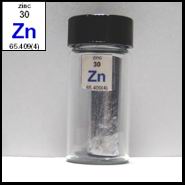
Zinc photo
Basic properties
Atomic number30
Atomic weight65.4094 amu
Element familyTransition metals
Period4
Group2
Blocks-block
Discovery year1000 BC
Isotope distribution
64Zn
48.6%
66Zn
27.9%
67Zn
4.1%
68Zn
18.8%
64Zn: 48.89%66Zn: 28.07%67Zn: 4.12%68Zn: 18.91%
64Zn (48.89%)
66Zn (28.07%)
67Zn (4.12%)
68Zn (18.91%)
Physical properties
Density 7.134 g/cm3 (STP)
Atomic hydrogen (H) 8.988E-5
Meitnerium (Mt) 28
Melting419.73 °C
Helium (He) -272.2
Carbon (C) 3675
Boiling907 °C
Helium (He) -268.9
Tungsten (W) 5927
Chemical properties
Oxidation states
(less common)
+2
(-2, 0, +1)
First ionization potential 9.394 eV
Cesium (Cs) 3.894
Helium (He) 24.587
Electron affinity -0.600 eV
Nobelium (No) -2.33
Atomic chlorine (Cl) 3.612725
Electronegativity1.65
Cesium (Cs) 0.79
Atomic fluorine (F) 3.98
Atomic radius
Covalent radius 1.18 Å
Atomic hydrogen (H) 0.32
Francium (Fr) 2.6
Van der Waals radius 1.39 Å
Atomic hydrogen (H) 1.2
Francium (Fr) 3.48
Metallic radius 1.34 Å
Beryllium (Be) 1.12
Cesium (Cs) 2.65
30ZnWebQC.OrgCovalentMetallicVan der Waals
Compounds
FormulaNameOxidation state
ZnCl2Zinc chloride+2
ZnOZinc oxide+2
ZnSO4Zinc sulfate+2
Zn(OH)2Zinc hydroxide+2
ZnSZinc sulfide+2
ZnCO3Zinc carbonate+2
ZnI2Zinc iodide+2
ZnBr2Zinc bromide+2
ZnF2Zinc fluoride+2
ZnSeZinc selenide+2
Zn(CN)2Zinc cyanide+2
ZnTeZinc telluride+2
Electronic properties
Electrons per shell2, 8, 18, 2
Electronic configuration[Ar] 3d104s2
Bohr atom model
Bohr atom model
Orbital box diagram
Orbital box diagram
Valence electrons12
Lewis dot structure Zinc Lewis dot structure
Orbital Visualization
🏠
▶️
📐
Electrons-

Zinc (Zn): Periodic Table Element

Scientific Review Article | Chemistry Reference Series

Abstract

Zinc, atomic number 30, stands as the twenty-fourth most abundant element in Earth's crust and represents a crucial d-block metal with unique properties that distinguish it from typical transition metals. With standard atomic weight 65.38 ± 0.02 u and electron configuration [Ar]3d¹⁰4s², zinc exhibits predominantly +2 oxidation state chemistry while maintaining essential roles in both industrial applications and biological systems. The element demonstrates hexagonal close-packed crystal structure, melting point 419.5°C (692.65 K), and characteristic bluish-white metallic appearance. Zinc's moderate reactivity, extensive coordination chemistry, and protective passivation properties enable widespread utilization in galvanization processes, alloy production, and as cofactor in numerous enzymatic systems. Five stable isotopes occur naturally, with ⁶⁴Zn comprising 49.17% natural abundance. Industrial significance encompasses annual global production exceeding 13 million tonnes, primarily from sphalerite ore processing, supporting applications ranging from corrosion protection to semiconductor technology.

Introduction

Zinc occupies a distinctive position within Group 12 of the periodic table, serving as the terminal member of the first transition series while exhibiting properties that often distinguish it from classical transition metals. Located between copper and gallium, zinc's completely filled 3d subshell confers unique electronic characteristics that manifest in its predominant +2 oxidation chemistry and diamagnetic behavior. The element's technological importance stems from millennia of human utilization, beginning with bronze age brass production and evolving into modern applications encompassing galvanization, die-casting alloys, and biochemical systems.

Historical development of zinc chemistry traces from ancient brass metallurgy through medieval alchemical investigations to systematic scientific characterization beginning in the eighteenth century. Andreas Marggraf's identification of metallic zinc in 1746 established the foundation for subsequent investigations into the element's fundamental properties and industrial potential. Contemporary understanding encompasses zinc's essential biological functions, discovered through carbonic anhydrase research in 1940, alongside sophisticated coordination chemistry and materials science applications.

Physical Properties and Atomic Structure

Fundamental Atomic Parameters

Zinc exhibits atomic number 30, corresponding to nuclear charge of +30 and ground-state electron configuration [Ar]3d¹⁰4s². The completely filled 3d subshell distinguishes zinc from preceding first-row transition metals, as both 4s electrons participate in chemical bonding while the stable 3d¹⁰ configuration remains intact in most chemical environments. Upon oxidation to the prevalent Zn²⁺ state, loss of both 4s electrons yields the noble-gas-like [Ar]3d¹⁰ configuration, contributing to the ion's thermodynamic stability and characteristic colorless appearance.

Atomic radius measurements indicate 134 pm for metallic zinc, while the Zn²⁺ ionic radius spans 74 pm in octahedral coordination environments. Effective nuclear charge calculations reveal approximately 5.97 for 4s electrons, reflecting substantial shielding from inner electron shells. The element's position following the 3d series completion results in notable contraction effects, influencing both atomic dimensions and chemical behavior relative to lighter Group 12 congeners.

Macroscopic Physical Characteristics

Zinc crystallizes in hexagonal close-packed structure with distinctive distortion from ideal geometry. The crystal lattice exhibits nearest-neighbor distances of 265.9 pm within hexagonal planes, while six additional neighbors occur at extended distance of 290.6 pm, creating coordination environments intermediate between typical close-packed arrangements. Unit cell dimensions reflect a/c ratio of 1.856, significantly deviating from ideal close-packed value of 1.633.

Thermal properties include melting point 419.5°C (692.65 K), boiling point 907°C (1180 K), and heat of fusion 7.32 kJ/mol. Heat of vaporization reaches 123.6 kJ/mol, while specific heat capacity measures 0.388 J/(g·K) at standard conditions. Density of 7.14 g/cm³ at 20°C positions zinc as moderately dense among metallic elements. The element displays characteristic bluish-white luster with high reflectivity across visible wavelengths.

Mechanical properties vary significantly with temperature. At ambient conditions, zinc exhibits considerable brittleness, limiting room-temperature deformation. However, heating to 100-150°C range induces malleability, enabling rolling and forming operations. Brittleness returns above 210°C, defining optimal processing temperature windows for zinc fabrication. Electrical conductivity measures approximately 16.6% that of copper, classifying zinc as a fair electrical conductor.

Chemical Properties and Reactivity

Electronic Structure and Bonding Behavior

Zinc's chemical behavior reflects its position at the conclusion of the first transition series, with filled 3d orbitals providing minimal participation in covalent bonding. The element exhibits predominantly +2 oxidation state across virtually all known compounds, with Zn²⁺ formation involving loss of both 4s electrons while retaining stable 3d¹⁰ configuration. Limited examples of +1 oxidation occur under specialized conditions, typically requiring gas-phase or matrix isolation environments, while theoretical +3 states remain computationally predicted but experimentally unobserved.

Bonding characteristics reflect greater covalent character compared to typical ionic compounds of s-block metals. Zinc-ligand interactions often involve significant orbital overlap, particularly in complexes with soft donor atoms following hard-soft acid-base principles. The absence of unpaired d electrons eliminates crystal field stabilization effects, resulting in coordination geometries determined primarily by steric and electrostatic considerations rather than electronic preferences characteristic of transition metals.

Coordination numbers in zinc compounds typically span 4 to 6, with tetrahedral and octahedral arrangements predominating. Five-coordinate complexes occur in specialized ligand environments, while higher coordination numbers remain uncommon. The d¹⁰ electronic configuration enables facile ligand exchange processes and labile coordination behavior in solution environments.

Electrochemical and Thermodynamic Properties

Electronegativity values place zinc at 1.65 on the Pauling scale and 4.45 eV on the Mulliken scale, indicating moderate electron-withdrawing character relative to main-group elements. First ionization energy measures 906.4 kJ/mol, followed by second ionization energy of 1733.3 kJ/mol, reflecting substantial energy difference between 4s electron removal and subsequent ionization from stable 3d¹⁰ configuration.

Standard reduction potential for the Zn²⁺/Zn couple reaches -0.7618 V versus standard hydrogen electrode, positioning zinc as moderately strong reducing agent comparable to manganese in electrochemical series. This negative potential drives galvanic protection applications, where zinc serves as sacrificial anode in corrosion prevention systems. Electron affinity values remain positive, indicating unfavorable anion formation under normal conditions.

Thermodynamic stability of zinc compounds generally decreases with increasing oxidation state, consistent with the preference for Zn²⁺ chemistry. Formation enthalpies for common binary compounds demonstrate substantial exothermic character: ZnO (-348.3 kJ/mol), ZnS (-206.0 kJ/mol), and ZnCl₂ (-415.1 kJ/mol), supporting their widespread occurrence and industrial utility.

Chemical Compounds and Complex Formation

Binary and Ternary Compounds

Zinc oxide (ZnO) represents the most significant binary compound, exhibiting wurtzite crystal structure under normal conditions with tetrahedral coordination of both zinc and oxide ions. The compound demonstrates semiconductor properties with wide bandgap of 3.37 eV, enabling applications in electronics, photocatalysis, and ultraviolet protection. Thermal stability extends to 1975°C decomposition temperature, while amphoteric character allows dissolution in both acidic and basic media.

Zinc sulfide occurs in two primary polymorphs: wurtzite (hexagonal) and sphalerite (cubic), with the latter representing the principal zinc ore mineral. Both forms exhibit tetrahedral coordination environments and demonstrate semiconductor behavior with applications in phosphors and luminescent materials. The sphalerite structure serves as prototype for numerous binary semiconductors, including cadmium sulfide and mercury telluride.

Halide compounds encompass ZnF₂, ZnCl₂, ZnBr₂, and ZnI₂, with increasing covalent character proceeding down the halogen series. Zinc chloride exhibits particularly high solubility in polar solvents and serves as Lewis acid catalyst in organic synthesis. The compound forms stable hydrates and demonstrates hygroscopic properties under ambient conditions.

Ternary compounds include diverse sulfates, nitrates, and carbonates, with zinc sulfate heptahydrate (ZnSO₄·7H₂O) representing a commercially important material in electroplating and agricultural applications. Basic zinc carbonate, Zn₅(OH)₆(CO₃)₂, forms naturally as protective patina layer on metallic zinc exposed to atmospheric carbon dioxide and moisture.

Coordination Chemistry and Organometallic Compounds

Zinc coordination complexes span diverse geometries and ligand types, with preference for tetrahedral arrangements in four-coordinate species and octahedral configurations in six-coordinate complexes. Common ligands include ammonia, ethylenediamine, and halide ions, forming complexes such as [Zn(NH₃)₄]²⁺ and [ZnCl₄]²⁻. The absence of ligand field stabilization energy results in coordination geometries determined primarily by steric factors and ligand-ligand repulsions.

Five-coordinate complexes exhibit trigonal bipyramidal or square pyramidal geometries depending on ligand constraints. Notable examples include zinc porphyrin complexes, where the metalloporphyrin framework enforces square planar basal coordination with axial ligand binding sites. These systems model biological zinc centers and demonstrate unique photochemical and catalytic properties.

Organozinc compounds comprise significant synthetic reagents, particularly dialkylzinc species such as diethylzinc (ZnEt₂) and dimethylzinc (ZnMe₂). These compounds exhibit tetrahedral coordination at zinc centers and demonstrate moderate thermal stability with applications in organometallic synthesis and chemical vapor deposition processes. Zinc-carbon bonds display moderate polarity, enabling nucleophilic reactivity patterns in organic transformations.

Natural Occurrence and Isotopic Analysis

Geochemical Distribution and Abundance

Zinc occurs at 75 ppm concentration in Earth's continental crust, representing the twenty-fourth most abundant element. Geochemical behavior classifies zinc as chalcophile element, demonstrating strong affinity for sulfur and heavy chalcogens during mineral formation processes. Primary occurrence involves sulfide minerals, particularly sphalerite (ZnS), which contains 60-62% zinc by mass and constitutes the dominant ore mineral for commercial extraction.

Additional zinc minerals include smithsonite (ZnCO₃), hemimorphite (Zn₄Si₂O₇(OH)₂·H₂O), and willemite (Zn₂SiO₄), typically formed through weathering and oxidation of primary sulfide deposits. Hydrothermal processes concentrate zinc through temperature-dependent solubility mechanisms, creating economically viable ore deposits in diverse geological environments including sedimentary basins, volcanic systems, and metamorphic terranes.

Oceanic zinc concentrations average 2-5 μg/L in surface waters, increasing to 8-15 μg/L in deep ocean environments through biological processes and thermohaline circulation. Marine biogeochemical cycling involves complexation with organic ligands, particulate scavenging, and biological uptake, influencing global zinc distribution patterns and availability for marine ecosystems.

Nuclear Properties and Isotopic Composition

Natural zinc comprises five stable isotopes with distinct abundance patterns: ⁶⁴Zn (49.17%), ⁶⁶Zn (27.73%), ⁶⁸Zn (18.45%), ⁶⁷Zn (4.04%), and ⁷⁰Zn (0.61%). Mass distribution reflects nuclear stability patterns, with even-mass isotopes predominating due to pairing energy effects and nuclear shell structure considerations.

Nuclear magnetic properties vary among isotopes: ⁶⁷Zn exhibits nuclear spin I = 5/2 with magnetic moment μ = 0.8755 nuclear magnetons, enabling nuclear magnetic resonance spectroscopy applications. Other stable isotopes possess zero nuclear spin, limiting their utility for NMR studies but simplifying spectroscopic interpretation in zinc-containing compounds.

Radioisotope ⁶⁵Zn demonstrates half-life of 243.66 days, making it the least radioactive artificial isotope and enabling applications in biological tracer studies and industrial quality control. Beta-plus decay mode with maximum energy 0.325 MeV provides suitable detection characteristics for medical and research applications. Additional short-lived isotopes span mass range 60-83, with decreasing stability at mass extremes.

Industrial Production and Technological Applications

Extraction and Purification Methodologies

Commercial zinc production predominantly utilizes pyrometallurgical and hydrometallurgical processing routes, with selection depending on ore composition, economic factors, and environmental considerations. Pyrometallurgical methods involve high-temperature reduction of zinc oxide using carbon or carbon monoxide, followed by condensation of zinc vapor at approximately 1100°C. The Imperial Smelting Process represents a widely employed pyrometallurgical technique, enabling simultaneous recovery of zinc and lead from mixed sulfide concentrates.

Hydrometallurgical extraction encompasses sulfuric acid leaching of zinc concentrates, producing zinc sulfate solutions subjected to purification and electrowinning processes. Solution purification removes impurities including iron, copper, and cadmium through selective precipitation and cementation reactions. Electrowinning employs aluminum cathodes and lead anodes to deposit high-purity zinc metal, achieving purities exceeding 99.99% in commercial operations.

Global zinc production approximates 13 million tonnes annually, with major producing regions including China (approximately 45% of world production), Peru, Australia, and Kazakhstan. Processing efficiency improvements focus on energy reduction, environmental impact minimization, and recovery of valuable byproducts including sulfuric acid, cadmium, and precious metals contained in zinc concentrates.

Technological Applications and Future Prospects

Galvanization represents the largest application sector, consuming approximately 50% of global zinc production for corrosion protection of steel structures and components. Hot-dip galvanizing creates metallurgically bonded zinc coatings with thickness typically ranging 45-150 μm, providing sacrificial protection through electrochemical mechanisms. The zinc coating oxidizes preferentially to underlying steel, forming protective zinc carbonate patina that inhibits further corrosion progression.

Brass production utilizes approximately 17% of zinc consumption, creating copper-zinc alloys with compositions ranging from 5-45% zinc content. Higher zinc concentrations produce materials with enhanced strength, ductility, and corrosion resistance suitable for marine hardware, musical instruments, and decorative applications. Die-casting alloys, particularly Zamak compositions containing aluminum and magnesium additions, enable precision manufacturing of automotive components, electronic housings, and consumer products.

Emerging applications encompass zinc-air batteries for energy storage systems, zinc oxide nanostructures for electronics and photocatalysis, and zinc-based semiconductors for optoelectronic devices. Biomedical applications include zinc-containing antimicrobial surfaces and biodegradable zinc implants for orthopedic and cardiovascular applications. Zinc's essential biological role as enzyme cofactor drives continued research into zinc homeostasis mechanisms and therapeutic applications for zinc deficiency disorders.

Historical Development and Discovery

Archaeological evidence demonstrates zinc utilization spanning over four millennia, beginning with brass production in Anatolia circa 1000 BCE through copper-zinc ore smelting processes. Ancient civilizations including Romans, Greeks, and Chinese developed brass manufacturing techniques without isolating pure zinc metal, referring to the material as aurichalcum, orichalcum, or similar terms denoting golden copper alloys.

Systematic zinc metallurgy emerged in medieval India during the twelfth century, where distillation processes enabled production of metallic zinc from zinc-bearing ores. The Zawar mines in Rajasthan developed sophisticated retort techniques for zinc vapor condensation, achieving production scales that supplied regional markets throughout the Indian subcontinent. Chinese metallurgists independently developed similar zinc production methods during the Ming Dynasty period.

European recognition of zinc as distinct metallic element occurred through Andreas Marggraf's investigations in 1746, where controlled experiments demonstrated zinc extraction from calamine ores using reduction techniques. Subsequent research by chemists including William Champion, Johann Pott, and Carl Scheele established fundamental understanding of zinc chemistry and industrial production methods. The element's name derives possibly from German "zinke" meaning tooth-like or pointed, referencing zinc crystal formations, or from Persian "seng" meaning stone.

Twentieth-century developments encompassed discovery of zinc's biological significance through carbonic anhydrase research, recognition of zinc deficiency diseases, and development of high-purity zinc production technologies. Contemporary research focuses on zinc nanotechnology, advanced alloy systems, and sustainable extraction processes addressing environmental and energy efficiency considerations in zinc metallurgy.

Conclusion

Zinc demonstrates exceptional versatility among metallic elements, bridging traditional metallurgical applications with advanced technological systems and essential biological functions. The element's unique position as terminal member of the first transition series, combined with its filled d-subshell electronic configuration, confers distinctive chemical properties that enable widespread utilization across diverse industrial sectors. From ancient brass production to contemporary semiconductor applications, zinc continues to demonstrate technological relevance spanning millennia of human civilization.

Future research directions encompass sustainable extraction technologies, advanced zinc-based materials for energy storage and conversion, and deeper understanding of zinc's biological roles in health and disease. The element's abundance, relatively low toxicity, and established industrial infrastructure position zinc as crucial material for addressing contemporary challenges in renewable energy, environmental protection, and biomedical applications, ensuring continued scientific and technological significance for generations to come.

Periodict table
Please let us know how we can improve this web app.

Menu Balance Molar mass Gas laws Units Chemistry tools Periodic table Chemical forum Symmetry Constants Contribute Contact us
How to cite?