Printed from https://www.webqc.org

Potassium @ Periodic Table of Chemical Elements

12345678 910111213141516 1718
IIIIIIbIVb VbVIbVIIbVIIIbIb IIbIIIIVVVI VIIVIII
1H
1.0079
2He
4.0026
3Li
6.9412
4Be
9.0121
5B
10.811
6C
12.010
7N
14.006
8O
15.999
9F
18.998
10Ne
20.179
11Na
22.989
12Mg
24.305
13Al
26.981
14Si
28.085
15P
30.973
16S
32.065
17Cl
35.453
18Ar
39.948
19K
39.098
20Ca
40.078
21Sc
44.955
22Ti
47.867
23V
50.941
24Cr
51.996
25Mn
54.938
26Fe
55.845
27Co
58.933
28Ni
58.693
29Cu
63.546
30Zn
65.409
31Ga
69.723
32Ge
72.641
33As
74.921
34Se
78.963
35Br
79.904
36Kr
83.798
37Rb
85.467
38Sr
87.621
39Y
88.905
40Zr
91.224
41Nb
92.906
42Mo
95.942
43Tc
98.906
44Ru
101.07
45Rh
102.90
46Pd
106.42
47Ag
107.86
48Cd
112.41
49In
114.81
50Sn
118.71
51Sb
121.76
52Te
127.60
53I
126.90
54Xe
131.29
55Cs
132.90
56Ba
137.32
57La
138.90
72Hf
178.49
73Ta
180.94
74W
183.84
75Re
186.20
76Os
190.23
77Ir
192.21
78Pt
195.08
79Au
196.96
80Hg
200.59
81Tl
204.38
82Pb
207.21
83Bi
208.98
84Po
208.98
85At
209.98
86Rn
222.01
87Fr
223.01
88Ra
226.02
89Ac
227.02
104Rf
261.10
105Db
262.11
106Sg
266.12
107Bh
264.12
108Hs
269
109Mt
278
110Ds
281
111Rg
282
112Cn
285
113Nh
286
114Fl
289
115Mc
290
116Lv
293
117Ts
294
118Og
294
Lanthanoids58Ce
140.11
59Pr
140.90
60Nd
144.24
61Pm
146.91
62Sm
150.36
63Eu
151.96
64Gd
157.25
65Tb
158.92
66Dy
162.50
67Ho
164.93
68Er
167.25
69Tm
168.93
70Yb
173.04
71Lu
174.96
Actinoids90Th
232.03
91Pa
231.03
92U
238.02
93Np
237.04
94Pu
244.06
95Am
243.06
96Cm
247.07
97Bk
247.07
98Cf
251.07
99Es
252.08
100Fm
257.09
101Md
258.09
102No
259.10
103Lr
260.10
Alkali metals Alkali earth metals Transition metals Other metals Metaloids Non-metals Halogens Noble gases
Element

19

K

Potassium

39.09831

2
8
8
1
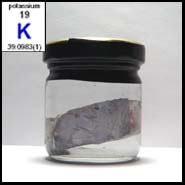
Potassium photo
Basic properties
Atomic number19
Atomic weight39.09831 amu
Element familyAlkali metals
Period4
Group1
Blocks-block
Discovery year1807
Isotope distribution
39K
93.2581%
41K
6.7302%
39K: 93.27%41K: 6.73%
39K (93.27%)
41K (6.73%)
Physical properties
Density 0.862 g/cm3 (STP)
Atomic hydrogen (H) 8.988E-5
Meitnerium (Mt) 28
Melting63.35 °C
Helium (He) -272.2
Carbon (C) 3675
Boiling774 °C
Helium (He) -268.9
Tungsten (W) 5927
Chemical properties
Oxidation states
(less common)
+1
(-1)
First ionization potential 4.340 eV
Cesium (Cs) 3.894
Helium (He) 24.587
Electron affinity 0.501 eV
Nobelium (No) -2.33
Atomic chlorine (Cl) 3.612725
Electronegativity0.82
Cesium (Cs) 0.79
Atomic fluorine (F) 3.98
Atomic radius
Covalent radius 1.96 Å
Atomic hydrogen (H) 0.32
Francium (Fr) 2.6
Van der Waals radius 2.75 Å
Atomic hydrogen (H) 1.2
Francium (Fr) 3.48
Metallic radius 2.27 Å
Beryllium (Be) 1.12
Cesium (Cs) 2.65
19KWebQC.OrgCovalentMetallicVan der Waals
Compounds
FormulaNameOxidation state
KClPotassium chloride+1
KOHPotassium hydroxide+1
KMnO4Potassium permanganate+1
KNO3Potassium nitrate+1
KClO3Potassium chlorate+1
KIPotassium iodide+1
KH2PO4Monopotassium phosphate+1
K2SO4Potassium sulfate+1
KBrPotassium bromide+1
K2Cr2O7Potassium dichromate+1
K2CO3Potassium carbonate+1
K2HPO4Dipotassium phosphate+1
Electronic properties
Electrons per shell2, 8, 8, 1
Electronic configuration[Ar] 4s1
Bohr atom model
Bohr atom model
Orbital box diagram
Orbital box diagram
Valence electrons1
Lewis dot structure Potassium Lewis dot structure
Orbital Visualization
🏠
▶️
📐
Electrons-

Potassium (K): Periodic Table Element

Scientific Review Article | Chemistry Reference Series

Abstract

Potassium exhibits fundamental properties characteristic of alkali metals, positioned as atomic number 19 in the periodic table with electronic configuration [Ar]4s¹. The element demonstrates extreme reactivity with atmospheric oxygen and water, forming stable ionic compounds exclusively in nature. Potassium's low ionization energy of 418.8 kJ/mol facilitates ready electron loss, establishing its predominant +1 oxidation state. Industrial applications exploit its high solubility properties, with 95% of production directed toward agricultural fertilizers. The element's abundance in crustal rocks averages 2.09 weight percent, occurring primarily in feldspathic minerals and mica structures. Three naturally occurring isotopes exist, with ⁴⁰K contributing minor radioactive decay processes. Physical properties include density of 0.862 g/cm³ at 293 K, melting point at 336.5 K, and characteristic violet flame emission at 766.5 nm wavelength.

Introduction

Potassium occupies a pivotal position in Group 1 of the periodic table, representing the archetypal alkali metal characteristics that define this chemical family. Located in the fourth period with atomic number 19, potassium possesses electronic configuration [Ar]4s¹, placing the outermost electron in an energetically accessible orbital for ionization processes. The element's chemical behavior stems directly from this electronic structure, wherein the single 4s electron experiences minimal effective nuclear charge due to inner shell shielding effects.

Historical significance emerged through Humphry Davy's pioneering electrolysis work in 1807, which first isolated metallic potassium from potash solutions. This achievement marked early progress in electrochemical methods for metal extraction, demonstrating the principle that sufficiently energetic electrical processes could overcome strong ionic bonding in alkali compounds. The element's name derives from "potash," referencing the traditional wood ash processing techniques employed for obtaining potassium carbonate.

Modern understanding reveals potassium's essential role in geological processes, biological systems, and industrial chemistry. The element's ionic radius of 1.38 Å and hydrated radius of 3.31 Å influence its behavior in aqueous systems, while the standard reduction potential of -2.925 V establishes its position among the most electropositive elements.

Physical Properties and Atomic Structure

Fundamental Atomic Parameters

Potassium's atomic structure centers on the nuclear configuration containing 19 protons, with the most abundant isotope ³⁹K possessing 20 neutrons. Electronic configuration follows the pattern [Ar]4s¹, wherein the 4s orbital houses the single valence electron responsible for the element's chemical characteristics. Successive ionization energies reveal the dramatic energy increase required for removing inner electrons: first ionization requires 418.8 kJ/mol, while second ionization demands 3052 kJ/mol, illustrating the stability of the resulting K⁺ cation with noble gas configuration.

Atomic radius measurements establish potassium at 2.27 Å for the metallic radius and 1.38 Å for the ionic radius of K⁺. These values reflect the significant contraction occurring upon electron removal, as the remaining electron cloud experiences increased effective nuclear charge. Covalent radius determinations place potassium at 2.03 Å, though covalent bonding remains energetically unfavorable compared to ionic interactions for this highly electropositive element.

Effective nuclear charge calculations indicate that the 4s electron experiences approximately 2.2 units of positive charge, substantially reduced from the full 19+ nuclear charge through screening effects from inner electron shells. This reduced effective nuclear charge contributes directly to potassium's low ionization energy and resultant high chemical reactivity.

Macroscopic Physical Characteristics

Potassium metal exhibits distinctive physical properties characteristic of alkali metals, presenting as a silvery-white metallic solid with notable softness permitting easy cutting with conventional blade implements. Density measurements establish 0.862 g/cm³ at standard temperature, making potassium the second-least dense metal after lithium. This low density results from the relatively large atomic size combined with the simple body-centered cubic crystal structure.

Thermal properties demonstrate potassium's metallic character while revealing relatively weak metallic bonding. Melting point occurs at 336.5 K (63.4°C), with boiling point at 1032 K (759°C). Heat of fusion measures 2.33 kJ/mol, while heat of vaporization reaches 76.9 kJ/mol. Specific heat capacity at constant pressure equals 0.757 J/g·K at 298 K, reflecting the thermal energy required to increase temperature in the solid metallic lattice.

Crystal structure analysis reveals body-centered cubic arrangement with lattice parameter a = 5.344 Å at room temperature. This structure maximizes space efficiency while maintaining the metallic bonding characteristic of delocalized electron interactions. Thermal expansion coefficient measures 83.3 × 10⁻⁶ K⁻¹, indicating substantial volume changes with temperature variation.

Chemical Properties and Reactivity

Electronic Structure and Bonding Behavior

Potassium's chemical reactivity stems fundamentally from its [Ar]4s¹ electronic configuration, which positions a single electron in an orbital experiencing minimal effective nuclear charge. This electron configuration determines that potassium exhibits exclusively the +1 oxidation state in chemical compounds, as removing the 4s electron yields the thermodynamically stable K⁺ cation with noble gas configuration. The energy barrier for accessing higher oxidation states proves prohibitively high, with second ionization energy of 3052 kJ/mol effectively precluding K²⁺ formation under normal chemical conditions.

Bonding characteristics demonstrate predominantly ionic interactions, with electronegativity value of 0.82 on the Pauling scale indicating strong electron-donating tendency. Covalent bonding occurs rarely and only with the most electronegative elements under specialized conditions. Coordination chemistry exhibits preference for high coordination numbers, typically 6-12, reflecting the large ionic radius and favorable electrostatic interactions with multiple ligands.

Orbital analysis reveals that the 4s orbital extends significantly beyond the inner electron shells, creating spatial separation that reduces electron-electron repulsion while maximizing distance from the nuclear charge. This orbital geometry facilitates ready electron removal and explains potassium's position among the most electropositive elements in the periodic table.

Electrochemical and Thermodynamic Properties

Electrochemical behavior establishes potassium among the most reducing elements, with standard reduction potential E°(K⁺/K) = -2.925 V indicating strong tendency to undergo oxidation. This value positions potassium as more reducing than sodium (-2.714 V) but less reducing than rubidium (-2.924 V), reflecting periodic trends in atomic size and ionization energy. The reduction potential governs potassium's behavior in aqueous systems, where K⁺ ions remain stable and metallic potassium reacts vigorously with water.

Thermodynamic parameters for potassium compounds demonstrate consistently negative enthalpies of formation, indicating favorable compound stability. Potassium chloride formation releases 436.7 kJ/mol, while potassium oxide formation liberates 361.5 kJ/mol. These values reflect strong ionic interactions between K⁺ cations and various anions, driving compound formation across diverse chemical environments.

Electronegativity analysis using multiple scales confirms potassium's electron-donating character: Pauling scale yields 0.82, Mulliken scale gives 0.91, and Allred-Rochow scale indicates 0.91. These consistent values demonstrate potassium's position as highly electropositive, with ready electron donation to more electronegative elements. Electron affinity measurements show positive values, indicating energy input required for anion formation, further confirming cationic behavior predominance.

Chemical Compounds and Complex Formation

Binary and Ternary Compounds

Potassium forms binary compounds with virtually all non-metallic elements, consistently maintaining +1 oxidation state throughout these interactions. Potassium oxide, K₂O, represents the normal oxide formed under controlled atmospheric conditions, exhibiting anti-fluorite crystal structure with lattice parameter a = 6.436 Å. Thermal decomposition of potassium compounds in oxygen-rich environments produces potassium superoxide, KO₂, which demonstrates paramagnetic properties due to unpaired electrons in the superoxide anion.

Halide series demonstrates systematic trends reflecting anion size effects. Potassium fluoride crystallizes in the rock salt structure with high lattice energy of 817 kJ/mol, while potassium iodide adopts similar geometry but exhibits reduced lattice energy of 649 kJ/mol due to increased anion radius. These compounds show high solubility in polar solvents, with KCl solubility reaching 347 g/L at 293 K in water.

Ternary compounds encompass diverse structural types including carbonates, sulfates, and phosphates. Potassium carbonate, K₂CO₃, crystallizes in monoclinic structure and demonstrates hygroscopic properties with deliquescence occurring above 45% relative humidity. Potassium sulfate forms orthorhombic crystals with space group Pnma, commonly occurring as the mineral arcanite in volcanic environments.

Coordination Chemistry and Organometallic Compounds

Coordination complexes of potassium typically exhibit high coordination numbers reflecting the large ionic radius of K⁺. Crown ether complexes demonstrate particularly stable binding, with 18-crown-6 forming the archetypal complex exhibiting binding constant log K = 2.03 in methanol solution. This binding involves six oxygen atoms arranged in macrocyclic geometry providing optimal electrostatic interactions with the K⁺ cation.

Cryptand complexes achieve even higher stability through three-dimensional encapsulation of the potassium cation. The [2.2.2]cryptand complex demonstrates binding constants exceeding 10⁶ M⁻¹, effectively sequestering K⁺ from aqueous solution and enabling phase-transfer catalysis applications. These supramolecular interactions depend critically on size complementarity between host cavity and guest cation radius.

Organometallic chemistry remains limited due to potassium's highly ionic character, though some specialized compounds exist. Potassium cyclopentadienide represents a rare example, existing as ionic compound with delocalized π-bonding in the anion. Such compounds require stringent exclusion of moisture and oxygen due to their extreme reactivity with protic solvents and oxidizing agents.

Natural Occurrence and Isotopic Analysis

Geochemical Distribution and Abundance

Potassium maintains crustal abundance of 20,900 ppm by weight, establishing it as the seventh most abundant element in Earth's crust. This abundance reflects potassium's incorporation into major rock-forming minerals during magmatic processes, particularly in feldspathic and mica structures. Igneous rocks typically contain 2-4 weight percent potassium, with higher concentrations in evolved granitic compositions compared to mafic basaltic rocks.

Geochemical behavior demonstrates incompatible element characteristics during partial melting processes, causing preferential concentration in residual melts. This behavior contributes to potassium enrichment in continental crustal rocks relative to oceanic compositions. Weathering processes mobilize potassium from primary minerals, though clay minerals and secondary phases readily sequester released K⁺ ions through cation exchange mechanisms.

Major mineral occurrences include orthoclase feldspar (KAlSi₃O₈), muscovite mica (KAl₂(AlSi₃O₁₀)(OH)₂), and biotite mica (K(Mg,Fe)₃(AlSi₃O₁₀)(OH)₂). These phases control potassium distribution in igneous and metamorphic environments. Sedimentary accumulations produce sylvite (KCl) and carnallite (KMgCl₃·6H₂O) deposits through evaporative concentration of brines.

Nuclear Properties and Isotopic Composition

Natural potassium comprises three isotopes with distinct nuclear properties and abundances. ³⁹K represents 93.258% of natural potassium, existing as stable isotope with nuclear spin I = 3/2 and magnetic moment μ = +0.391 nuclear magnetons. This isotope exhibits NMR-active properties, enabling spectroscopic analysis of potassium environments in various chemical and biological systems.

⁴¹K constitutes 6.730% of natural abundance, characterized by nuclear spin I = 3/2 and magnetic moment μ = +0.215 nuclear magnetons. This stable isotope contributes to the average atomic mass calculation and provides isotopic signatures useful for geochemical tracing applications. The slight mass difference enables isotope fractionation during physical and chemical processes.

⁴⁰K comprises 0.012% of natural potassium but carries significant importance due to radioactive properties. This isotope undergoes dual decay modes: 89.3% β⁻ decay to ⁴⁰Ca with half-life 1.248 × 10⁹ years, and 10.7% electron capture to ⁴⁰Ar with identical half-life. The ⁴⁰K-⁴⁰Ar system provides fundamental geochronological tool for dating potassium-bearing minerals, while ⁴⁰K decay contributes approximately 4000 Bq/kg to natural radioactivity in the human body.

Industrial Production and Technological Applications

Extraction and Purification Methodologies

Industrial potassium production relies primarily on electrolytic reduction of molten potassium chloride, employing methodologies similar to sodium production but requiring modified operating conditions. The process operates at temperatures around 773-873 K using KCl-LiCl eutectic mixtures to reduce melting point and improve conductivity. Steel cathodes collect metallic potassium while graphite anodes release chlorine gas, with cell voltages typically ranging 3.5-4.2 V.

Alternative production methods include thermal reduction techniques using metallic sodium and potassium chloride at elevated temperatures around 1123 K. This displacement reaction exploits the higher vapor pressure of potassium compared to sodium at reaction temperature, enabling product separation through fractional distillation. The process equation follows: Na + KCl → NaCl + K, with thermodynamic favorability at high temperature due to entropy contributions.

Purification procedures typically involve multiple distillation stages to remove sodium contamination, achieving potassium purities exceeding 99.8%. Production costs remain higher than sodium due to lower demand volumes and specialized handling requirements. Global production capacity reaches approximately 200,000 metric tons annually, with facilities concentrated in regions possessing abundant chlor-alkali infrastructure.

Technological Applications and Future Prospects

Agricultural applications dominate potassium consumption, accounting for approximately 95% of global usage through fertilizer production. Potassium chloride, potassium sulfate, and potassium nitrate provide essential nutrient sources for crop production, with potassium deficiency limiting agricultural yields across diverse geographical regions. Modern precision agriculture employs soil testing protocols to optimize potassium application rates, improving both crop performance and environmental stewardship.

Industrial applications exploit potassium compounds' chemical properties across diverse sectors. Potassium hydroxide serves crucial roles in soap manufacturing, biodiesel production, and alkaline battery electrolytes. Potassium carbonate functions as essential component in specialty glass production, providing thermal expansion control and chemical durability enhancement. Potassium nitrate enables both fertilizer and pyrotechnic applications through its oxidizing properties.

Emerging technologies investigate potassium-ion battery systems as potential alternatives to lithium-ion devices for large-scale energy storage applications. Research focuses on developing suitable electrode materials accommodating the larger K⁺ ionic radius while maintaining acceptable cycling performance. Potential advantages include lower material costs and greater elemental abundance compared to lithium systems, though technical challenges require continued development efforts.

Historical Development and Discovery

Potassium's chemical history traces to ancient civilizations' empirical knowledge of potash properties for glassmaking and soap production, though elemental understanding awaited modern electrochemical developments. Medieval alchemists recognized distinctions between various alkaline substances but lacked theoretical frameworks for comprehending elemental composition. The transformation from empirical knowledge to scientific understanding spanned several centuries of incremental progress.

Martin Heinrich Klaproth's 1797 investigations of leucite and lepidolite minerals provided early evidence for potassium as distinct chemical element, proposing the name "kali" to distinguish it from known alkaline substances. This work established fundamental principles of analytical chemistry while demonstrating that mineral analysis could reveal new elemental constituents beyond those previously recognized.

Humphry Davy's pioneering electrolysis experiments in 1807 achieved first isolation of metallic potassium, employing voltaic piles to decompose moistened potash. This breakthrough demonstrated electrochemical principles for metal extraction while revealing potassium's extreme reactivity with atmospheric components. Davy's systematic approach established electrolysis as powerful tool for isolating highly electropositive elements previously inaccessible through conventional chemical reduction methods.

Subsequent developments refined understanding of potassium's chemical behavior, isotopic composition, and industrial applications. Twentieth-century advances in nuclear chemistry revealed ⁴⁰K radioactivity and its applications for geochronological dating. Modern analytical techniques enable precise determination of potassium concentrations across diverse sample types, supporting agricultural optimization, nutritional assessment, and environmental monitoring applications.

Conclusion

Potassium occupies an essential position among the alkali metals, exhibiting characteristic properties that derive from its [Ar]4s¹ electronic configuration and resulting +1 oxidation state predominance. The element's high reactivity, low density, and strong reducing character establish it as archetypal representative of Group 1 chemical behavior. Industrial significance centers on agricultural applications through fertilizer production, while emerging technologies explore energy storage applications. Future research directions encompass sustainable production methods, advanced battery technologies, and environmental applications exploiting potassium's unique chemical properties. The element's abundance, accessibility, and well-understood chemistry position it for continued technological importance across diverse application sectors.

Periodict table
Please let us know how we can improve this web app.

Menu Balance Molar mass Gas laws Units Chemistry tools Periodic table Chemical forum Symmetry Constants Contribute Contact us
How to cite?