| Element | |
|---|---|
25MnManganese54.93804552
8 13 2 |
|
| Basic properties | |
|---|---|
| Atomic number | 25 |
| Atomic weight | 54.9380455 amu |
| Element family | Transition metals |
| Period | 4 |
| Group | 2 |
| Block | s-block |
| Discovery year | 1774 |
| Isotope distribution |
|---|
55Mn 100% |
| Physical properties | |
|---|---|
| Density | 7.44 g/cm3 (STP) |
Atomic hydrogen (H) 8.988E-5 Meitnerium (Mt) 28 | |
| Melting | 649 °C |
Helium (He) -272.2 Carbon (C) 3675 | |
| Boiling | 2097 °C |
Helium (He) -268.9 Tungsten (W) 5927 | |
| Chemical properties | |
|---|---|
| Oxidation states (less common) | +2, +4, +7 (-3, -2, -1, 0, +1, +3, +5, +6) |
| First ionization potential | 7.434 eV |
Cesium (Cs) 3.894 Helium (He) 24.587 | |
| Electron affinity | -0.500 eV |
Nobelium (No) -2.33 Atomic chlorine (Cl) 3.612725 | |
| Electronegativity | 1.55 |
Cesium (Cs) 0.79 Atomic fluorine (F) 3.98 | |
| Atomic radius | |
|---|---|
| Covalent radius | 1.19 Å |
Atomic hydrogen (H) 0.32 Francium (Fr) 2.6 | |
| Metallic radius | 1.27 Å |
Beryllium (Be) 1.12 Cesium (Cs) 2.65 | |
| Compounds | ||
|---|---|---|
| Formula | Name | Oxidation state |
| MnSO4 | Manganese(II) sulfate | +2 |
| MnCl2 | Manganese(II) chloride | +2 |
| MnBr2 | Manganese(II) bromide | +2 |
| Mn3O4 | Manganese(II,III) oxide | +2,+3 |
| MnF3 | Manganese(III) fluoride | +3 |
| MnCl3 | Manganese(III) chloride | +3 |
| MnO2 | Manganese(IV) oxide | +4 |
| MnF4 | Manganese(IV) fluoride | +4 |
| K2MnO4 | Potassium manganate | +6 |
| BaMnO4 | Barium manganate | +6 |
| KMnO4 | Potassium permanganate | +7 |
| Mn2O7 | Manganese(VII) oxide | +7 |
| Electronic properties | |
|---|---|
| Electrons per shell | 2, 8, 13, 2 |
| Electronic configuration | [Ar] 3d5 |
|
Bohr atom model
| |
|
Orbital box diagram
| |
| Valence electrons | 7 |
| Lewis dot structure |
|
| Orbital Visualization | |
|---|---|
|
| |
| Electrons | - |
Manganese (Mn): Periodic Table Element
Abstract
Manganese (Mn, atomic number 25) stands as a crucial transition metal characterized by its silvery metallic appearance and remarkable versatility across multiple oxidation states ranging from −3 to +7. With an atomic mass of 54.938043 ± 0.000002 u and a unique electron configuration of [Ar] 3d5 4s2, manganese exhibits complex allotropic behavior with four distinct crystal phases. The element demonstrates essential biological functionality as a cofactor in numerous enzymes and serves as an indispensable component in steel production, consuming 85-90% of global manganese demand. Manganese compounds manifest diverse chemical properties, from the deep violet oxidizing agent potassium permanganate (KMnO4) to the paramagnetic behavior observed at ambient temperature. Natural occurrence is limited to a single stable isotope, 55Mn, while industrial applications span metallurgy, aluminum alloys, chemical oxidation processes, and emerging technologies including advanced battery systems and novel pigment development.
Introduction
Manganese occupies a unique position within the first transition series of the periodic table, situated between chromium and iron in Group 7 (formerly Group VIIB). The element's electronic configuration places five unpaired electrons in the 3d orbital, resulting in exceptional magnetic and catalytic properties that distinguish it from neighboring transition metals. This half-filled d-orbital configuration contributes to manganese's remarkable stability across numerous oxidation states, making it one of the most chemically versatile elements in the periodic table.
The discovery of manganese in the 1770s by Johan Gottlieb Gahn marked a significant advancement in metallurgical chemistry, though manganese compounds had been utilized in decorative applications for millennia. Archaeological evidence indicates that manganese dioxide was employed in cave paintings dating back 30,000-24,000 years, demonstrating humanity's early interaction with this element's compounds. Modern understanding of manganese's role extends far beyond its historical applications, encompassing critical functions in biological systems, advanced materials science, and industrial catalysis.
Contemporary manganese chemistry encompasses diverse research frontiers, from the development of manganese-based catalysts for water oxidation to the investigation of manganese compounds in next-generation battery technologies. The element's ability to undergo facile electron transfer reactions while maintaining structural integrity positions it as a key component in sustainable energy systems and environmental remediation processes.
Physical Properties and Atomic Structure
Fundamental Atomic Parameters
Manganese exhibits atomic number 25 with a standard atomic weight of 54.938043 ± 0.000002 u, reflecting the monoisotopic nature of naturally occurring manganese. The electronic configuration [Ar] 3d5 4s2 represents a particularly stable arrangement, with the half-filled 3d subshell contributing significantly to the element's chemical behavior and magnetic properties. This configuration results in five unpaired electrons, maximizing exchange energy stabilization according to Hund's rule.
The atomic radius of manganese measures approximately 127 pm for the metallic radius, while ionic radii vary considerably with oxidation state and coordination geometry. Manganese(II) typically exhibits ionic radii of 67 pm in octahedral coordination, while the higher oxidation states demonstrate progressive contraction. The effective nuclear charge experienced by valence electrons increases substantially across the transition series, with manganese demonstrating intermediate shielding effects between the early and late transition metals.
Successive ionization energies reveal the electronic structure's influence on chemical behavior. The first ionization energy (717.3 kJ/mol) corresponds to removal of a 4s electron, while the second ionization energy (1509.0 kJ/mol) involves 3d electron removal. The relative ease of multiple electron removal facilitates manganese's accessibility to high oxidation states, particularly in strongly oxidizing environments or when stabilized by appropriate ligands.
Macroscopic Physical Characteristics
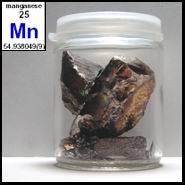
Metallic manganese presents as a silvery, hard, and brittle solid under standard conditions. The element exhibits remarkable polymorphism, manifesting four distinct allotropic modifications with varying crystal structures and stability ranges. α-Manganese, stable at room temperature, crystallizes in a complex body-centered cubic structure containing 58 atoms per unit cell, representing one of the most complex metallic structures known.
The melting point of 1519 K (1246°C) reflects strong metallic bonding contributions from both 3d and 4s electrons. Thermal transitions between allotropic forms occur at elevated temperatures: β-manganese forms above 973 K with primitive cubic symmetry, γ-manganese adopts face-centered cubic structure above 1370 K, and δ-manganese reverts to body-centered cubic arrangement above 1406 K. These structural transformations are accompanied by significant changes in magnetic behavior and physical properties.
Density variations among the allotropes reflect different atomic packing efficiencies, with α-manganese exhibiting the highest density due to its complex structure. The element demonstrates paramagnetic behavior at ambient temperature, becoming antiferromagnetic below 95 K (-178°C). This magnetic transition temperature provides insight into exchange interactions between unpaired 3d electrons in the metallic lattice.
Mechanical properties include significant hardness and brittleness, limiting direct applications of pure manganese metal. The Mohs hardness approaches 6, while tensile strength remains modest due to the brittle nature of the α-phase. These mechanical limitations have historically directed manganese applications toward alloying rather than structural applications of the pure element.
Chemical Properties and Reactivity
Electronic Structure and Bonding Behavior
The chemical reactivity of manganese stems from its electronic configuration and the accessibility of multiple oxidation states. The half-filled 3d5 configuration provides exceptional stability to the Mn2+ ion, which represents the most common oxidation state in aqueous solution. However, the element readily accommodates oxidation states from −3 to +7, with +2, +3, +4, +6, and +7 being most frequently observed in chemical compounds.
Bonding characteristics vary dramatically with oxidation state and chemical environment. Low oxidation states (0, +1, +2) typically involve primarily ionic bonding with modest covalent contributions, while higher oxidation states (+4, +6, +7) exhibit substantial covalent character. The Mn7+ state, exemplified in permanganate (MnO4−), demonstrates extensive π-bonding between manganese d-orbitals and oxygen p-orbitals.
Coordination chemistry reveals manganese's affinity for octahedral geometry, particularly in the +2 and +3 oxidation states. Crystal field stabilization energies favor high-spin configurations for Mn2+ (d5) and Mn3+ (d4) in weak-field environments. However, strong-field ligands can induce spin-pairing, leading to low-spin complexes with altered magnetic and spectroscopic properties.
Electron transfer processes involving manganese are facile due to the availability of multiple accessible oxidation states. This characteristic underlies manganese's effectiveness as both oxidizing and reducing agents, depending on the specific oxidation state and reaction conditions. The Mn3+/Mn2+ couple is particularly important in biological systems, while higher oxidation states serve as potent oxidizing agents in analytical and synthetic chemistry.
Electrochemical and Thermodynamic Properties
Electrochemical behavior of manganese reflects the thermodynamic stability relationships among its various oxidation states. Standard reduction potentials reveal that higher oxidation states become increasingly oxidizing, with the MnO4−/Mn2+ couple exhibiting a potential of +1.51 V under standard conditions. This high potential makes permanganate an exceptionally strong oxidizing agent, capable of oxidizing most organic compounds and many inorganic species.
The electronegativity of manganese (1.55 on the Pauling scale) positions it as moderately electropositive among transition metals. This value facilitates compound formation with both highly electronegative elements like oxygen and fluorine, as well as less electronegative species including sulfur and phosphorus. The moderate electronegativity also enables manganese to participate in both ionic and covalent bonding modes.
Successive ionization energies demonstrate the increasing difficulty of electron removal from higher charged ions. The particularly large increase between the second and third ionization energies (3248 kJ/mol for the third) reflects the stability of the 3d5 configuration in Mn2+. However, appropriate chemical environments can stabilize higher oxidation states through ligand field effects and π-bonding interactions.
Thermodynamic stability of manganese compounds varies significantly with oxidation state and chemical environment. Lower oxides (MnO, Mn3O4) exhibit high thermal stability, while higher oxides become increasingly unstable toward thermal decomposition. The thermodynamic instability of Mn2O7 makes it explosive under certain conditions, limiting its practical applications despite its potent oxidizing properties.
Chemical Compounds and Complex Formation
Binary and Ternary Compounds
Manganese forms a comprehensive series of binary oxides that exemplify the element's variable oxidation behavior. Manganese(II) oxide (MnO) crystallizes in the rock salt structure and exhibits basic properties, dissolving in acids to form pale pink Mn2+ solutions. Manganese(III) oxide (Mn2O3) demonstrates amphoteric behavior, while manganese(IV) oxide (MnO2) serves as a crucial industrial compound with applications ranging from battery electrodes to oxidizing agents.
The mixed-valence compound Mn3O4 (hausmannite) contains both Mn2+ and Mn3+ ions in a spinel structure, demonstrating manganese's ability to stabilize multiple oxidation states within a single compound. This compound's magnetic properties arise from the antiferromagnetic coupling between different manganese sites, resulting in complex temperature-dependent magnetic behavior.
Halide compounds span the full range of manganese oxidation states, with fluorides extending to the highest oxidation levels. Manganese(II) halides (MnF2, MnCl2, MnBr2, MnI2) adopt typical ionic structures, while higher halides exhibit increasing covalent character. Manganese tetrafluoride (MnF4) represents one of the most stable tetravalent manganese compounds, demonstrating the stabilizing influence of highly electronegative ligands.
Sulfide and selenide compounds provide insight into manganese's behavior with less electronegative chalcogens. Manganese(II) sulfide (MnS) occurs naturally as alabandite and exhibits antiferromagnetic ordering below 152 K. The compound's green color in the α-phase and red color in the β-phase illustrate how structural modifications influence electronic transitions and optical properties.
Ternary compounds including manganese encompass numerous industrially significant materials. Manganese ferrites (MnFe2O4) exhibit soft magnetic properties useful in electronic applications, while manganese-containing perovskites demonstrate remarkable catalytic activity for oxidation reactions. These complex oxides often exhibit synergistic effects where manganese's variable oxidation states enhance overall compound performance.
Coordination Chemistry and Organometallic Compounds
Coordination complexes of manganese demonstrate remarkable diversity in geometry, oxidation state, and magnetic behavior. Manganese(II) complexes typically adopt octahedral or tetrahedral geometries, with the high-spin d5 configuration resulting in five unpaired electrons and significant magnetic moments. The pale pink color characteristic of aqueous Mn2+ arises from spin-forbidden d-d transitions that become partially allowed through vibronic coupling.
Higher oxidation states require strong-field ligands for stabilization, leading to the formation of low-spin complexes with altered spectroscopic and magnetic properties. Manganese(III) complexes often exhibit Jahn-Teller distortions due to the d4 electronic configuration, resulting in elongated or compressed octahedral geometries that influence both stability and reactivity.
Manganese carbonyl compounds represent significant organometallic species, with manganese pentacarbonyl cation [Mn(CO)5]+ serving as a useful synthetic intermediate. Dimanganese decacarbonyl [Mn2(CO)10] exhibits a weak metal-metal bond that readily undergoes homolytic cleavage under photochemical conditions, generating reactive manganese carbonyl radicals useful in organic synthesis.
Cyclopentadienyl manganese complexes, particularly manganese tricarbonyl cyclopentadienide [MnCp(CO)3], demonstrate the element's ability to participate in π-bonding with aromatic ligands. These compounds serve as models for understanding metal-ligand interactions and have found applications in catalytic processes including hydrogenation and polymerization reactions.
Schiff base complexes of manganese exhibit remarkable catalytic activity for oxidation reactions, particularly epoxidation of olefins and hydroxylation of aromatic compounds. The ability of these complexes to cycle between different oxidation states while maintaining structural integrity makes them valuable biomimetic catalysts for modeling enzyme active sites.
Natural Occurrence and Isotopic Analysis
Geochemical Distribution and Abundance
Manganese exhibits a crustal abundance of approximately 950 ppm, ranking it as the 12th most abundant element in the Earth's crust. The element's geochemical behavior is strongly influenced by redox conditions, with manganese(II) being mobile in reducing environments while higher oxidation states precipitate under oxidizing conditions. This redox sensitivity results in the formation of concentrated manganese deposits in specific geological environments.
Seafloor manganese nodules represent one of the most significant manganese resources, containing approximately 29% manganese by mass along with valuable cobalt, nickel, and copper. These polymetallic nodules form through slow precipitation processes on the deep ocean floor, with growth rates measured in millimeters per million years. Current estimates suggest over 500 billion tons of manganese nodules exist on ocean floors worldwide.
Terrestrial manganese deposits occur primarily as oxide and carbonate minerals, often associated with iron formations. The most important ore minerals include pyrolusite (MnO2), psilomelane (BaMn9O16(OH)4), and rhodochrosite (MnCO3). These deposits typically form through weathering processes, hydrothermal activity, or sedimentary precipitation under specific pH and redox conditions.
Biological concentration mechanisms also contribute to manganese distribution patterns. Certain bacteria and plants can accumulate manganese to levels far exceeding those in surrounding media, leading to localized enrichment. These biogeochemical processes have operated throughout Earth's history, contributing to the formation of sedimentary manganese deposits and influencing manganese cycling in modern environments.
Nuclear Properties and Isotopic Composition
Natural manganese consists entirely of the stable isotope 55Mn, making it monoisotopic among naturally occurring elements. This isotope contains 25 protons and 30 neutrons, resulting in a nuclear spin of I = 5/2 and a nuclear magnetic moment of +3.4687 nuclear magnetons. The monoisotopic nature simplifies analytical determinations and eliminates isotopic fractionation concerns in geochemical studies.
Artificial radioactive isotopes of manganese span mass numbers from 46 to 72, with varying half-lives and decay modes. The most stable radioactive isotope, 53Mn, exhibits a half-life of 3.7 million years and decays by electron capture to 53Cr. This relatively long half-life makes 53Mn useful for dating certain meteorites and understanding early solar system processes.
54Mn, with a half-life of 312.2 days, serves as an important radioisotope for research applications. Its decay by electron capture produces characteristic X-rays that enable non-destructive analysis techniques. The isotope finds applications in studying manganese metabolism in biological systems and as a tracer in environmental and industrial processes.
Shorter-lived isotopes including 52Mn (half-life 5.591 days) and 56Mn (half-life 2.579 hours) are primarily of interest for nuclear physics research and specialized medical applications. These isotopes' decay properties provide insights into nuclear structure and have potential applications in positron emission tomography imaging techniques.
Nuclear cross-sections for neutron absorption by 55Mn are relatively low, with thermal neutron capture producing 56Mn. This characteristic influences manganese's behavior in nuclear reactor environments and must be considered in materials selection for nuclear applications. The relatively low cross-section also enables manganese use in certain neutron detection systems.
Industrial Production and Technological Applications
Extraction and Purification Methodologies
Industrial manganese production employs diverse extraction methodologies depending on ore composition and desired product purity. Pyrometallurgical processes dominate commercial production, with carbothermic reduction of manganese oxides serving as the primary route to ferromanganese alloys. The reaction proceeds according to the stoichiometry MnO2 + C → Mn + CO2, though industrial processes are more complex due to the presence of iron oxides and other impurities.
Electric arc furnaces operate at temperatures exceeding 1700°C to ensure complete reduction of manganese oxides. The process requires careful control of carbon potential and slag composition to optimize manganese recovery while minimizing energy consumption. Typical ferromanganese contains 75-80% manganese, with the remainder primarily iron and small amounts of carbon, silicon, and phosphorus.
Silicothermic reduction provides an alternative route for producing higher purity manganese metal, particularly for specialized applications. This process employs silicon as the reducing agent in the reaction 2MnO + Si → 2Mn + SiO2, requiring temperatures around 1200°C. The resulting manganese exhibits lower carbon content but higher silicon levels compared to carbothermic products.
Hydrometallurgical processes have gained importance for processing lower-grade ores and recovering manganese from secondary sources. Sulfuric acid leaching selectively dissolves manganese values, followed by purification steps including solvent extraction and electrowinning. These processes offer enhanced selectivity and can treat ores unsuitable for pyrometallurgical processing, though they require careful environmental management of acid solutions.
Electrolytic manganese production yields high-purity metal suitable for specialty applications. The process involves electrolysis of purified manganese sulfate solutions using inert anodes and controlled current densities. Resulting manganese exhibits purities exceeding 99.9% but requires significant electrical energy input, limiting applications to high-value markets.
Technological Applications and Future Prospects
Steel production consumes 85-90% of global manganese demand, with the element serving multiple essential functions. Manganese acts as a deoxidizer, removing dissolved oxygen through the formation of MnO inclusions that are readily removed from the melt. Additionally, manganese serves as a desulfurizer, forming MnS inclusions that improve steel machinability by providing favorable chip-breaking properties during machining operations.
Alloying applications of manganese in steel exploit its ability to increase hardenability, strength, and wear resistance. Hadfield steel, containing 12-14% manganese, exhibits extraordinary work-hardening characteristics that make it ideal for applications involving severe abrasion and impact. This steel type has found applications ranging from railroad switches to military armor, demonstrating manganese's contribution to advanced metallurgical properties.
Aluminum alloys represent the second-largest application area for manganese, with additions of 0.8-1.5% significantly improving corrosion resistance. The 3004 and 3104 aluminum-manganese alloys dominate the beverage container market, where manganese's ability to improve formability and strength enables the production of lightweight, durable containers. The element's role in preventing galvanic corrosion between aluminum and steel components makes it essential in automotive and aerospace applications.
Chemical applications of manganese compounds span diverse industrial sectors. Potassium permanganate serves as a versatile oxidizing agent for water treatment, organic synthesis, and analytical chemistry. Manganese dioxide finds applications in dry-cell batteries, where it functions as a depolarizer, and in glass manufacturing for decolorizing iron-tinted glass or producing amethyst coloration.
Emerging technologies are expanding manganese's role in advanced materials and energy systems. Lithium-manganese oxide cathodes in lithium-ion batteries offer improved safety and environmental compatibility compared to cobalt-containing alternatives. Research into manganese-based catalysts for water splitting and carbon dioxide reduction reflects the element's potential in sustainable energy technologies.
Future prospects for manganese applications include development of manganese-containing permanent magnets as alternatives to rare-earth based systems. Advanced high-strength steels incorporating manganese for automotive lightweighting represent another growth area, where the element's strengthening mechanisms enable thinner sections while maintaining crashworthiness. Environmental applications including manganese-based sorbents for heavy metal removal and catalysts for air purification continue to expand as regulatory requirements become more stringent.
Historical Development and Discovery
The historical development of manganese knowledge spans millennia, beginning with ancient civilizations' use of manganese dioxide for decorative purposes. Archaeological evidence from caves in France and Spain reveals the use of manganese-containing pigments in paintings dating back 30,000-24,000 years, representing humanity's earliest documented interaction with manganese compounds. These prehistoric applications preceded any understanding of the element's chemical nature by tens of thousands of years.
Scientific investigation of manganese compounds began in the 18th century as part of broader efforts to understand mineral composition and properties. Swedish chemist Carl Wilhelm Scheele recognized in 1774 that pyrolusite contained a previously unknown element, though he was unable to isolate it due to the technical limitations of available reduction methods. Scheele's work established the theoretical foundation for manganese's existence and properties.
Johan Gottlieb Gahn achieved the first successful isolation of manganese metal in 1774 through carbothermic reduction of manganese dioxide. Gahn's method involved heating pyrolusite with charcoal in a crucible, producing impure manganese metal that nonetheless demonstrated the element's fundamental properties. This achievement marked the beginning of systematic manganese chemistry and enabled subsequent investigations into the element's behavior and applications.
The 19th century witnessed rapid expansion of manganese knowledge through the work of numerous chemists and metallurgists. Development of permanganic acid and its salts revealed manganese's capacity for high oxidation states, while investigations of manganese alloys established the element's crucial role in steel production. The discovery of manganese's complex allotropic behavior awaited 20th-century crystallographic techniques and high-temperature experimental capabilities.
Modern understanding of manganese's biological significance emerged through 20th-century biochemical research. Recognition of manganese as an essential trace element led to investigations of its role in enzyme systems, photosynthesis, and metabolic processes. This biological perspective transformed manganese from a purely industrial element to a component essential for life, spurring research into manganese deficiency, toxicity, and therapeutic applications.
Contemporary manganese research encompasses diverse frontiers including catalysis, energy storage, and environmental applications. The development of single-site manganese catalysts for selective oxidation reactions represents a significant advancement in understanding structure-activity relationships. Similarly, investigations of manganese's role in artificial photosynthesis systems aim to replicate nature's water oxidation processes for sustainable energy production.
Conclusion
Manganese's unique position in the periodic table, characterized by its half-filled d orbital configuration and accessibility to multiple oxidation states, establishes it as one of the most chemically versatile transition metals. The element's fundamental importance spans from essential biological functions in enzyme systems and photosynthesis to critical industrial applications in metallurgy and chemical processing. Its monoisotopic natural occurrence as 55Mn simplifies analytical determinations while its complex allotropic behavior demonstrates the sophisticated structure-property relationships characteristic of transition metals.
Future research directions for manganese encompass sustainable technologies including advanced battery systems, water splitting catalysts, and environmental remediation processes. The element's ability to cycle between oxidation states while maintaining structural integrity positions it as a key component in next-generation energy storage and conversion systems. Continued investigation of manganese-based catalysts for selective oxidation and carbon dioxide reduction reflects the element's potential contributions to addressing global sustainability challenges while advancing fundamental understanding of transition metal chemistry.

Please let us know how we can improve this web app.