Printed from https://www.webqc.org

Carbon @ Periodic Table of Chemical Elements

12345678 910111213141516 1718
IIIIIIbIVb VbVIbVIIbVIIIbIb IIbIIIIVVVI VIIVIII
1H
1.0079
2He
4.0026
3Li
6.9412
4Be
9.0121
5B
10.811
6C
12.010
7N
14.006
8O
15.999
9F
18.998
10Ne
20.179
11Na
22.989
12Mg
24.305
13Al
26.981
14Si
28.085
15P
30.973
16S
32.065
17Cl
35.453
18Ar
39.948
19K
39.098
20Ca
40.078
21Sc
44.955
22Ti
47.867
23V
50.941
24Cr
51.996
25Mn
54.938
26Fe
55.845
27Co
58.933
28Ni
58.693
29Cu
63.546
30Zn
65.409
31Ga
69.723
32Ge
72.641
33As
74.921
34Se
78.963
35Br
79.904
36Kr
83.798
37Rb
85.467
38Sr
87.621
39Y
88.905
40Zr
91.224
41Nb
92.906
42Mo
95.942
43Tc
98.906
44Ru
101.07
45Rh
102.90
46Pd
106.42
47Ag
107.86
48Cd
112.41
49In
114.81
50Sn
118.71
51Sb
121.76
52Te
127.60
53I
126.90
54Xe
131.29
55Cs
132.90
56Ba
137.32
57La
138.90
72Hf
178.49
73Ta
180.94
74W
183.84
75Re
186.20
76Os
190.23
77Ir
192.21
78Pt
195.08
79Au
196.96
80Hg
200.59
81Tl
204.38
82Pb
207.21
83Bi
208.98
84Po
208.98
85At
209.98
86Rn
222.01
87Fr
223.01
88Ra
226.02
89Ac
227.02
104Rf
261.10
105Db
262.11
106Sg
266.12
107Bh
264.12
108Hs
269
109Mt
278
110Ds
281
111Rg
282
112Cn
285
113Nh
286
114Fl
289
115Mc
290
116Lv
293
117Ts
294
118Og
294
Lanthanoids58Ce
140.11
59Pr
140.90
60Nd
144.24
61Pm
146.91
62Sm
150.36
63Eu
151.96
64Gd
157.25
65Tb
158.92
66Dy
162.50
67Ho
164.93
68Er
167.25
69Tm
168.93
70Yb
173.04
71Lu
174.96
Actinoids90Th
232.03
91Pa
231.03
92U
238.02
93Np
237.04
94Pu
244.06
95Am
243.06
96Cm
247.07
97Bk
247.07
98Cf
251.07
99Es
252.08
100Fm
257.09
101Md
258.09
102No
259.10
103Lr
260.10
Alkali metals Alkali earth metals Transition metals Other metals Metaloids Non-metals Halogens Noble gases
Element

6

C

Carbon

12.01078

2
4
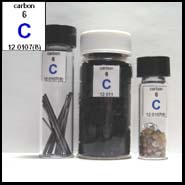
Carbon photo
Basic properties
Atomic number6
Atomic weight12.01078 amu
Element familyNon-metals
Period2
Group14
Blockp-block
Discovery year3750 BC
Isotope distribution
12C
98.90%
13C
1.10%
12C: 98.90%13C: 1.10%
12C (98.90%)
13C (1.10%)
Physical properties
Density 2.267 g/cm3 (STP)
Atomic hydrogen (H) 8.988E-5
Meitnerium (Mt) 28
Melting3675 °C
Helium (He) -272.2
Carbon (C) 3675
Boiling4827 °C
Helium (He) -268.9
Tungsten (W) 5927
Chemical properties
Oxidation states-4, -3, -2, -1, 0, +1, +2, +3, +4
First ionization potential 11.260 eV
Cesium (Cs) 3.894
Helium (He) 24.587
Electron affinity 1.262 eV
Nobelium (No) -2.33
Atomic chlorine (Cl) 3.612725
Electronegativity2.55
Cesium (Cs) 0.79
Atomic fluorine (F) 3.98
Atomic radius
Covalent radius 0.75 Å
Atomic hydrogen (H) 0.32
Francium (Fr) 2.6
Van der Waals radius 1.7 Å
Atomic hydrogen (H) 1.2
Francium (Fr) 3.48
6CWebQC.OrgCovalentVan der Waals
Compounds
FormulaNameOxidation state
CH4Methane-4
CO2Carbon dioxide+4
CaCO3Calcium carbonate+4
Na2CO3Sodium carbonate+4
NaHCO3Sodium hydrogen carbonate+4
Electronic properties
Electrons per shell2, 4
Electronic configuration[He] 2s22p2
Bohr atom model
Bohr atom model
Orbital box diagram
Orbital box diagram
Valence electrons4
Lewis dot structure Carbon Lewis dot structure
Orbital Visualization
🏠
▶️
📐
Electrons-

Carbon (C): Periodic Table Element

Scientific Review Article | Chemistry Reference Series

Abstract

Carbon, with atomic number 6 and symbol C, represents the fundamental building block of organic chemistry and serves as the basis for all known life on Earth. This nonmetallic element exhibits remarkable structural diversity through its allotropic forms, including graphite, diamond, fullerenes, and graphene. Carbon's tetravalent nature, arising from its 1s²2s²2p² electron configuration, enables the formation of an extraordinary variety of chemical compounds exceeding two hundred million documented structures. The element demonstrates exceptional covalent bonding capabilities and catenation properties, facilitating the construction of complex molecular architectures. Carbon constitutes approximately 0.025% of Earth's crust by mass and represents the fourth most abundant element in the universe. Its unique combination of chemical versatility, thermodynamic stability, and structural polymorphism establishes carbon as an element of unparalleled significance in both fundamental chemistry and technological applications.

Introduction

Carbon occupies a central position in the periodic table as the sixth element, defining the chemical behavior of Group 14 and establishing the foundation for organic chemistry. The element's location in Period 2 places it among the first-row p-block elements, where its 2p² electronic configuration generates a tetravalent character that distinguishes carbon from its heavier congeners. This electronic structure, combined with carbon's moderate electronegativity of 2.55 on the Pauling scale, facilitates the formation of stable covalent bonds with both electropositive and electronegative elements. The historical significance of carbon extends to antiquity, as civilizations have utilized its various forms for millennia, from charcoal production to the recognition of diamond's exceptional hardness. Modern chemical understanding of carbon emerged through systematic investigations of combustion phenomena and the development of atomic theory, ultimately revealing its role as the central atom in organic molecules. Carbon's abundance in stellar nucleosynthesis processes, particularly through the carbon-nitrogen-oxygen cycle, underscores its fundamental importance in cosmic chemistry and energy production mechanisms.

Physical Properties and Atomic Structure

Fundamental Atomic Parameters

Carbon's atomic structure centers on a nucleus containing six protons, establishing its atomic number Z = 6 and defining its chemical identity. The ground-state electron configuration 1s²2s²2p² positions four valence electrons in the outer shell, creating the potential for tetrahedral coordination geometry through sp³ hybridization. The atomic radius of carbon measures 67 pm for the covalent radius, with bond lengths varying systematically: C−C single bonds average 154 pm, C=C double bonds measure 134 pm, and C≡C triple bonds span 120 pm. These progressive decreases reflect increased s-character in the hybrid orbitals and enhanced orbital overlap. The effective nuclear charge experienced by valence electrons approximates +3.25, accounting for shielding effects from inner-shell electrons. Carbon's ionization energies progress systematically: first ionization requires 1086.5 kJ/mol, second ionization 2352.6 kJ/mol, third ionization 4620.5 kJ/mol, and fourth ionization 6222.7 kJ/mol. This energetic progression reflects the increasing difficulty of removing electrons from progressively more stable configurations, with the fourth ionization representing removal from the filled 1s orbital.

Macroscopic Physical Characteristics

Carbon manifests extraordinary structural diversity through its allotropic forms, each exhibiting distinct physical properties despite identical atomic composition. Graphite, the thermodynamically stable form under standard conditions, displays a layered hexagonal structure with metallic luster and electrical conductivity. The density of graphite measures 2.267 g/cm³, while its mechanical properties include a hardness of 1-2 on the Mohs scale and excellent thermal conductivity of approximately 1000 W·m⁻¹·K⁻¹ parallel to the graphene layers. Diamond represents the metastable cubic allotrope, characterized by exceptional hardness (10 on the Mohs scale), optical transparency, and electrical insulation properties. Diamond's density reaches 3.515 g/cm³, reflecting its compact tetrahedral bonding network. The thermal conductivity of diamond exceeds 2000 W·m⁻¹·K⁻¹, making it one of the most thermally conductive materials known. Carbon's phase behavior exhibits unusual characteristics, with no liquid phase existing at atmospheric pressure due to direct sublimation at approximately 3915 K. The triple point occurs at 10.8 ± 0.2 MPa and 4600 ± 300 K, requiring extreme conditions for liquid carbon formation.

Chemical Properties and Reactivity

Electronic Structure and Bonding Behavior

Carbon's chemical versatility originates from its half-filled p subshell, enabling multiple hybridization states that accommodate diverse molecular geometries. The sp³ hybridization generates tetrahedral coordination with bond angles of 109.5°, exemplified in methane and diamond structures. Trigonal planar geometry emerges through sp² hybridization, creating 120° bond angles and enabling π-bonding formation, as observed in alkenes and graphene. Linear geometry results from sp hybridization, producing 180° bond angles and facilitating triple bond formation in compounds such as acetylene. Carbon exhibits oxidation states ranging from −4 to +4, with the most common being −4 in hydrocarbons, 0 in elemental carbon, +2 in carbon monoxide, and +4 in carbon dioxide. The electronegativity value of 2.55 positions carbon between typical metals and nonmetals, facilitating polar covalent bonding with both electronegative elements like oxygen and fluorine, and electropositive elements including hydrogen and metals. Bond dissociation energies demonstrate carbon's strong covalent character: C−C bonds require approximately 346 kJ/mol, C=C bonds 602 kJ/mol, and C≡C bonds 835 kJ/mol for homolytic cleavage.

Electrochemical and Thermodynamic Properties

Carbon's electrochemical behavior reflects its intermediate position between metals and nonmetals, with standard reduction potentials varying significantly based on the specific carbon species and solution conditions. The reduction of carbon dioxide to organic carbon occurs at approximately −0.2 V versus the standard hydrogen electrode under standard conditions, though this value varies considerably with pH and specific organic product formed. Carbon's electron affinity measures 121.9 kJ/mol, indicating a moderate tendency to accept electrons and form anions. The successive ionization energies reveal the progressive stabilization of cationic species, with the first four ionizations accessing valence electrons and subsequent ionizations requiring substantially higher energies to remove core electrons. Thermodynamic stability analysis demonstrates graphite's favored status under standard conditions, with a formation enthalpy of zero by definition. Diamond exhibits a formation enthalpy of +1.9 kJ/mol relative to graphite, explaining its metastable character. The entropy difference between graphite and diamond (2.4 J·mol⁻¹·K⁻¹) contributes to graphite's thermodynamic preference at ambient conditions.

Chemical Compounds and Complex Formation

Binary and Ternary Compounds

Carbon forms an extensive series of binary compounds that demonstrate its variable oxidation states and bonding preferences. The carbon oxides represent fundamental examples: carbon monoxide (CO) features a triple bond with partial ionic character, while carbon dioxide (CO₂) exhibits linear geometry with two double bonds. Carbon disulfide (CS₂) maintains similar linear geometry but demonstrates reduced polarity due to sulfur's lower electronegativity. The carbon halides include carbon tetrachloride (CCl₄), carbon tetrafluoride (CF₄), and other tetrahalides that exhibit tetrahedral geometry and varying degrees of chemical stability. Carbon tetrafluoride displays exceptional chemical inertness due to the strength of C−F bonds and steric protection around the carbon center. Silicon carbide (SiC) represents a significant binary compound with covalent network structure, exhibiting extreme hardness and thermal stability. Calcium carbide (CaC₂) demonstrates carbon's ability to form acetylide ions (C₂²⁻) in ionic compounds. Ternary compounds include metal carbonyls such as nickel tetracarbonyl [Ni(CO)₄], which feature carbon monoxide as a ligand, and calcium carbonate (CaCO₃), representing carbon's prevalence in mineral systems.

Coordination Chemistry and Organometallic Compounds

Carbon participates extensively in coordination chemistry primarily through carbon monoxide ligands, which function as both σ-donors and π-acceptors in transition metal complexes. The synergistic bonding in metal carbonyls involves electron donation from carbon's lone pair to empty metal d orbitals, coupled with back-donation from filled metal d orbitals to carbon monoxide's π* antibonding orbitals. This interaction stabilizes low oxidation states in transition metals and generates the characteristic properties of carbonyl complexes. Examples include iron pentacarbonyl [Fe(CO)₅], chromium hexacarbonyl [Cr(CO)₆], and manganese decacarbonyl [Mn₂(CO)₁₀]. Organometallic chemistry extends carbon's coordination behavior through direct metal-carbon bonds, as exemplified by Grignard reagents (RMgX), organolithium compounds (RLi), and transition metal alkyl complexes. The strength of metal-carbon bonds varies systematically across the periodic table, with early transition metals forming stronger carbides and late transition metals participating more readily in organometallic chemistry. Carbon's ability to bridge multiple metal centers appears in cluster compounds and extended solid-state structures like metal carbides.

Natural Occurrence and Isotopic Analysis

Geochemical Distribution and Abundance

Carbon's geochemical distribution reflects its participation in both organic and inorganic processes throughout Earth's history. The crustal abundance of approximately 0.025% by mass translates to roughly 250 parts per million in average crustal rock. This abundance varies dramatically across geological environments, with sedimentary rocks typically containing higher concentrations due to organic matter accumulation and carbonate mineral precipitation. The largest carbon reservoirs include limestone and dolomite formations, which collectively contain vast quantities of carbon in the form of carbonate minerals. Coal deposits represent concentrated organic carbon, with carbon content ranging from 60% in lignite to over 95% in anthracite coal. Petroleum reservoirs contain complex hydrocarbon mixtures derived from ancient organic matter subjected to thermal and pressure transformations over geological time scales. Atmospheric carbon dioxide maintains a concentration of approximately 420 parts per million by volume, participating actively in the global carbon cycle through photosynthesis, respiration, and oceanic exchange processes. Oceanic carbon exists primarily as dissolved bicarbonate and carbonate ions, with total oceanic carbon content exceeding terrestrial reservoirs by a substantial margin.

Nuclear Properties and Isotopic Composition

Natural carbon consists predominantly of two stable isotopes: carbon-12 and carbon-13, with abundances of 98.938% and 1.078% respectively. Carbon-12 serves as the reference standard for atomic mass units, defined precisely as 12.000000 u. The mass difference between carbon-12 and carbon-13 (1.0033548378 u) enables isotopic discrimination in various analytical techniques and biological processes. Carbon-13 nuclear magnetic resonance spectroscopy exploits the nuclear spin I = 1/2 of this isotope for structural determination of organic compounds. Carbon-14, with a half-life of 5,730 years, represents the most significant radioactive isotope and serves as the basis for radiocarbon dating techniques. This isotope forms continuously in the upper atmosphere through cosmic ray bombardment of nitrogen-14, maintaining steady-state concentrations in living organisms until death terminates carbon exchange. Additional radioactive isotopes include carbon-11 (half-life 20.4 minutes), used in positron emission tomography, and carbon-10 (half-life 19.3 seconds). The nuclear binding energy per nucleon for carbon-12 measures 7.68 MeV, reflecting the nuclear stability that contributes to carbon's cosmic abundance through stellar nucleosynthesis processes.

Industrial Production and Technological Applications

Extraction and Purification Methodologies

Industrial carbon production encompasses diverse methodologies tailored to specific applications and desired purity levels. Coal extraction represents the largest-scale carbon recovery process, involving surface and underground mining techniques to access sedimentary carbon deposits. Beneficiation processes separate coal from mineral impurities through density separation, flotation, and washing procedures that enhance carbon content while reducing ash and sulfur levels. Petroleum refining produces various carbon-containing fractions through fractional distillation, catalytic cracking, and reforming processes that optimize molecular weight distributions for specific applications. Synthetic graphite production involves high-temperature treatment of petroleum coke or coal-derived precursors at temperatures exceeding 3000°C under inert atmospheres. This graphitization process transforms amorphous carbon structures into the ordered hexagonal layers characteristic of synthetic graphite. Diamond synthesis employs either high-pressure high-temperature (HPHT) methods that replicate natural diamond formation conditions, or chemical vapor deposition (CVD) techniques that deposit diamond films from gaseous carbon precursors. Carbon black production utilizes controlled combustion or thermal decomposition of hydrocarbon feedstocks under oxygen-limited conditions, generating fine particulate carbon with high surface areas.

Technological Applications and Future Prospects

Carbon's technological applications span traditional industries and emerging technologies, reflecting its structural diversity and chemical versatility. Steel production relies on carbon as both a reducing agent and an alloying element, with carbon content determining mechanical properties from soft iron to high-carbon tool steels. Graphite applications include electrodes for aluminum production, lubricants for extreme conditions, and neutron moderators in nuclear reactors. The exceptional thermal conductivity and chemical inertness of graphite enable its use in high-temperature applications including furnace components and rocket nozzles. Diamond technology exploits the material's extreme hardness for cutting tools, abrasives, and drilling equipment, while thermal management applications utilize diamond's superior heat conduction properties. Advanced carbon materials represent rapidly expanding technological frontiers. Carbon fiber composites combine high strength-to-weight ratios with chemical resistance, enabling aerospace, automotive, and sporting goods applications. Graphene's two-dimensional structure provides exceptional electrical conductivity and mechanical strength, promising revolutionary advances in electronics, energy storage, and membrane technologies. Carbon nanotubes offer unique properties including ballistic electron transport and exceptional tensile strength, supporting developments in nanoelectronics and composite materials. Emerging applications include carbon capture and storage technologies, advanced battery electrodes, and photocatalytic systems for environmental remediation.

Historical Development and Discovery

Carbon's recognition as a distinct chemical element emerged gradually from ancient observations of combustion and the properties of charcoal, coal, and diamond. Early civilizations exploited carbon-containing materials without understanding their chemical nature: charcoal production for metallurgy, coal burning for fuel, and diamond recognition as a precious stone. The systematic study of carbon began during the 18th century with investigations of combustion phenomena. Antoine Lavoisier's work on oxidation established carbon dioxide as a definite compound and recognized carbon as an elementary substance. The discovery that diamond and graphite both consist of pure carbon, despite their dramatically different properties, provided early evidence for the concept of allotropy. Friedrich Wöhler's synthesis of urea from ammonium cyanate in 1828 challenged the vital force theory and established the foundation for synthetic organic chemistry. The structural determination of organic compounds advanced through the work of August Kekulé, who proposed the tetrahedral nature of carbon bonding and the cyclic structure of benzene. The 20th century brought revolutionary discoveries including fullerenes by Kroto, Curl, and Smalley, followed by the isolation of graphene by Geim and Novoselov. These achievements demonstrated carbon's continued capacity to surprise the scientific community and generate new research directions in materials science and nanotechnology.

Conclusion

Carbon's unique position in the periodic table establishes it as the quintessential element for both fundamental chemistry and technological innovation. The combination of moderate electronegativity, tetravalent bonding capacity, and exceptional catenation properties enables carbon to form the structural backbone of organic chemistry while maintaining significance in inorganic and materials chemistry. The discovery of novel carbon allotropes continues to expand technological possibilities, from graphene's electronic applications to carbon nanotube composites. Future research directions encompass carbon-based quantum materials, enhanced carbon capture methodologies, and sustainable carbon cycling technologies. The element's central role in both terrestrial biochemistry and cosmic nucleosynthesis ensures continued scientific interest and technological development. Understanding carbon's fundamental properties remains essential for advancing fields ranging from catalysis and materials science to environmental chemistry and renewable energy systems.

Periodict table
Please let us know how we can improve this web app.

Menu Balance Molar mass Gas laws Units Chemistry tools Periodic table Chemical forum Symmetry Constants Contribute Contact us
How to cite?