Printed from https://www.webqc.org

Bromine @ Periodic Table of Chemical Elements

12345678 910111213141516 1718
IIIIIIbIVb VbVIbVIIbVIIIbIb IIbIIIIVVVI VIIVIII
1H
1.0079
2He
4.0026
3Li
6.9412
4Be
9.0121
5B
10.811
6C
12.010
7N
14.006
8O
15.999
9F
18.998
10Ne
20.179
11Na
22.989
12Mg
24.305
13Al
26.981
14Si
28.085
15P
30.973
16S
32.065
17Cl
35.453
18Ar
39.948
19K
39.098
20Ca
40.078
21Sc
44.955
22Ti
47.867
23V
50.941
24Cr
51.996
25Mn
54.938
26Fe
55.845
27Co
58.933
28Ni
58.693
29Cu
63.546
30Zn
65.409
31Ga
69.723
32Ge
72.641
33As
74.921
34Se
78.963
35Br
79.904
36Kr
83.798
37Rb
85.467
38Sr
87.621
39Y
88.905
40Zr
91.224
41Nb
92.906
42Mo
95.942
43Tc
98.906
44Ru
101.07
45Rh
102.90
46Pd
106.42
47Ag
107.86
48Cd
112.41
49In
114.81
50Sn
118.71
51Sb
121.76
52Te
127.60
53I
126.90
54Xe
131.29
55Cs
132.90
56Ba
137.32
57La
138.90
72Hf
178.49
73Ta
180.94
74W
183.84
75Re
186.20
76Os
190.23
77Ir
192.21
78Pt
195.08
79Au
196.96
80Hg
200.59
81Tl
204.38
82Pb
207.21
83Bi
208.98
84Po
208.98
85At
209.98
86Rn
222.01
87Fr
223.01
88Ra
226.02
89Ac
227.02
104Rf
261.10
105Db
262.11
106Sg
266.12
107Bh
264.12
108Hs
269
109Mt
278
110Ds
281
111Rg
282
112Cn
285
113Nh
286
114Fl
289
115Mc
290
116Lv
293
117Ts
294
118Og
294
Lanthanoids58Ce
140.11
59Pr
140.90
60Nd
144.24
61Pm
146.91
62Sm
150.36
63Eu
151.96
64Gd
157.25
65Tb
158.92
66Dy
162.50
67Ho
164.93
68Er
167.25
69Tm
168.93
70Yb
173.04
71Lu
174.96
Actinoids90Th
232.03
91Pa
231.03
92U
238.02
93Np
237.04
94Pu
244.06
95Am
243.06
96Cm
247.07
97Bk
247.07
98Cf
251.07
99Es
252.08
100Fm
257.09
101Md
258.09
102No
259.10
103Lr
260.10
Alkali metals Alkali earth metals Transition metals Other metals Metaloids Non-metals Halogens Noble gases
Element

35

Br

Bromine

79.9041

2
8
18
7
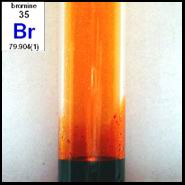
Bromine photo
Basic properties
Atomic number35
Atomic weight79.9041 amu
Element familyHalogens
Period4
Group17
Blockp-block
Discovery year1825
Isotope distribution
79Br
50.69%
81Br
49.31%
79Br: 50.69%81Br: 49.31%
79Br (50.69%)
81Br (49.31%)
Physical properties
Density 3.122 g/cm3 (STP)
Atomic hydrogen (H) 8.988E-5
Meitnerium (Mt) 28
Melting-7.1 °C
Helium (He) -272.2
Carbon (C) 3675
Boiling58.8 °C
Helium (He) -268.9
Tungsten (W) 5927
Chemical properties
Oxidation states
(less common)
-1, +1, +3, +5
(+2, +4, +7)
First ionization potential 11.814 eV
Cesium (Cs) 3.894
Helium (He) 24.587
Electron affinity 3.364 eV
Nobelium (No) -2.33
Atomic chlorine (Cl) 3.612725
Electronegativity2.96
Cesium (Cs) 0.79
Atomic fluorine (F) 3.98
Atomic radius
Covalent radius 1.14 Å
Atomic hydrogen (H) 0.32
Francium (Fr) 2.6
Van der Waals radius 1.85 Å
Atomic hydrogen (H) 1.2
Francium (Fr) 3.48
35BrWebQC.OrgCovalentVan der Waals
Compounds
FormulaNameOxidation state
KBrPotassium bromide-1
HBrHydrogen bromide-1
NaBrSodium bromide-1
Br2ODibromine monoxide+1
BrClBromine monochloride+1
BrFBromine monofluoride+1
BrOBromine monoxide radical+2
BrF3Bromine trifluoride+3
Br2O3Dibromine trioxide+3
BrO2Bromine dioxide+4
BrF5Bromine pentafluoride+5
Br2O5Dibromine pentoxide+5
Electronic properties
Electrons per shell2, 8, 18, 7
Electronic configuration[Ar] 3d104s24p5
Bohr atom model
Bohr atom model
Orbital box diagram
Orbital box diagram
Valence electrons7
Lewis dot structure Bromine Lewis dot structure
Orbital Visualization
🏠
▶️
📐
Electrons-

Bromine (Br): Periodic Table Element

Scientific Review Article | Chemistry Reference Series

Abstract

Bromine exhibits distinctive characteristics as the only nonmetallic element existing as a liquid at standard temperature and pressure besides mercury. With atomic number 35 and electronic configuration [Ar]4s²3d¹⁰4p⁵, bromine demonstrates intermediate properties between chlorine and iodine within group 17 of the periodic table. The element manifests significant industrial importance through its applications in flame retardants, representing over half of global bromine consumption. Its reddish-brown volatile nature and sharp penetrating odor distinguish bromine from neighboring halogens. The element's reactivity enables formation of diverse binary compounds, interhalogen species, and organobromine molecules. Bromine compounds exhibit essential biological functions while high concentrations produce toxic effects including bromism. Industrial extraction occurs primarily from concentrated brines in the Dead Sea and Arkansas, utilizing halogen displacement reactions for commercial production.

Introduction

Bromine occupies a unique position in modern industrial chemistry as the sole liquid nonmetallic element under standard conditions. Positioned in group 17 and period 4 of the periodic table, bromine demonstrates intermediate properties between the lighter chlorine and heavier iodine, following predictable periodic trends. The element's discovery in 1825-1826 by Carl Jacob Löwig and Antoine Jérôme Balard marked significant advancement in halogen chemistry. Its name derives from the Greek "bromos" meaning stench, reflecting the element's characteristically pungent odor. The electronic structure [Ar]4s²3d¹⁰4p⁵ positions bromine one electron short of noble gas configuration, driving its strong oxidizing behavior and diverse chemical reactivity. Contemporary applications span flame retardancy, water treatment, pharmaceutical synthesis, and industrial processing, establishing bromine as a critical element in technological applications.

Physical Properties and Atomic Structure

Fundamental Atomic Parameters

Bromine possesses atomic number 35 with standard atomic weight ranging from 79.901 to 79.907 u, reflecting natural isotopic variation. The electronic configuration [Ar]4s²3d¹⁰4p⁵ indicates seven valence electrons in the outermost shell, characteristic of halogen elements. The atomic radius measures 120 pm, intermediate between chlorine (99 pm) and iodine (140 pm), demonstrating regular periodic trends. Successive ionization energies show first ionization energy of 1139.9 kJ/mol, second ionization energy of 2103 kJ/mol, and third ionization energy of 3470 kJ/mol. The effective nuclear charge experienced by valence electrons approximates 7.6, accounting for screening effects of inner electron shells. Covalent radius measures 120 pm while van der Waals radius extends to 195 pm, influencing intermolecular interactions in condensed phases.

Macroscopic Physical Characteristics

Bromine exhibits distinctive reddish-brown coloration in liquid phase, transitioning to orange-red vapor at elevated temperatures. The element freezes at -7.2°C and boils at 58.8°C under standard atmospheric pressure, demonstrating moderate volatility. Density at 20°C measures 3.1023 g/cm³, significantly higher than water due to compact molecular packing. Heat of fusion equals 10.571 kJ/mol while heat of vaporization reaches 29.96 kJ/mol, indicating relatively weak intermolecular forces compared to other liquid elements. Specific heat capacity measures 0.474 J/(g·K) in liquid phase. The crystalline solid adopts orthorhombic structure with Br-Br bond distance of 227 pm, closely matching gaseous phase bond length of 228 pm. Electrical conductivity remains extremely low at 5×10⁻¹³ Ω⁻¹cm⁻¹ near melting point, characteristic of molecular crystals.

Chemical Properties and Reactivity

Electronic Structure and Bonding Behavior

Bromine demonstrates strong oxidizing properties with standard reduction potential of +1.087 V for the Br₂/Br⁻ couple, positioned between chlorine (+1.395 V) and iodine (+0.615 V). The element readily accepts electrons to achieve stable octet configuration, forming bromide anions in ionic compounds. Common oxidation states include -1, +1, +3, +5, and +7, with -1 being most stable in aqueous solutions. Covalent bonding occurs through sp³ hybridization in compounds like BrF₃, exhibiting T-shaped molecular geometry. Bond dissociation energy of Br₂ measures 193 kJ/mol, lower than Cl₂ (243 kJ/mol) but higher than I₂ (151 kJ/mol). Electronegativity on the Pauling scale equals 2.96, facilitating polar covalent bond formation with less electronegative elements.

Electrochemical and Thermodynamic Properties

Electronegativity values demonstrate systematic variation across different scales: Pauling (2.96), Mulliken (2.74), and Allred-Rochow (2.74). Successive ionization energies reveal electronic structure effects, with first ionization energy of 1139.9 kJ/mol reflecting 4p electron removal, while second ionization energy of 2103 kJ/mol corresponds to 4p⁴ configuration. Electron affinity measures 324.6 kJ/mol, indicating favorable electron capture. Standard electrode potentials vary with pH and species: HOBr/Br⁻ (+1.341 V in acidic solution), BrO₃⁻/Br⁻ (+1.399 V), and BrO₄⁻/BrO₃⁻ (+1.853 V). Thermodynamic stability of bromine compounds generally decreases with increasing oxidation state, as evidenced by the strong oxidizing nature of perbromate species.

Chemical Compounds and Complex Formation

Binary and Ternary Compounds

Bromine forms extensive series of binary compounds with most elements across the periodic table. Metal bromides demonstrate ionic character for electropositive elements, exemplified by NaBr (rock salt structure) and CaBr₂ (fluorite structure). Nonmetal bromides exhibit covalent bonding, including PBr₃ (pyramidal geometry) and SiBr₄ (tetrahedral arrangement). Hydrogen bromide represents the fundamental bromine compound, existing as colorless gas that dissolves readily in water to form hydrobromic acid (pKₐ = -9). Binary oxides prove less stable than corresponding chlorine oxides, with Br₂O decomposing above -17.5°C. Ternary compounds include bromates (BrO₃⁻) and perbromates (BrO₄⁻), demonstrating higher oxidation states and strong oxidizing properties.

Coordination Chemistry and Organometallic Compounds

Bromine participates in coordination complexes primarily as bromide ligand, forming octahedral complexes like [CoBr₆]³⁻ and tetrahedral species such as [ZnBr₄]²⁻. Coordination numbers typically range from 2 to 6, depending on central metal ion size and electronic configuration. Bromine-containing ligands exhibit weaker field strength compared to chloride, positioned lower in spectrochemical series. Organometallic bromine compounds include alkyl bromides (C-Br bond length ≈ 194 pm) and aryl bromides, serving as versatile synthetic intermediates. Grignard reagents containing bromine (RMgBr) demonstrate enhanced reactivity compared to chloride analogs. Metal-bromine bonds in organometallic complexes typically exhibit greater ionic character than corresponding chloride bonds due to bromine's lower electronegativity.

Natural Occurrence and Isotopic Analysis

Geochemical Distribution and Abundance

Bromine occurs in Earth's crust at concentrations of approximately 2.5 ppm, significantly lower than chlorine (145 ppm) and fluorine (585 ppm). Geochemical processes concentrate bromine in evaporite deposits and brines through preferential leaching and accumulation. Seawater contains 65 ppm bromine as bromide ions, representing a Br:Cl ratio of approximately 1:660. The Dead Sea exhibits exceptional bromine concentration at 4000 ppm (0.4%), making it the world's primary source for commercial extraction. Salt lakes in Arkansas, Michigan, and Israel contain economically viable bromine concentrations exceeding 1000 ppm. Geothermal brines and oil field waters occasionally show elevated bromine levels through subsurface concentration mechanisms.

Nuclear Properties and Isotopic Composition

Natural bromine consists of two stable isotopes: ⁷⁹Br (50.69% abundance) and ⁸¹Br (49.31% abundance), both possessing nuclear spin 3/2. This near-equal distribution facilitates isotopic identification through mass spectrometry, producing characteristic doublet patterns. Nuclear magnetic resonance studies preferentially utilize ⁸¹Br due to larger magnetic moment and quadrupole moment. Radioactive isotopes include ⁸⁰Br (half-life 17.7 minutes), ⁸²Br (half-life 35.3 hours), and ⁸³Br (half-life 2.4 hours), produced through neutron activation of natural bromine. The most stable radioisotope, ⁷⁷Br, exhibits half-life of 57.0 hours. Neutron capture cross-sections for thermal neutrons measure 6.9 barns for ⁷⁹Br and 2.7 barns for ⁸¹Br, enabling isotope production for medical applications.

Industrial Production and Technological Applications

Extraction and Purification Methodologies

Commercial bromine production relies primarily on halogen displacement reactions using chlorine gas to oxidize bromide ions in concentrated brines. The process operates at temperatures between 80-100°C with reaction stoichiometry: Cl₂ + 2Br⁻ → Br₂ + 2Cl⁻. Steam distillation removes elemental bromine from reaction mixture, followed by condensation and purification through fractional distillation. Alternative extraction employs direct electrolysis of bromide-containing brines, generating bromine at the anode: 2Br⁻ → Br₂ + 2e⁻. Purification involves treatment with sulfuric acid to remove water and organic impurities, achieving 99.5% purity for commercial applications. Annual global production approximates 800,000 metric tons, with Israel and Jordan accounting for 75% of world output.

Technological Applications and Future Prospects

Flame retardant applications consume approximately 55% of global bromine production, utilizing compounds like tetrabromobisphenol A and decabromodiphenyl ether in polymers and electronics. The mechanism involves radical scavenging during combustion, where bromine species interrupt free radical chain reactions. Water treatment applications employ bromine-based biocides for controlling bacteria, algae, and mollusks in cooling systems and swimming pools. Pharmaceutical synthesis utilizes bromine for introducing bromine atoms into drug molecules, enhancing bioactivity and selectivity. Oil and gas drilling operations employ bromide brines as high-density completion fluids due to their stability and environmental compatibility. Emerging applications include bromine flow batteries for grid-scale energy storage and advanced materials synthesis. Environmental regulations increasingly restrict certain organobromine compounds due to ozone depletion concerns, driving development of more sustainable alternatives.

Historical Development and Discovery

Bromine's discovery emerged from parallel investigations by Carl Jacob Löwig and Antoine Jérôme Balard during 1825-1826. Löwig first isolated bromine from mineral springs in Bad Kreuznach using chlorine displacement, while Balard extracted the element from Mediterranean seaweed ash. Initially mistaken for iodine monochloride, careful characterization revealed bromine's unique properties intermediate between chlorine and iodine. The name "bromine" originates from Greek "bromos" (stench), reflecting the element's distinctive penetrating odor. Early applications included daguerreotype photography beginning in 1840, where bromine provided advantages over iodine in silver halide emulsion preparation. Medical applications emerged in the mid-19th century with potassium bromide serving as anticonvulsant and sedative until replacement by modern pharmaceuticals. The development of synthetic organic chemistry expanded bromine applications through nucleophilic substitution and addition reactions, establishing its role in modern industrial processes.

Conclusion

Bromine occupies a distinctive position among the elements as the sole liquid nonmetal at standard conditions, exhibiting properties intermediate between chlorine and iodine that reflect systematic periodic trends. Its industrial significance centers on flame retardant applications, where bromine compounds provide essential fire safety protection through radical scavenging mechanisms. The element's chemical versatility enables diverse applications spanning pharmaceuticals, water treatment, and energy storage systems. Future developments will likely focus on environmentally sustainable bromine compounds that maintain performance while reducing ecological impact. Research opportunities exist in developing more efficient extraction methods, novel bromine-containing materials, and advanced applications in renewable energy technologies.

Periodict table
Please let us know how we can improve this web app.

Menu Balance Molar mass Gas laws Units Chemistry tools Periodic table Chemical forum Symmetry Constants Contribute Contact us
How to cite?