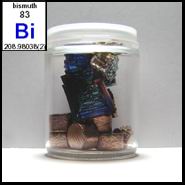
| Element | |
|---|---|
83BiBismuth208.9804012
8 18 32 18 5 |
|
| Basic properties | |
|---|---|
| Atomic number | 83 |
| Atomic weight | 208.980401 amu |
| Element family | Other metals |
| Period | 6 |
| Group | 15 |
| Block | p-block |
| Discovery year | 1000 |
| Isotope distribution |
|---|
209Bi 100% |
| Physical properties | |
|---|---|
| Density | 9.807 g/cm3 (STP) |
Atomic hydrogen (H) 8.988E-5 Meitnerium (Mt) 28 | |
| Melting | 271.52 °C |
Helium (He) -272.2 Carbon (C) 3675 | |
| Boiling | 1560 °C |
Helium (He) -268.9 Tungsten (W) 5927 | |
| Chemical properties | |
|---|---|
| Oxidation states (less common) | +3 (-3, -2, -1, 0, +1, +2, +4, +5) |
| First ionization potential | 7.286 eV |
Cesium (Cs) 3.894 Helium (He) 24.587 | |
| Electron affinity | 0.942 eV |
Nobelium (No) -2.33 Atomic chlorine (Cl) 3.612725 | |
| Electronegativity | 2.02 |
Cesium (Cs) 0.79 Atomic fluorine (F) 3.98 | |
| Atomic radius | |
|---|---|
| Covalent radius | 1.51 Å |
Atomic hydrogen (H) 0.32 Francium (Fr) 2.6 | |
| Van der Waals radius | 2.07 Å |
Atomic hydrogen (H) 1.2 Francium (Fr) 3.48 | |
| Compounds | ||
|---|---|---|
| Formula | Name | Oxidation state |
| Bi2O3 | Bismuth(III) oxide | +3 |
| BiCl3 | Bismuth(III) chloride | +3 |
| Bi2Te3 | Bismuth(III) telluride | +3 |
| Bi(CH3COO)3 | Bismuth(III) acetate | +3 |
| Bi(NO3)3 | Bismuth(III) nitrate | +3 |
| Bi12SiO20 | Bismuth silicon oxide | +3 |
| Bi2(SO4)3 | Bismuth(III) sulfate | +3 |
| Bi2S3 | Bismuth(III) sulfide | +3 |
| Bi2Se3 | Bismuth selenide | +3 |
| NaBiO3 | Sodium bismuthate | +5 |
| Bi2O5 | Bismuth(V) oxide | +5 |
| BiF5 | Bismuth pentafluoride | +5 |
| Electronic properties | |
|---|---|
| Electrons per shell | 2, 8, 18, 32, 18, 5 |
| Electronic configuration | [Xe] 4f14 |
|
Bohr atom model
| |
|
Orbital box diagram
| |
| Valence electrons | 5 |
| Lewis dot structure |
|
| Orbital Visualization | |
|---|---|
|
| |
| Electrons | - |
Bismuth (Bi): Periodic Table Element
Abstract
Bismuth (Bi), atomic number 83, represents the heaviest non-radioactive element in the periodic table, exhibiting unique physical and chemical properties that distinguish it from other post-transition metals. Characterized by its rhombohedral crystal structure, lustrous brownish-silver appearance, and diamagnetic behavior, bismuth demonstrates remarkable thermal expansion upon solidification and exceptional electrical properties. With a melting point of 271°C and density of 9.78 g/cm³, bismuth forms predominantly trivalent compounds and exhibits minimal toxicity compared to neighboring heavy metals. The element's industrial significance spans from traditional low-melting alloys to modern applications in electronics, pharmaceuticals, and advanced materials. Recent discovery of its very slight radioactivity, with ²⁰⁹Bi exhibiting a half-life of 2.01 × 10¹⁹ years, establishes bismuth as a bridge between stable and radioactive elements in nuclear chemistry.
Introduction
Bismuth occupies position 83 in the periodic table as the terminal stable element of Group 15 (pnictogens), exhibiting the characteristic ns²np³ electron configuration that defines this chemical family. The element's position at the intersection of metallic and non-metallic behavior manifests through its unique combination of metallic luster, brittle texture, and semiconductor properties when deposited in thin films. Bismuth's electronic structure [Xe] 4f¹⁴ 5d¹⁰ 6s² 6p³ reflects the lanthanide contraction effect and relativistic influences that become pronounced in heavy elements. Industrial production of approximately 20,000 tonnes annually, primarily from Chinese sources, supports diverse applications ranging from lead-free solders to pharmaceutical formulations. The element's historical significance extends from ancient metallurgy to contemporary topological insulator research, establishing bismuth as both a classical material and a subject of cutting-edge scientific investigation.
Physical Properties and Atomic Structure
Fundamental Atomic Parameters
Bismuth's atomic structure exhibits atomic number Z = 83 with standard atomic weight 208.98040 ± 0.00001 u, reflecting the dominance of the ²⁰⁹Bi isotope in natural samples. The electron configuration [Xe] 4f¹⁴ 5d¹⁰ 6s² 6p³ demonstrates complete filling of 4f and 5d subshells before population of the 6p orbital, characteristic of post-lanthanide elements. Effective nuclear charge calculations indicate significant shielding by inner electron shells, resulting in relatively large atomic radius compared to lighter Group 15 elements. The three unpaired 6p electrons contribute to bismuth's chemical bonding patterns and magnetic properties. Relativistic effects become substantial at this atomic number, influencing orbital energies and contributing to the element's unique physical characteristics. First ionization energy measurements of 703 kJ/mol reflect moderate ease of electron removal from the outermost 6p orbital, consistent with metallic character.
Macroscopic Physical Characteristics
Bismuth crystallizes in a rhombohedral lattice structure identical to arsenic and antimony, with unit cell parameters reflecting the increased atomic size characteristic of heavy pnictogens. The element exhibits lustrous brownish-silver appearance when freshly prepared, though surface oxidation rapidly produces characteristic rosy casts and eventual iridescent films through thin-layer optical interference. Melting point measurement of 271°C (544.15 K) combined with density determination of 9.78 g/cm³ establishes bismuth's position among low-melting heavy metals. The element demonstrates anomalous thermal expansion of 3.32% upon solidification, sharing this unusual property with water, silicon, germanium, and gallium. This expansion behavior reflects structural reorganization during the liquid-to-solid phase transition and contributes to bismuth's utility in compensating alloys. Thermal conductivity measurements place bismuth among the poorest metallic heat conductors, exceeded only by manganese among stable elements.
Chemical Properties and Reactivity
Electronic Structure and Bonding Behavior
Bismuth's chemical reactivity stems from its 6s²6p³ valence electron configuration, which readily accommodates oxidation to the +3 state through loss of the three 6p electrons. The resulting Bi³⁺ cation exhibits considerable stability due to the inert pair effect, where the 6s² electrons resist oxidation and contribute to the predominance of trivalent bismuth compounds. Coordination chemistry demonstrates preference for distorted octahedral and pyramidal geometries, reflecting stereochemical activity of the lone electron pair in Bi³⁺ complexes. Covalent bonding characteristics emerge in organobismuth compounds, where Bi-C bonds exhibit significant ionic character due to electronegativity differences. The +5 oxidation state appears only in BiF₅ and related fluoride complexes, requiring strongly oxidizing conditions for stabilization. Rare bismuthide compounds contain bismuth in the -3 oxidation state, forming with highly electropositive metals under specialized synthetic conditions.
Electrochemical and Thermodynamic Properties
Electronegativity values for bismuth (2.02 on the Pauling scale) reflect intermediate character between metallic and non-metallic behavior, consistent with its position at the metal-nonmetal boundary. Successive ionization energies demonstrate clear breaks after removal of the three 6p electrons, with first ionization energy (703 kJ/mol), second ionization energy (1610 kJ/mol), and third ionization energy (2466 kJ/mol) supporting the stability of the Bi³⁺ cation. Standard reduction potentials for bismuth couples indicate moderate reducing character, with Bi³⁺/Bi showing E° = +0.308 V versus standard hydrogen electrode. Thermodynamic stability of bismuth compounds varies significantly with oxidation state and anion identity, with oxides and halides generally exhibiting high formation enthalpies. Electrochemical behavior in aqueous solutions demonstrates pH-dependent stability regions, with bismuth(III) species predominating under acidic conditions and oxide phases forming in neutral to basic media.
Chemical Compounds and Complex Formation
Binary and Ternary Compounds
Bismuth trioxide (Bi₂O₃) represents the most thermodynamically stable binary oxide, crystallizing in multiple polymorphic forms including α, β, γ, and δ phases with distinct structural characteristics. Formation occurs readily through oxidation of metallic bismuth at elevated temperatures or through thermal decomposition of bismuth salts. Bismuth pentoxide (Bi₂O₅) exists only under strongly oxidizing conditions and decomposes to the trioxide above room temperature. Halide compounds demonstrate systematic trends, with all trihalides (BiX₃) being well-characterized while only BiF₅ exists as a stable pentahalide. The trihalides exhibit layer structures with bismuth in distorted octahedral coordination, readily hydrolyzing to form bismuth oxyhalides (BiOX) of significant technological importance. Bismuth trisulfide (Bi₂S₃) occurs naturally as the mineral bismuthinite and serves as the primary bismuth ore, exhibiting semiconductor properties and photovoltaic applications.
Coordination Chemistry and Organometallic Compounds
Bismuth coordination complexes typically exhibit coordination numbers of 3-9, with geometries ranging from trigonal pyramidal to distorted tricapped trigonal prismatic depending on ligand size and electronic requirements. The stereochemically active lone pair in Bi³⁺ complexes influences molecular geometries and contributes to distortions from ideal coordination polyhedra. Soft donor ligands such as phosphines, thiolates, and aryl groups form particularly stable bismuth complexes through enhanced covalent bonding character. Organobismuth chemistry encompasses triarylbismuth compounds, bismuth ylides, and bismacyclic systems with applications in organic synthesis and materials science. Bismuth-carbon bonds typically exhibit 10-20% ionic character, intermediate between purely covalent and ionic extremes. Recent developments in bismuth coordination chemistry include cluster compounds with unusual nuclearities and mixed-valence species containing both Bi³⁺ and metallic bismuth centers.
Natural Occurrence and Isotopic Analysis
Geochemical Distribution and Abundance
Crustal abundance of bismuth varies among geological surveys from 8 to 180 parts per billion, with most estimates converging near 25 ppb, placing it among the rarest naturally occurring stable elements. Geochemical behavior reflects chalcophile and siderophile tendencies, with bismuth concentrating in sulfide-rich environments and metallic phases during planetary differentiation. Primary mineral occurrences include native bismuth deposits in Australia, Bolivia, and China, alongside bismuthinite (Bi₂S₃) and bismite (Bi₂O₃) formations. Hydrothermal processes concentrate bismuth through preferential transport in sulfur-rich fluids, leading to association with copper, lead, and tungsten mineralization. Economic extraction relies primarily on byproduct recovery from base metal smelting operations rather than dedicated bismuth mining. Global production statistics indicate annual output of approximately 20,000 tonnes, with China providing 80% of world supply through integrated metallurgical processing.
Nuclear Properties and Isotopic Composition
Natural bismuth consists entirely of the ²⁰⁹Bi isotope, making it the heaviest monoisotopic element in the periodic table. Nuclear properties reveal alpha-decay radioactivity with half-life determination of (2.01 ± 0.08) × 10¹⁹ years, exceeding the age of the universe by nearly ten orders of magnitude. Specific activity calculations yield approximately 3 becquerels per kilogram, representing extremely low radiation levels comparable to natural background. Alpha particle energies of 3.14 MeV result from decay to ²⁰⁵Tl, with branching ratio approaching 100% for this decay mode. Artificial bismuth isotopes span mass numbers 184-218, with ²¹⁰Bi (5.01 days) and ²¹³Bi (45.6 minutes) finding applications in nuclear medicine and targeted alpha therapy. Nuclear cross-sections for thermal neutron capture (0.0338 barns) facilitate isotope production in reactor environments. Mass spectrometric analysis confirms isotopic homogeneity in terrestrial samples, contrasting with elements exhibiting natural isotopic variation.
Industrial Production and Technological Applications
Extraction and Purification Methodologies
Primary bismuth production relies on pyrometallurgical extraction from lead refinery residues, copper smelter slimes, and tungsten processing waste streams. The Betterton-Kroll process removes bismuth from lead through calcium and magnesium addition, forming intermetallic compounds that separate based on density differences. Electrolytic refining provides high-purity bismuth through controlled electrodeposition from alkaline bismuth solutions using carefully optimized current densities and bath compositions. Hydrometallurgical approaches employ selective leaching with nitric acid followed by precipitation and reduction steps to recover bismuth from complex ore matrices. Vacuum distillation enables final purification to 99.99% purity through preferential volatilization of bismuth over associated metals. Production costs reflect the dilute nature of bismuth-bearing raw materials and complex metallurgical processing requirements. Quality control protocols ensure specified impurity levels for electronics-grade bismuth applications, with particular attention to arsenic, antimony, and lead contamination.
Technological Applications and Future Prospects
Traditional bismuth applications center on fusible alloys for fire protection systems, where precise melting point control provides reliable thermal triggers for sprinkler activation and electrical fuse operation. The element's expansion upon solidification compensates for shrinkage in lead-tin-bismuth typesetting alloys, maintaining dimensional stability in printing applications. Environmental regulations drive growth in lead-free alternatives, with bismuth-based solders offering reduced toxicity for electronics assembly and plumbing systems. Pharmaceutical applications exploit bismuth's low toxicity in compounds such as bismuth subsalicylate for gastrointestinal treatment and bismuth-containing formulations for Helicobacter pylori eradication therapy. Advanced materials research explores bismuth-containing superconductors, particularly Bi₂Sr₂Ca₂Cu₃O₁₀ (Bi-2223) systems achieving critical temperatures above 100 K. Thermoelectric applications utilize bismuth telluride alloys for solid-state cooling and power generation, with nanostructured materials showing enhanced figure-of-merit values. Topological insulator research investigates bismuth-based compounds for quantum computing and spintronic applications, representing frontier areas of technological development.
Historical Development and Discovery
Bismuth ranks among the earliest known metals, with archaeological evidence suggesting familiarity dating to ancient civilizations including Egypt and Inca cultures. Historical confusion with lead and tin persisted until systematic chemical analysis in the 18th century established bismuth's unique identity through distinct physical and chemical properties. The element's name derives from uncertain etymological origins, possibly related to the German phrase "weiße Masse" (white mass) or Arabic terms for white antimony. Georgius Agricola's 16th-century metallurgical treatises provided early documentation of bismuth-containing ores and extraction procedures. Chemical distinction from lead became definitive through the work of Claude François Geoffroy in 1753, who demonstrated distinct oxidation products and chemical behavior. Industrial applications evolved from traditional cosmetics and pharmaceutical preparations to modern electronics and materials science applications. Nuclear properties remained unknown until 2003, when sensitive detection methods revealed the extremely long-lived alpha radioactivity that establishes bismuth's unique position as the heaviest naturally occurring quasi-stable element. Contemporary research continues to reveal new aspects of bismuth chemistry and physics, maintaining its relevance in cutting-edge scientific investigations.
Conclusion
Bismuth occupies a distinctive position in the periodic table as the heaviest element exhibiting long-term stability, bridging traditional heavy metal chemistry with contemporary advanced materials research. Its unique combination of low toxicity, useful physical properties, and diverse chemical reactivity continues to drive technological innovation across multiple industrial sectors. The element's diamagnetic character, thermal expansion behavior, and coordination chemistry provide fundamental insights into heavy element physics and bonding theory. Future research directions encompass topological materials, quantum technologies, and sustainable chemistry applications that leverage bismuth's environmental compatibility. The recent recognition of bismuth's radioactive nature adds nuclear chemistry dimensions to an already rich scientific landscape, ensuring continued relevance in both fundamental research and practical applications.

Please let us know how we can improve this web app.