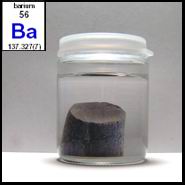
| Element | |
|---|---|
56BaBarium137.32772
8 18 18 8 2 |
|
| Basic properties | |
|---|---|
| Atomic number | 56 |
| Atomic weight | 137.3277 amu |
| Element family | Alkali earth metals |
| Period | 6 |
| Group | 2 |
| Block | s-block |
| Discovery year | 1772 |
| Isotope distribution |
|---|
130Ba 0.106% 132Ba 0.101% 134Ba 2.417% 135Ba 6.592% 136Ba 7.854% 137Ba 11.23% 138Ba 71.70% |
134Ba (2.42%) 135Ba (6.59%) 136Ba (7.85%) 137Ba (11.23%) 138Ba (71.70%) |
| Physical properties | |
|---|---|
| Density | 3.594 g/cm3 (STP) |
Atomic hydrogen (H) 8.988E-5 Meitnerium (Mt) 28 | |
| Melting | 729 °C |
Helium (He) -272.2 Carbon (C) 3675 | |
| Boiling | 1640 °C |
Helium (He) -268.9 Tungsten (W) 5927 | |
| Chemical properties | |
|---|---|
| Oxidation states (less common) | +2 (+1) |
| First ionization potential | 5.212 eV |
Cesium (Cs) 3.894 Helium (He) 24.587 | |
| Electron affinity | 0.145 eV |
Nobelium (No) -2.33 Atomic chlorine (Cl) 3.612725 | |
| Electronegativity | 0.89 |
Cesium (Cs) 0.79 Atomic fluorine (F) 3.98 | |
| Electronic properties | |
|---|---|
| Electrons per shell | 2, 8, 18, 18, 8, 2 |
| Electronic configuration | [Xe] 6s2 |
|
Bohr atom model
| |
|
Orbital box diagram
| |
| Valence electrons | 2 |
| Lewis dot structure |
|
| Orbital Visualization | |
|---|---|
|
| |
| Electrons | - |
Barium (Ba): Periodic Table Element
Abstract
Barium (Ba, atomic number 56) represents the fifth element in Group 2 of the periodic table and constitutes a soft, silvery alkaline earth metal with significant industrial and scientific applications. With atomic mass 137.327 ± 0.007 u and density 3.62 g/cm³, barium exhibits characteristic alkaline earth properties including high chemical reactivity, formation of predominantly ionic compounds in the +2 oxidation state, and distinctive green flame coloration. The element occurs naturally in Earth's crust at 0.0425% abundance, primarily as barite (BaSO₄) and witherite (BaCO₃) minerals. Industrial applications encompass drilling fluids, medical imaging contrast agents, vacuum tube gettering materials, and specialized ceramic components. Water-soluble barium compounds demonstrate significant toxicity, necessitating careful handling protocols in laboratory and industrial settings.
Introduction
Barium occupies position 56 in the periodic table, representing the fifth member of the alkaline earth metals (Group 2) and completing the sixth period's s-block configuration. The element exhibits electron configuration [Xe]6s², establishing its characteristic divalent chemistry and positioning within established periodic trends of increasing atomic radius, decreasing ionization energy, and enhanced metallic character proceeding down Group 2. Discovery traces to 1772 when Carl Scheele identified baryte as containing a previously unknown element, though metallic isolation required electrolytic techniques developed by Humphry Davy in 1808. The name derives from Greek βαρύς (barys), meaning "heavy," reflecting the element's notable density among common minerals. Modern understanding positions barium as essential to specialized technological applications while simultaneously recognizing its biological hazards.
Physical Properties and Atomic Structure
Fundamental Atomic Parameters
Barium exhibits atomic number 56 with electron configuration [Xe]6s², establishing eighteen-electron noble gas core plus two valence electrons in the 6s orbital. Atomic radius measures 268 pm, representing predictable increase from strontium (249 pm) and calcium (231 pm) consistent with additional electron shell. Ionic radius for Ba²⁺ equals 149 pm, reflecting removal of 6s electrons and subsequent contraction. First ionization energy equals 502.9 kJ/mol, demonstrating characteristic alkaline earth decrease from magnesium (737.7 kJ/mol) through calcium (589.8 kJ/mol) and strontium (549.5 kJ/mol). Second ionization energy reaches 965.2 kJ/mol, maintaining relatively accessible removal of the second valence electron. Effective nuclear charge experienced by valence electrons approximates +2.85, accounting for screening by inner electron shells.
Macroscopic Physical Characteristics
Metallic barium displays silvery-white appearance with characteristic pale yellow tint when ultrapure, rapidly tarnishing to dark gray oxide coating upon air exposure. Crystal structure adopts body-centered cubic arrangement with lattice parameter 503 pm and barium-barium distance expanding at rate 1.8 × 10⁻⁵ per °C temperature increase. Physical hardness registers 1.25 on Mohs scale, indicating substantial malleability typical of Group 2 metals. Melting point occurs at 1000 K (727°C), positioning intermediate between strontium (1050 K) and radium (973 K), while boiling point reaches 2170 K (1897°C), substantially exceeding strontium (1655 K). Density equals 3.62 g/cm³ at room temperature, reflecting expected trend between strontium (2.36 g/cm³) and radium (~5 g/cm³). Electrical conductivity demonstrates metallic behavior with resistance increasing linearly with temperature elevation.
Chemical Properties and Reactivity
Electronic Structure and Bonding Behavior
Barium reactivity patterns reflect 6s² valence configuration favoring complete electron loss to achieve stable [Xe] noble gas configuration. Oxidation state +2 predominates virtually exclusively in all compounds, with Ba²⁺ ion demonstrating exceptional stability through favorable lattice energies and hydration enthalpies. Bond formation proceeds through ionic mechanisms with electronegativity 0.89 on Pauling scale, indicating strong preference for electron donation to more electronegative elements. Coordination numbers typically range from 6 to 12 in crystalline solids, reflecting large ionic radius permitting extensive ligand approach. Polarizing power remains relatively low due to large ionic size, resulting in predominantly ionic rather than covalent bonding character across most compound types.
Electrochemical and Thermodynamic Properties
Standard reduction potential for Ba²⁺/Ba couple equals -2.912 V versus standard hydrogen electrode, positioning barium among most reducing metallic elements and indicating spontaneous reaction with water, acids, and atmospheric oxygen. Electronegativity measures 0.89 on Pauling scale and 0.97 on Mulliken scale, confirming strong electropositive character. First ionization energy 502.9 kJ/mol reflects relatively facile electron removal, while second ionization energy 965.2 kJ/mol maintains accessibility compared to transition metals. Electron affinity approaches zero, consistent with metallic character and tendency toward cation formation. Thermodynamic stability of Ba²⁺ compounds generally exceeds corresponding alkaline earth analogs due to favorable lattice energies offsetting ionization energy requirements.
Chemical Compounds and Complex Formation
Binary and Ternary Compounds
Barium oxide (BaO) forms through direct oxidation at elevated temperatures, crystallizing in rock salt structure with Ba-O distance 276 pm and demonstrating basic character in aqueous solution. Barium sulfide (BaS) results from carbothermic reduction of sulfate, exhibiting similar rock salt structure and serving as synthetic precursor for other barium compounds. Halide series includes BaF₂ (fluorite structure, sparingly soluble), BaCl₂ (rutile-type, highly soluble), BaBr₂, and BaI₂, with solubility increasing down halogen group following typical trends. Barium carbonate (BaCO₃) occurs naturally as witherite mineral, displaying orthorhombic aragonite structure and limited water solubility. Barium sulfate (BaSO₄) constitutes extremely insoluble compound (Ksp = 1.08 × 10⁻¹⁰) crystallizing in barite structure and representing primary natural occurrence form.
Coordination Chemistry and Organometallic Compounds
Barium coordination complexes typically exhibit coordination numbers 6-12 reflecting large ionic radius and weak crystal field effects. Common ligands include water, acetate, nitrate, and chelating agents such as EDTA and crown ethers. Crown ether complexes demonstrate particular stability with 18-crown-6 showing exceptional Ba²⁺ selectivity useful in separation processes. Organobarium chemistry remains limited due to highly ionic Ba-C bonding, though dialkylbarium compounds have been synthesized under anhydrous conditions using specialized synthetic routes. These organometallic species require inert atmosphere handling and demonstrate extreme sensitivity toward protic solvents and atmospheric moisture.
Natural Occurrence and Isotopic Analysis
Geochemical Distribution and Abundance
Crustal abundance averages 425 ppm (0.0425%), positioning barium as 14th most abundant element in Earth's crust and most abundant heavy alkaline earth metal. Seawater concentration measures 13 μg/L, reflecting limited solubility of common barium minerals under oceanic conditions. Primary mineral associations include barite (BaSO₄) formed through hydrothermal processes and sedimentary precipitation, and witherite (BaCO₃) occurring in lead-zinc ore deposits. Geochemical behavior resembles strontium and calcium, with substitution possible in carbonate and sulfate mineral lattices. Barium concentrates in K-feldspar and biotite during igneous differentiation, with subsequent mobilization during weathering and hydrothermal alteration processes.
Nuclear Properties and Isotopic Composition
Natural barium comprises seven stable isotopes: ¹³⁰Ba (0.106%), ¹³²Ba (0.101%), ¹³⁴Ba (2.417%), ¹³⁵Ba (6.592%), ¹³⁶Ba (7.854%), ¹³⁷Ba (11.232%), and ¹³⁸Ba (71.698%). ¹³⁸Ba constitutes most abundant isotope with nuclear spin 0 and absence of quadrupole moment. ¹³⁰Ba undergoes extremely slow double beta plus decay to ¹³⁰Xe with half-life (0.5-2.7) × 10²¹ years, approximately 10¹¹ times universe age. Artificial radioisotopes include ¹³³Ba (t₁/₂ = 10.51 years) used in gamma-ray calibration standards, and shorter-lived isotopes ranging from ¹¹⁴Ba to ¹⁵³Ba. Most stable artificial isotope ¹³³Ba finds applications in nuclear medicine and radiation detection calibration due to convenient gamma emission energies and appropriate half-life duration.
Industrial Production and Technological Applications
Extraction and Purification Methodologies
Primary production begins with barite ore (BaSO₄) mining, concentrated through froth flotation to achieve >95% purity with minimal iron and silica content. Carbothermic reduction converts barite to barium sulfide at 1100-1200°C according to BaSO₄ + 2C → BaS + 2CO₂. Water-soluble BaS serves as intermediate for producing other compounds: oxidation yields sulfate, nitric acid treatment produces nitrate, CO₂ exposure forms carbonate. Metallic barium production employs aluminum reduction of barium oxide at 1100°C through formation of intermediate BaAl₄ compound, followed by further reduction with BaO to yield metallic barium and BaAl₂O₄ byproduct. Vacuum distillation purifies crude metal, achieving >99% purity with principal impurities being strontium (0.8%) and calcium (0.25%). Annual production approximates 6-8 million tonnes barite globally, with China dominating at >50% world output.
Technological Applications and Future Prospects
Drilling fluid applications consume >90% of barite production, where high density (4.5 g/cm³) and chemical inertness provide hydrostatic pressure control in oil and gas well operations. Medical imaging employs barium sulfate as radiocontrast agent due to high X-ray opacity and biological inertness, enabling gastrointestinal tract visualization. Vacuum tube technology utilizes metallic barium as getter material for removing residual gases through reaction and adsorption mechanisms. Specialized ceramic applications include barium titanate (BaTiO₃) in electronic components exhibiting ferroelectric properties and high dielectric constants. Emerging technologies investigate barium compounds in high-temperature superconductors, particularly YBCO (YBa₂Cu₃O₇) systems achieving critical temperatures above liquid nitrogen boiling point.
Historical Development and Discovery
Medieval alchemists recognized "Bologna stones" (barite specimens) exhibiting phosphorescent properties after light exposure, with documented observations by Vincenzo Casciorolus in 1602. Carl Scheele's 1772 analysis of heavy spar identified presence of unknown earth, though isolation proved beyond contemporary techniques. Johan Gottlieb Gahn achieved similar results in 1774, while William Withering described heavy mineral deposits in Cumberland lead mines, now recognized as witherite. Systematic nomenclature development involved Antoine Lavoisier's designation "baryte" and subsequent adaptation to "barium" following metallic isolation. Humphry Davy accomplished first metallic isolation in 1808 through electrolysis of molten barium hydroxide, establishing barium among newly discovered alkaline earth elements. Robert Bunsen and Augustus Matthiessen refined production methods using electrolysis of barium chloride-ammonium chloride mixtures, enabling larger-scale preparation for research purposes.
Conclusion
Barium occupies a distinctive position within the alkaline earth series, combining characteristic Group 2 reactivity with unique applications in modern technology and industry. The element's high density, chemical reactivity, and distinctive spectroscopic properties establish its utility in specialized applications ranging from petroleum extraction to medical diagnostics. Future research directions emphasize developing environmentally sustainable extraction processes, expanding applications in advanced ceramics and superconductor technologies, and addressing toxicological concerns through improved handling protocols and compound design.

Please let us know how we can improve this web app.