Printed from https://www.webqc.org

Aluminum @ Periodic Table of Chemical Elements

12345678 910111213141516 1718
IIIIIIbIVb VbVIbVIIbVIIIbIb IIbIIIIVVVI VIIVIII
1H
1.0079
2He
4.0026
3Li
6.9412
4Be
9.0121
5B
10.811
6C
12.010
7N
14.006
8O
15.999
9F
18.998
10Ne
20.179
11Na
22.989
12Mg
24.305
13Al
26.981
14Si
28.085
15P
30.973
16S
32.065
17Cl
35.453
18Ar
39.948
19K
39.098
20Ca
40.078
21Sc
44.955
22Ti
47.867
23V
50.941
24Cr
51.996
25Mn
54.938
26Fe
55.845
27Co
58.933
28Ni
58.693
29Cu
63.546
30Zn
65.409
31Ga
69.723
32Ge
72.641
33As
74.921
34Se
78.963
35Br
79.904
36Kr
83.798
37Rb
85.467
38Sr
87.621
39Y
88.905
40Zr
91.224
41Nb
92.906
42Mo
95.942
43Tc
98.906
44Ru
101.07
45Rh
102.90
46Pd
106.42
47Ag
107.86
48Cd
112.41
49In
114.81
50Sn
118.71
51Sb
121.76
52Te
127.60
53I
126.90
54Xe
131.29
55Cs
132.90
56Ba
137.32
57La
138.90
72Hf
178.49
73Ta
180.94
74W
183.84
75Re
186.20
76Os
190.23
77Ir
192.21
78Pt
195.08
79Au
196.96
80Hg
200.59
81Tl
204.38
82Pb
207.21
83Bi
208.98
84Po
208.98
85At
209.98
86Rn
222.01
87Fr
223.01
88Ra
226.02
89Ac
227.02
104Rf
261.10
105Db
262.11
106Sg
266.12
107Bh
264.12
108Hs
269
109Mt
278
110Ds
281
111Rg
282
112Cn
285
113Nh
286
114Fl
289
115Mc
290
116Lv
293
117Ts
294
118Og
294
Lanthanoids58Ce
140.11
59Pr
140.90
60Nd
144.24
61Pm
146.91
62Sm
150.36
63Eu
151.96
64Gd
157.25
65Tb
158.92
66Dy
162.50
67Ho
164.93
68Er
167.25
69Tm
168.93
70Yb
173.04
71Lu
174.96
Actinoids90Th
232.03
91Pa
231.03
92U
238.02
93Np
237.04
94Pu
244.06
95Am
243.06
96Cm
247.07
97Bk
247.07
98Cf
251.07
99Es
252.08
100Fm
257.09
101Md
258.09
102No
259.10
103Lr
260.10
Alkali metals Alkali earth metals Transition metals Other metals Metaloids Non-metals Halogens Noble gases
Element

13

Al

Aluminum

26.98153868

2
8
3
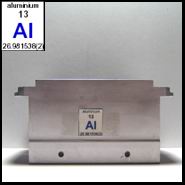
Aluminum photo
Basic properties
Atomic number13
Atomic weight26.98153868 amu
Element familyOther metals
Period3
Group13
Blockp-block
Discovery year1824
Isotope distribution
27Al
100%
Physical properties
Density 2.698 g/cm3 (STP)
Atomic hydrogen (H) 8.988E-5
Meitnerium (Mt) 28
Melting660.25 °C
Helium (He) -272.2
Carbon (C) 3675
Boiling2467 °C
Helium (He) -268.9
Tungsten (W) 5927
Chemical properties
Oxidation states
(less common)
+3
(-2, -1, 0, +1, +2)
First ionization potential 5.985 eV
Cesium (Cs) 3.894
Helium (He) 24.587
Electron affinity 0.433 eV
Nobelium (No) -2.33
Atomic chlorine (Cl) 3.612725
Electronegativity1.61
Cesium (Cs) 0.79
Atomic fluorine (F) 3.98
Atomic radius
Covalent radius 1.26 Å
Atomic hydrogen (H) 0.32
Francium (Fr) 2.6
Van der Waals radius 1.84 Å
Atomic hydrogen (H) 1.2
Francium (Fr) 3.48
Metallic radius 1.43 Å
Beryllium (Be) 1.12
Cesium (Cs) 2.65
13AlWebQC.OrgCovalentMetallicVan der Waals
Compounds
FormulaNameOxidation state
Al2OAluminium(I) oxide+1
AlBrAluminium monobromide+1
AlClAluminium monochloride+1
AlFAluminium monofluoride+1
AlIAluminium monoiodide+1
AlB12Aluminium dodecaboride+2
AlB2Aluminium diboride+2
AlOAluminium(II) oxide+2
Al2(SO4)3Aluminium sulfate+3
Al2O3Aluminium oxide+3
AlCl3Aluminium chloride+3
Al(OH)3Aluminium hydroxide+3
Electronic properties
Electrons per shell2, 8, 3
Electronic configuration[Ne] 3s23p1
Bohr atom model
Bohr atom model
Orbital box diagram
Orbital box diagram
Valence electrons3
Lewis dot structure Aluminum Lewis dot structure
Orbital Visualization
🏠
▶️
📐
Electrons-

Aluminium (Al): Periodic Table Element

Scientific Review Article | Chemistry Reference Series

Abstract

Aluminium (atomic number 13, symbol Al) represents a fundamental post-transition metal in the boron group of the periodic table. With an electron configuration of [Ne] 3s² 3p¹, aluminium exhibits characteristic properties including low density (2.70 g/cm³), high reactivity toward oxygen, and excellent thermal and electrical conductivity. The element demonstrates predominant oxidation state +3, forming compounds with significant covalent character due to its high charge-to-size ratio. Aluminium's crustal abundance of 8.23% makes it the third most abundant element in Earth's crust, primarily occurring in bauxite minerals. Industrial extraction via the Hall-Héroult process enables widespread technological applications ranging from aerospace alloys to electronic components. The element's unique combination of low density, corrosion resistance through oxide passivation, and mechanical properties establishes its critical role in modern materials science and engineering applications.

Introduction

Aluminium occupies position 13 in the periodic table, situated in period 3 and group 13 (IIIA), commonly designated as the boron group. The element's electronic structure, characterized by three valence electrons beyond a stable neon core configuration, fundamentally determines its chemical behavior and physical properties. Aluminium's discovery in 1825 by Hans Christian Ørsted marked the beginning of extensive research into post-transition metal chemistry, culminating in the development of industrial extraction processes that transformed global materials science.

The element's significance extends beyond its fundamental chemical properties to encompass critical technological applications in aerospace, construction, and electronics industries. Aluminium's unique property profile, featuring low density coupled with substantial mechanical strength when alloyed, positions it as an essential material for weight-sensitive applications. The element's high affinity for oxygen results in spontaneous formation of protective oxide layers, conferring exceptional corrosion resistance that enhances durability in environmental applications.

Periodic trends within group 13 demonstrate aluminium's intermediate position between boron's covalent character and the increasingly metallic behavior observed in gallium, indium, and thallium. This positioning manifests in aluminium's amphoteric nature, enabling formation of both cationic and anionic species depending on chemical environment and reaction conditions.

Physical Properties and Atomic Structure

Fundamental Atomic Parameters

Aluminium's atomic structure comprises 13 protons, 14 neutrons in its most abundant isotope ²⁷Al, and 13 electrons arranged in the configuration [Ne] 3s² 3p¹. The atomic radius measures 143 pm for the neutral atom, while the ionic radius of Al³⁺ contracts significantly to 53.5 pm in octahedral coordination and 39 pm in tetrahedral coordination, reflecting the high charge-to-size ratio characteristic of aluminium ions.

The first three ionization energies of aluminium are 577.5 kJ/mol, 1816.7 kJ/mol, and 2744.8 kJ/mol respectively, while the fourth ionization energy increases dramatically to 11,577 kJ/mol due to disruption of the stable neon-like electron configuration. This ionization pattern explains aluminium's tendency to form Al³⁺ ions rather than higher oxidation states under normal conditions.

Electronegativity values for aluminium register 1.61 on the Pauling scale and 1.47 on the Allred-Rochow scale, positioning the element between predominantly ionic and covalent bonding regimes. The effective nuclear charge experienced by valence electrons equals approximately 2.99, accounting for screening effects from inner electrons and contributing to aluminium's moderate electronegativity compared to neighboring elements.

Macroscopic Physical Characteristics

Aluminium exhibits characteristic silvery-white metallic luster with exceptional light-reflecting properties across ultraviolet, visible, and infrared spectral regions. The element crystallizes in a face-centered cubic (fcc) structure with lattice parameter a = 4.0495 Å at room temperature. This crystal structure, shared with copper and lead, maximizes packing efficiency and contributes to aluminium's mechanical properties.

Thermodynamic properties include melting point of 660.3°C, boiling point of 2519°C, heat of fusion 10.71 kJ/mol, and heat of vaporization 294.0 kJ/mol. The specific heat capacity measures 0.897 J/(g·K) at 25°C, while thermal conductivity reaches 237 W/(m·K), ranking among the highest for metallic elements. Electrical conductivity equals 37.7 × 10⁶ S/m, approximately 61% that of copper while maintaining only 30% of copper's density.

Density measurements yield 2.70 g/cm³ at standard conditions, significantly lower than most structural metals including iron (7.87 g/cm³) and copper (8.96 g/cm³). This low density results from aluminium's relatively light atomic mass (26.98 u) combined with efficient crystal packing, making it advantageous for applications requiring high strength-to-weight ratios.

Chemical Properties and Reactivity

Electronic Structure and Bonding Behavior

Aluminium's chemical reactivity derives from its [Ne] 3s² 3p¹ electron configuration, featuring three readily available valence electrons for bond formation. The element demonstrates strong tendency toward +3 oxidation state through loss of all valence electrons, though lower oxidation states (+1, +2) exist in specialized conditions such as high-temperature gas phase reactions and organometallic complexes.

Bond formation in aluminium compounds exhibits significant covalent character despite formal ionic charge distributions. The Al³⁺ ion's high charge density (charge-to-radius ratio) induces polarization of electron clouds in neighboring atoms, leading to partially covalent bonding according to Fajans' rules. This covalent character manifests in properties such as volatility of aluminium halides and solubility patterns of aluminium compounds.

Coordination chemistry typically involves tetrahedral or octahedral geometries, with coordination numbers ranging from 4 to 6 in most compounds. Aluminium's preference for sp³ and sp³d² hybridization enables formation of complex structures including aluminate ions [Al(OH)₄]⁻ and octahedral complexes [AlF₆]³⁻. The absence of available d-orbitals in the valence shell restricts coordination numbers compared to transition metals.

Electrochemical and Thermodynamic Properties

Standard reduction potential for the Al³⁺/Al couple measures -1.66 V versus standard hydrogen electrode, indicating strong reducing character in aqueous solution. This negative potential explains aluminium's position in the electrochemical series and its thermodynamic tendency to undergo oxidation reactions, particularly with water and atmospheric oxygen.

Successive ionization energies demonstrate the stability of the +3 oxidation state: I₁ = 577.5 kJ/mol, I₂ = 1816.7 kJ/mol, I₃ = 2744.8 kJ/mol, with a dramatic increase to I₄ = 11,577 kJ/mol. Electron affinity measures -42.5 kJ/mol, indicating unfavorable formation of Al⁻ anions and explaining aluminium's exclusively cationic behavior in ionic compounds.

Thermodynamic stability of aluminium oxide (Al₂O₃) exhibits exceptional magnitude with standard enthalpy of formation ΔH°f = -1675.7 kJ/mol. This enormous stability drives aluminium's reactivity toward oxygen and underlies the protective passivation phenomenon observed in atmospheric exposure. The Gibbs free energy of formation for Al₂O₃ equals -1582.3 kJ/mol, confirming thermodynamic favorability under standard conditions.

Chemical Compounds and Complex Formation

Binary and Ternary Compounds

Aluminium oxide (Al₂O₃) represents the most significant binary compound, existing in multiple polymorphic forms including α-alumina (corundum), γ-alumina, and δ-alumina. The α-form exhibits hexagonal crystal structure with exceptional hardness (9 on Mohs scale) and chemical inertness, while γ-alumina demonstrates high surface area and catalytic activity. Formation occurs through direct oxidation or thermal decomposition of hydroxides, with thermodynamic driving force provided by the large negative enthalpy of formation.

Aluminium halides demonstrate varying properties dependent on halogen identity. AlF₃ exhibits ionic character with high melting point (1291°C) and low volatility, while AlCl₃, AlBr₃, and AlI₃ display molecular character with dimeric structures in solid and vapor phases. Al₂Cl₆ dimers feature bridging chlorine atoms creating four-coordinate aluminium centers, demonstrating electron-deficient bonding characteristic of boron group elements.

Aluminium sulfide (Al₂S₃) crystallizes in a hexagonal structure and hydrolyzes readily in moist air to produce Al₂O₃ and hydrogen sulfide. Aluminium nitride (AlN) exhibits wurtzite structure with significant covalent character, demonstrating excellent thermal conductivity and electrical insulation properties valuable in semiconductor applications. The carbide Al₄C₃ forms through direct reaction at elevated temperatures, producing methane upon hydrolysis according to the reaction: Al₄C₃ + 12H₂O → 4Al(OH)₃ + 3CH₄.

Coordination Chemistry and Organometallic Compounds

Aluminium coordination complexes typically exhibit tetrahedral or octahedral geometries dictated by ligand steric requirements and electronic factors. Common coordination numbers include 4, 5, and 6, with examples including [AlCl₄]⁻, [AlF₆]³⁻, and [Al(H₂O)₆]³⁺. The high charge density of Al³⁺ leads to strong electrostatic interactions with ligands and significant ligand activation.

Aqueous chemistry features the hexaaquaaluminium ion [Al(H₂O)₆]³⁺, which undergoes hydrolysis reactions producing [Al(H₂O)₅OH]²⁺ and higher hydroxylated species. Progressive deprotonation leads to formation of polynuclear species and ultimately precipitation of amorphous Al(OH)₃. The pH-dependent speciation demonstrates aluminium's amphoteric behavior, forming soluble aluminate ions [Al(OH)₄]⁻ under strongly alkaline conditions.

Organometallic chemistry encompasses alkyl and aryl derivatives, typically requiring stabilization through Lewis base coordination due to electron deficiency at aluminium centers. Trimethylaluminium (Al(CH₃)₃) exists as a dimer in condensed phases, featuring bridging methyl groups similar to aluminium halide structures. Industrial applications include Ziegler-Natta polymerization catalysis and chemical vapor deposition processes for semiconductor manufacturing.

Natural Occurrence and Isotopic Analysis

Geochemical Distribution and Abundance

Aluminium ranks as the third most abundant element in Earth's crust with concentration approximately 8.23% by mass, equivalent to 82,300 ppm. This abundance surpasses all metals except silicon and oxygen, establishing aluminium as the most abundant metal in crustal rocks. Distribution occurs primarily in aluminosilicate minerals including feldspars, micas, and clay minerals, reflecting aluminium's strong affinity for oxygen and silicon in geological environments.

Bauxite represents the principal economic source of aluminium, comprising hydrated aluminium oxides including gibbsite (Al(OH)₃), boehmite (AlO(OH)), and diaspore (AlO(OH)). Major bauxite deposits occur in tropical and subtropical regions where intense weathering processes concentrate aluminium through leaching of more soluble elements. Australia, Guinea, and Brazil contain the largest reserves, collectively accounting for approximately 60% of global bauxite resources.

Geochemical behavior reflects aluminium's high field strength and lithophile character, leading to preferential incorporation into silicate minerals during magmatic processes. Weathering releases aluminium from primary minerals, with subsequent transport and deposition controlled by pH and organic complexation. Residence time in soils often extends to thousands of years due to low solubility under normal environmental conditions.

Nuclear Properties and Isotopic Composition

Aluminium exhibits mononuclidic character with ²⁷Al representing the sole stable isotope, possessing atomic mass 26.9815385 u. Nuclear spin equals 5/2 with magnetic moment +3.6415 nuclear magnetons, enabling nuclear magnetic resonance applications with 100% natural abundance providing exceptional sensitivity for analytical techniques.

Radioactive isotopes span mass numbers from 21 to 43, with ²⁶Al being the longest-lived radioactive nuclide (half-life 7.17 × 10⁵ years). ²⁶Al undergoes beta-plus decay to ²⁶Mg and serves as a cosmogenic radionuclide produced by cosmic ray spallation of atmospheric argon. Ratios of ²⁶Al to ¹⁰Be provide chronological markers for geological processes over timescales of 10⁵ to 10⁶ years.

Nuclear cross-sections for thermal neutron capture measure 0.231 barns for ²⁷Al, producing short-lived ²⁸Al (half-life 2.24 minutes) through (n,γ) reactions. Nuclear properties including binding energy per nucleon (8.3 MeV) reflect the stability of the ²⁷Al nucleus within the nuclear shell model framework.

Industrial Production and Technological Applications

Extraction and Purification Methodologies

Industrial aluminium production relies on the Hall-Héroult electrolytic process, involving dissolution of purified alumina (Al₂O₃) in molten cryolite (Na₃AlF₆) at approximately 960°C. Electrolysis occurs between carbon anodes and cathodes, with the overall reaction: 2Al₂O₃ + 3C → 4Al + 3CO₂. Current densities typically range from 0.7 to 1.0 A/cm², requiring approximately 13-15 kWh of electrical energy per kilogram of aluminium produced.

Alumina preparation involves the Bayer process, wherein bauxite undergoes digestion in concentrated sodium hydroxide solution at 150-240°C, dissolving aluminium-bearing minerals while leaving iron oxides and silicates as insoluble residue. Precipitation of pure aluminium hydroxide occurs through controlled cooling and seeding, followed by calcination at 1000-1200°C to produce metallurgical-grade alumina.

Global production capacity exceeds 65 million metric tons annually, with China dominating production at approximately 57% of world output. Energy requirements represent the primary economic factor, with smelters typically located near abundant hydroelectric power sources. Recycling contributes significantly to supply, requiring only 5% of the energy needed for primary production while maintaining material quality through remelting processes.

Technological Applications and Future Prospects

Aerospace applications exploit aluminium's favorable strength-to-weight ratio through advanced alloy systems including 2xxx (Al-Cu), 6xxx (Al-Mg-Si), and 7xxx (Al-Zn-Mg) series. Precipitation hardening mechanisms enable yield strengths exceeding 500 MPa while maintaining densities below 3.0 g/cm³. Aircraft structures utilize approximately 80% aluminium alloys by weight, with applications ranging from fuselage panels to engine components.

Transportation sector consumption encompasses automotive body panels, engine blocks, and wheels, driven by fuel efficiency requirements and emissions regulations. Heat treatment processes including solution annealing, quenching, and artificial aging optimize mechanical properties for specific applications. Advanced forming techniques such as superplastic forming enable complex geometries while maintaining structural integrity.

Electronic applications leverage aluminium's electrical conductivity in power transmission lines, heat sinks, and integrated circuit metallization. Thin film deposition through sputtering or evaporation creates conductive paths in semiconductor devices, with aluminium-silicon alloys preventing junction spiking phenomena. Corrosion resistance in marine environments supports applications in offshore platforms and naval vessels through appropriate alloy selection and surface treatments.

Emerging technologies include additive manufacturing using aluminium powders, enabling complex geometries impossible through conventional machining. Research focuses on nanostructured alloys, functionally graded materials, and hybrid composites incorporating ceramic reinforcements. Hydrogen storage applications exploit aluminium's reaction with water to generate hydrogen gas, potentially supporting future energy storage systems.

Historical Development and Discovery

Aluminium's discovery chronology illustrates the evolution of chemical knowledge and industrial capabilities during the 19th century. Hans Christian Ørsted first isolated metallic aluminium in 1825 through reduction of aluminium chloride with potassium amalgam, producing small quantities of impure metal. Friedrich Wöhler refined the process in 1827, obtaining pure aluminium through reduction with metallic potassium and establishing basic properties including density and metallic character.

Henri Étienne Sainte-Claire Deville developed the first commercial production method in 1854, substituting sodium for potassium in reduction reactions and achieving sufficient scale for industrial applications. Napoleon III's patronage supported early development, with aluminium initially valued above gold due to production difficulties and rarity. The element's designation as "silver from clay" reflected both its appearance and geological abundance in aluminosilicate minerals.

Revolutionary advancement occurred in 1886 with simultaneous development of electrolytic processes by Paul Héroult in France and Charles Martin Hall in the United States. The Hall-Héroult process enabled large-scale production by eliminating expensive chemical reductants, instead utilizing electrical energy for direct oxide reduction in molten fluoride electrolytes. This innovation reduced aluminium prices by over 95% within a decade, transforming the element from a precious metal to an industrial commodity.

Karl Josef Bayer's development of the alumina extraction process in 1887 completed the industrial foundation, providing efficient means for purifying bauxite ores and producing high-grade aluminium oxide feedstock for electrolytic reduction. Integration of the Bayer and Hall-Héroult processes established the modern aluminium industry, enabling applications in aerospace, transportation, and construction that define contemporary materials science.

Conclusion

Aluminium's position in the periodic table and unique combination of physical and chemical properties establish its fundamental importance in modern chemistry and technology. The element's electron configuration determines characteristic behaviors including formation of stable +3 oxidation states, amphoteric reactivity, and strong oxide-forming tendency that provides corrosion protection. Low density coupled with excellent mechanical properties when alloyed creates exceptional utility in weight-sensitive applications ranging from aerospace structures to consumer electronics.

Industrial significance extends beyond current applications to encompass emerging technologies including additive manufacturing, energy storage systems, and advanced composite materials. Research directions focus on nanostructured alloys, surface modification techniques, and recycling optimization to address sustainability concerns while expanding performance capabilities. The element's abundance and established extraction infrastructure position aluminium as a cornerstone material for future technological development across diverse engineering disciplines.

Periodict table
Please let us know how we can improve this web app.

Menu Balance Molar mass Gas laws Units Chemistry tools Periodic table Chemical forum Symmetry Constants Contribute Contact us
How to cite?